The Technical Triumph Behind Gaming’s Most Efficient Cult Classic
In an era where video game installations routinely consume 100 gigabytes or more of precious storage space, where day-one patches often exceed the size of complete games from previous generations, there exists a remarkable outlier that challenges contemporary assumptions about digital bloat. Far Cry 3: Blood Dragon, the 2013 standalone expansion that redefined what downloadable content could achieve, stands as a testament to efficient design and disciplined technical execution. With a game size that seems almost impossibly modest by modern standards, this neon-soaked cyberpunk adventure delivered a complete, satisfying experience that proved storage requirements and entertainment value share no direct correlation.
Table of Contents
The Numbers That Defy Expectation
When Far Cry 3: Blood Dragon initially released across PC, PlayStation 3, and Xbox 360 platforms, its installation footprint ranged from approximately 2.5 to 3.5 gigabytes depending on platform and regional variations. This figure becomes genuinely astonishing when contextualized against the content density the game actually delivers. Within this compact package, players discovered a fully realized open world, fifteen primary story missions, numerous side activities, complete voice acting, an original synthwave soundtrack, and visual aesthetics that remain distinctive over a decade later.
Comparative analysis reveals the magnitude of this achievement. Contemporary full-priced releases of similar scope typically demanded 15 to 25 gigabytes during the same generation. Other downloadable content offerings, even those significantly less ambitious than Blood Dragon, often matched or exceeded its storage requirements while delivering fractionally less actual gameplay. The technical team behind this expansion achieved compression and optimization that bordered on alchemy, transforming limited storage into seemingly unlimited possibility.
Modern re-releases and backward compatibility versions have expanded this footprint modestly, primarily through resolution enhancements and compatibility layers. Even these updated iterations typically occupy under 8 gigabytes, maintaining the essential efficiency that characterized the original release. For players navigating increasingly constrained storage situations on modern consoles, Blood Dragon represents a rare opportunity to install a complete, high-quality experience without the storage anxiety that accompanies contemporary releases.
The Architecture of Efficiency
Understanding Blood Dragon’s remarkable size efficiency requires examining the technical foundations upon which it was constructed. The game utilizes a modified version of the Dunia Engine, the same technology powering its parent title Far Cry 3, but implements this foundation with surgical precision that eliminates redundancy while preserving essential functionality.
Asset reuse, often stigmatized in gaming discourse as evidence of creative bankruptcy, becomes evidence of intelligent resource management in Blood Dragon’s implementation. The development team identified core environmental assets from the parent game that could serve the expansion’s aesthetic transformation without compromising visual identity. Through aggressive retexturing, lighting modification, and atmospheric adjustment, familiar geometric foundations became unrecognizable components of a radically different world. This approach eliminated the need for extensive new environmental modeling while creating genuine visual novelty.
The audio implementation demonstrates equally sophisticated efficiency. Rather than recording extensive new sound libraries, the team processed existing assets through filters and effects that transformed them into appropriate cyberpunk equivalents. Gunfire acquired electronic enhancement, explosions gained synthesized bass frequencies, and environmental ambience shifted from tropical authenticity to synthetic otherworldliness. The original synthwave soundtrack, commissioned specifically for the expansion, utilized efficient digital composition tools that produced distinctive musical identity without massive audio file requirements.
Visual Design as Compression Strategy
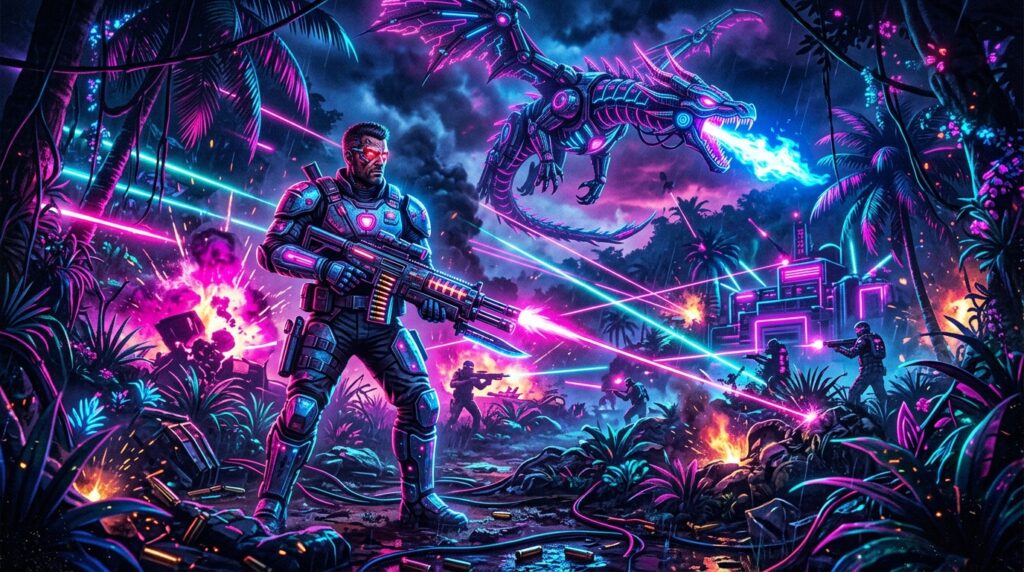
Bload Dragon’s distinctive aesthetic, often celebrated as creative choice, simultaneously serves as technical optimization strategy. The pervasive VHS filter, scanline effects, and chromatic aberration that define the visual experience aren’t merely stylistic decisions—they’re compression allies that reduce the need for pristine texture fidelity. When the game deliberately degrades image quality to evoke vintage technology, it simultaneously gains permission to utilize lower-resolution assets that would appear inadequate in photorealistic contexts.
The color palette’s restricted range—dominated by hot pinks, electric blues, and radioactive greens against dark backgrounds—enables aggressive texture compression. Limited color variation in individual assets allows more efficient encoding than the complex chromatic variation required for naturalistic environments. The neon aesthetic that defines Blood Dragon’s identity thus emerges from the intersection of creative vision and technical necessity, each reinforcing the other.
Character design follows identical principles. The cybernetic enhancements and exaggerated musculature of Rex Colt and his adversaries justify stylized proportions that require less polygonal complexity than realistic human figures. Enemy designs embrace mutation and mechanical augmentation that excuse simplified geometry beneath aesthetic justification. Every visual element serves dual purposes: establishing distinctive identity while minimizing resource consumption.
The Open World Paradox
Perhaps most impressive is Blood Dragon’s implementation of open-world architecture within its constrained footprint. The game presents a complete island environment featuring multiple biomes, enemy strongholds, collectible locations, and dynamic ecosystem elements including the titular blood dragons. This scope would suggest substantial storage requirements, yet the actual implementation achieves remarkable density through procedural generation and intelligent streaming.
Terrain elevation data, the foundation of open-world environments, occupies surprisingly minimal space when efficiently encoded. Blood Dragon utilizes heightmap representations that describe landscape contours mathematically rather than storing complete three-dimensional geometry. The engine reconstructs terrain surfaces in real-time from these compact data sources, generating the rolling hills, jagged cliffs, and coastal formations that players explore.
Vegetation and environmental detail employ similar efficiency. Rather than storing unique models for every tree, rock, and structure, the game utilizes instancing systems that place identical assets repeatedly with positional and rotational variation. The distinctive visual uniformity of Blood Dragon’s wasteland—where similar architectural elements recur across the landscape—emerges partly from this technical approach, creating coherent aesthetic identity through necessary repetition.
Mission Design and Linear Content Efficiency
The narrative and mission content within Blood Dragon demonstrates equally impressive size discipline. Voice acting, often a significant contributor to game storage requirements, was recorded with deliberate brevity that matched the game’s B-movie aesthetic. Dialogue exchanges remain concise, cutscenes limited, and narrative exposition delivered through environmental storytelling rather than extended cinematic sequences.
Mission scripting utilizes efficient encoding that describes objectives and triggers without storing extensive unique assets for each sequence. The game engine’s robust scripting capabilities allow complex mission behaviors to emerge from compact instruction sets, creating varied gameplay experiences from minimal data footprints. This approach enabled the development team to craft fifteen distinct primary missions plus numerous side activities without exponential storage growth.
The collectible system, a significant component of open-world engagement, implements similar efficiency. VHS tapes, scientist notes, and other collectibles utilize text-based content with minimal associated audio or visual assets. Reading these discoveries provides narrative expansion without the storage burden of voiced dialogue or animated presentation that contemporary games might employ.
Platform-Specific Optimization
Bload Dragon’s release across multiple platforms required tailored optimization approaches that respected each system’s unique constraints and capabilities. The PC version offered the most flexible installation, with adjustable texture quality settings that allowed players to balance visual fidelity against storage availability. This version also benefited most obviously from the game’s efficient foundation, installing and loading with remarkable speed even on modest hardware configurations.
Console versions demanded particular attention to optical media limitations and hard drive constraints. The PlayStation 3 version navigated the system’s divided memory architecture and Blu-ray disc format with optimization that maintained consistent performance despite technically challenging platform characteristics. The Xbox 360 version similarly respected the DVD format’s capacity limitations and the console’s storage constraints, delivering equivalent experience without requiring mandatory installation that would consume limited hard drive space.
These platform-specific optimizations ensured that Blood Dragon’s modest size translated to accessible availability. Players without extensive storage expansion could install and enjoy the complete experience without the difficult prioritization decisions that larger titles demanded. This accessibility contributed significantly to the game’s commercial success and cultural penetration, removing technical barriers that might have limited its audience.
Frequently Asked Questions (FAQs)
1. What is the size of Far Cry 3: Blood Dragon?
Far Cry 3: Blood Dragon is a relatively small game compared to modern AAA titles, with a download size of around 2–5 GB depending on the platform.
2. Why is Far Cry 3: Blood Dragon’s game size so small?
The game was designed as a standalone expansion with a focused scope, simplified map design, and optimized assets, which reduced its overall file size.
3. Does a smaller game size affect gameplay quality?
No. Despite its small size, the game delivers high-quality visuals, smooth gameplay, and a complete story experience without sacrificing performance.
4. How long does it take to complete Far Cry 3: Blood Dragon?
Most players can complete the main story in about 6 to 8 hours, making it a compact but full experience.
5. Is Far Cry 3: Blood Dragon open-world?
Yes, it features an open-world design, but the map is smaller and more focused compared to other Far Cry titles.
6. Can Far Cry 3: Blood Dragon run on low-end PCs?
Yes, due to its small size and optimized graphics, it can run smoothly on many low-end and mid-range systems.
7. Why is Blood Dragon considered a “compact masterpiece”?
Because it delivers engaging gameplay, humor, action, and a full story experience in a short and efficient package.
8. Is Far Cry 3: Blood Dragon worth playing in 2026?
Yes, it remains a popular retro-style shooter with unique visuals, fast-paced gameplay, and nostalgic 80s-inspired design.
9. Does the game include DLC or expansions?
No major DLC expansions exist; it is a standalone title inspired by Far Cry 3.
10. What makes its small size beneficial?
The small size makes it quick to download, easy to install, and accessible to players with limited storage or slower internet connections.
The Philosophy of Constraint
Beyond technical implementation, Blood Dragon’s modest size reflects a design philosophy that embraces constraint as creative catalyst rather than obstacle to overcome. The development team operated with explicit awareness that their downloadable content format imposed expectations of efficiency and focus. Rather than resisting these constraints through feature expansion that would inflate scope and storage requirements, they accepted limitations as defining parameters that shaped every decision.
This philosophy manifests in the game’s concentrated experience. Blood Dragon contains no filler content, no padding mechanisms designed to justify inflated price points through extended duration. Every mission, every collectible, every system serves the core aesthetic and mechanical experience. The modest size becomes external indicator of internal discipline, a promise that installation commits players to genuine entertainment rather than repetitive obligation.
The downloadable content format itself, increasingly obsolete in an era of digital distribution where size distinctions between “full games” and “expansions” have blurred, provided essential framework for this discipline. Blood Dragon emerged when downloadable content still carried expectations of focused scope, before the industry normalized massive patches and installation requirements that erase meaningful distinctions between content categories.
Contemporary Relevance and Preservation
As gaming confronts escalating storage crisis—where individual titles consume substantial percentages of available console space and PC gamers navigate terabyte-scale libraries—Blood Dragon’s efficiency gains renewed appreciation. The game demonstrates that compelling experiences need not demand corresponding storage sacrifice, that technical discipline and creative focus can deliver satisfaction without digital bloat.
For preservationists and archivists, the modest size facilitates long-term accessibility. Complete game installations fit comfortably on inexpensive storage media, transfer rapidly across network connections, and migrate easily between hardware generations. The game’s survival across platform transitions, from original release through backward compatibility to potential future remastering, benefits significantly from the minimal barriers that compact size creates.
Emulation and community preservation efforts particularly value this efficiency. Blood Dragon can be archived, shared, and maintained with minimal resource requirements, ensuring that future generations can access this distinctive experience regardless of technological evolution. The compact footprint that enabled original release continues serving preservation purposes that the development team likely never anticipated.
Conclusion: Size as Statement
Far Cry 3: Blood Dragon’s modest game size ultimately represents a statement of values that contemporary gaming would benefit from recalling. In an industry increasingly normalized to digital excess, where storage requirements inflate without proportional quality improvement, this compact masterpiece demonstrates alternative possibility. The game proves that discipline, creativity, and technical excellence can deliver experiences that outshine bloated competitors while respecting player resources.
For players encountering Blood Dragon today, whether through original hardware, backward compatibility, or digital re-release, the installation process itself delivers a moment of unexpected satisfaction. The download completes quickly, the installation occupies minimal space, and the launch arrives without the extended loading that massive titles demand. This efficiency creates immediate positive impression before gameplay even begins, establishing expectation of focused quality that the experience consistently fulfills.
Rex “Power” Colt’s cybernetic adventure through neon apocalypse endures partly because its compact footprint enabled broad accessibility, because its efficient architecture preserved it across technological generations, and because its disciplined scope concentrated creative vision into essential purity. The game size that seemed remarkable in 2013 appears almost miraculous in 2026, a standard of efficiency that contemporary developers might study with profit.
In the end, Far Cry 3: Blood Dragon reminds us that the best things in gaming—like the best things in life—often come in surprisingly small packages. The explosions remain enormous, the dragons stay massive, and the entertainment proves infinite, all within a footprint that respects your storage and your time.
Far Cry 3: Blood Dragon is a perfect example of how a game does not need massive storage or ultra-large file sizes to deliver a powerful and memorable experience. While modern AAA games often exceed 50–100 GB in size, Blood Dragon stands out as a compact title that still offers intense action, creative design, and a full gaming experience in a much smaller package.
The game size of Far Cry 3: Blood Dragon typically ranges from 2 GB to 5 GB, depending on the platform and version. This makes it significantly smaller compared to most open-world shooters. However, what makes it impressive is that this small size does not limit the quality of the gameplay or storytelling. Instead, it reflects a smart development approach focused on efficiency and creativity.
One of the main reasons for its compact size is that Blood Dragon is built as a standalone expansion of Far Cry 3. Rather than creating an entirely new engine or overly complex systems, the developers reused and optimized existing assets. This allowed them to focus on delivering a unique retro-futuristic experience without unnecessary bulk.
Despite its small size, the game still offers an open-world environment filled with missions, enemies, weapons, and exploration opportunities. The map is smaller compared to traditional Far Cry games, but it is carefully designed to ensure fast-paced action and engaging gameplay. Players are not overwhelmed by a massive world; instead, they experience a tightly packed and well-structured adventure.
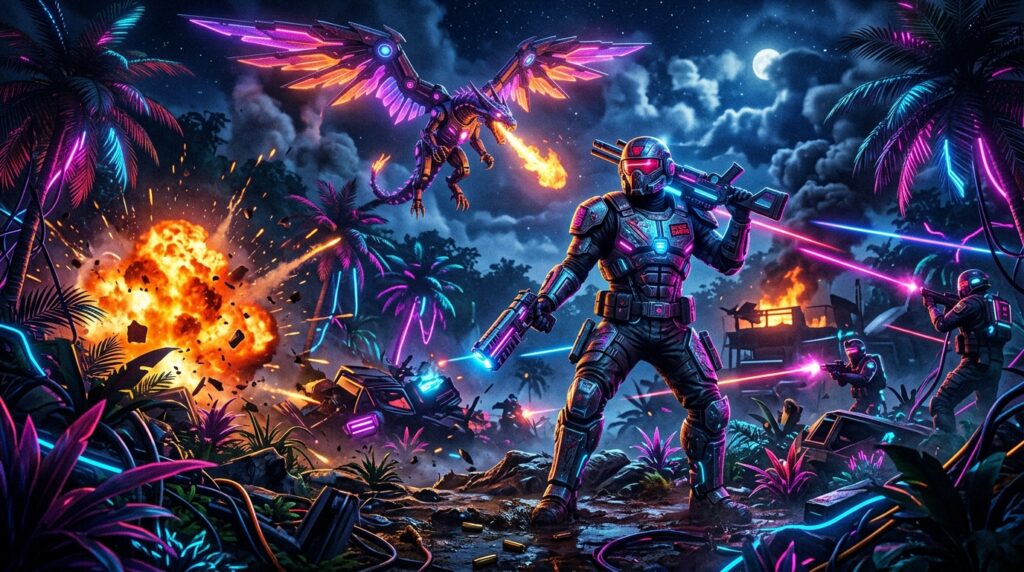
Another reason the game feels so impactful is its strong artistic direction. Blood Dragon uses a stylized neon aesthetic inspired by 1980s sci-fi movies. Instead of relying on high-resolution realism, the game focuses on bold colors, glowing effects, and retro visuals. This design choice reduces file size while enhancing visual identity.
The gameplay also plays a big role in maximizing impact. It includes smooth shooting mechanics, stealth options, and unique enemies like cybernetic dragons. Every feature is designed to be fun and accessible, without unnecessary complexity. This keeps the game lightweight while still offering depth.
In conclusion, Far Cry 3: Blood Dragon proves that a game does not need a huge file size to be memorable. Its 2–5 GB size hides a rich, action-packed experience that combines creativity, humor, and engaging gameplay. By focusing on smart design rather than excessive content, it delivers maximum entertainment in minimal space, making it a true compact masterpiece in modern gaming history.