The phrase “Dragon’s Blood Video Game”—whether referring to specific titles like Far Cry 3: Blood Dragon, DOTA: Dragon’s Blood, or the broader genre of games that mobilize draconic mythology—opens productive space for examining how colonial imaginaries persist and transform within interactive digital media. The video game as technological form, emerging from military-industrial research and commercial entertainment industries centered in metropolitan powers, carries inherent colonial dimensions that structure its representation of indigenous symbols, its procedural encoding of power relations, and its global circulation as commodity. The dragon’s blood that flows through these games, whether as narrative device, gameplay mechanic, or aesthetic motif, materializes specific relationships between metropolitan players and peripheral cultures that demand postcolonial analysis. This article examines how the figure of dragon’s blood operates across multiple gaming contexts to encode colonial extraction, to enable fantasy of indigenous incorporation, and to obscure the material conditions of global cultural production that enable digital play.
The foundational premise of video games as dragon’s blood narrative immediately establishes postcolonial coordinates through the mobilization of global mythology for metropolitan entertainment. The dragon as cross-cultural figure, appearing in Chinese imperial tradition, European medieval demonology, and various indigenous cosmologies, becomes in gaming context generic resource available for unlimited recombination without obligation to specific historical meaning. The blood that distinguishes this dragon, that marks its vitality and its vulnerability, transforms from sacred substance or historical referent into gameplay mechanic—health potion, ability fuel, crafting material, or collectible achievement. This transformation exemplifies the colonial logic of extraction that postcolonial theory has extensively documented, where the cultural and material resources of colonized populations become raw material for imperial production and consumption. The video game as form intensifies this extraction through its procedural nature, training players in repetitive actions that naturalize the appropriation of indigenous symbols as pleasurable activity.
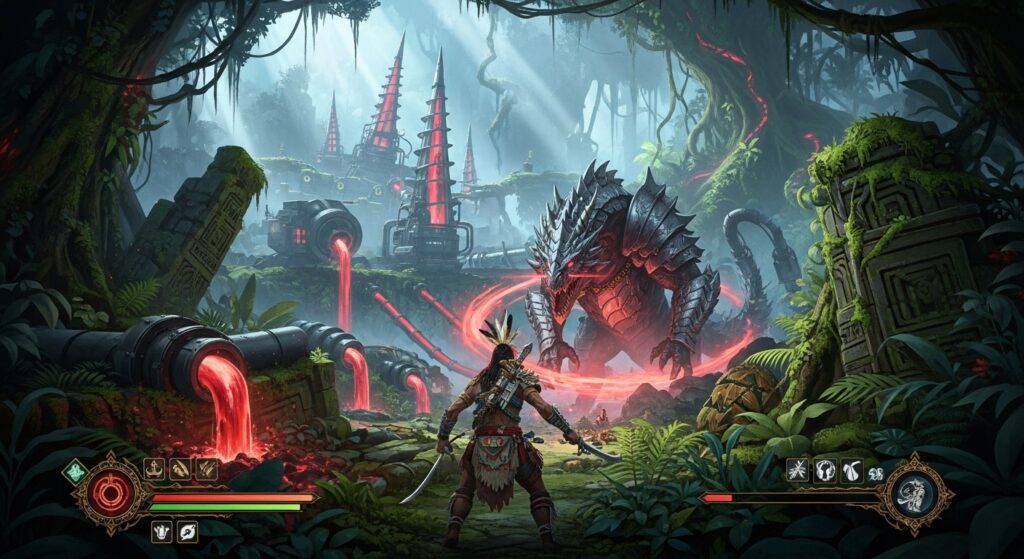
The specific case of Far Cry 3: Blood Dragon (2013) demonstrates how colonial nostalgia operates through retrofuturist aesthetics that reference 1980s action cinema’s reproduction of Cold War imperial ideology. The game’s blood dragons, nuclear-mutated reptiles that shoot laser beams from their eyes, represent the monstrous other produced by superpower conflict, simultaneously victim and threat, indigenous power transformed by colonial technology into resource for player enhancement. The Southeast Asian setting, deliberately abstracted from specific historical or geographical reference, becomes available for American military adventure without acknowledgment of the actual Vietnam War and its devastating impact on Vietnamese populations. The dragon’s blood that players harvest from these creatures, that enables their continued survival and combat effectiveness, literalizes the colonial fantasy of extracting value from colonized territories while maintaining moral superiority through technological dominance. The video game procedure of hunting, killing, and harvesting reproduces the repetitive violence of colonial extraction as pleasurable gameplay loop.
The adaptation of DOTA: Dragon’s Blood (2021-2022) from multiplayer game to animated series and potential return to interactive form illustrates the circularity of colonial cultural production across media platforms. Valve’s original Defense of the Ancients 2 established competitive mechanics of resource extraction and territorial domination that the animated series narrativized through Davion’s hybrid identity as Dragon Knight. The hypothetical “Dragon’s Blood Video Game” as adaptation of the series would complete a circuit of extraction where indigenous symbols are continuously transformed without return to communities of origin. The dragon’s blood that flows through Davion’s veins in the narrative, that marks his incorporation of ancient Slyrak’s power, becomes in potential game form player resource for character progression and ability unlock. This procedural translation intensifies the colonial logic of the original mythology, making the indigenous substance that enables heroism into fuel for consumption and accumulation.
The JRPG tradition’s engagement with dragon blood, exemplified by series like Dragon Quest and Tales of Arise, reveals how Japanese game development negotiates colonial modernity through appropriation of Western fantasy conventions that themselves appropriate global mythology. The dragon that gives Dragon Quest its name and iconography, appearing across decades of titles as enemy, ally, or symbolic presence, represents Japanese creative response to American cultural imperialism, the transformation of colonizer’s symbols for subaltern expression. Yet this response remains constrained by commercial frameworks that demand global marketability, the dragon’s blood that flows through these games becoming increasingly generic resource as franchises expand internationally. Tales of Arise‘s explicit engagement with colonial narrative, its representation of Renan domination of Dahna, demonstrates both the possibilities and limitations of JRPG critique—its procedural systems of resource extraction potentially contradicting its narrative condemnation of imperial violence, its dragon blood appearing as collectible material for player empowerment.
The procedural rhetoric of video games, the specific skills and attitudes trained through repeated interaction with game systems, encodes colonial subjectivity regardless of narrative content. The dragon’s blood as gameplay mechanic typically requires players to defeat dragon enemies, extract their essence, and utilize this resource for personal enhancement—procedures that mirror colonial extraction even when narrative framing suggests critique. The health restoration, mana replenishment, or ability enhancement that dragon blood enables trains players in dependency on indigenous resources for survival and success, naturalizing the appropriation of colonized vitality as necessary condition of metropolitan flourishing. The video game as form thus produces what postcolonial theorists identify as the persistence of colonial modernity through digital globalization, where the appearance of player agency and creative freedom obscures structural reproduction of imperial violence.
The global political economy of video game production, where labor distributed across peripheral studios generates value for metropolitan corporations, materializes colonial extraction in the very infrastructure that enables digital play. The dragon’s blood as visual effect, rendered through particle systems and shader technologies developed by teams in South and Southeast Asia, traces supply chains of creative labor that extend from design conception in American or European headquarters to execution in facilities with limited autonomy or profit participation. The blood that animates screens, that provides satisfying feedback for player actions, connects to actual bleeding in postcolonial territories where game development occurs under conditions of precarious employment and environmental degradation. The video game as commodity thus materializes colonial violence in its physical and digital existence, the dragon that gives it mythological resonance masking the actual dragons of global labor exploitation.
The reception and fan engagement with dragon’s blood video games demonstrate how colonial imaginaries circulate through participatory culture beyond control of original producers. Player discussions, wiki documentation, streaming content, and creative extensions transform the dragon’s blood from specific game mechanic into free-floating signifier available for unlimited appropriation. This fan labor generates value for corporate rights-holders while receiving limited recognition or return, the extraction of creative capacity from gaming communities paralleling the extraction of cultural resources from colonized territories. The blood that flows through these discussions, that marks passionate engagement with game systems and narratives, becomes resource for platform monetization and data collection, the indigenous vitality of fan communities transformed into fuel for continued corporate expansion.
The critical potential of dragon’s blood video games lies not in their successful critique of colonial ideology but in their failure, the contradictions and confusions they generate potentially opening space for recognition of how deeply colonial structures permeate interactive media. The procedural contradiction between narrative condemnation and systemic reproduction of extraction, the visual pleasure of indigenous vitality that obscures its material conditions of production, the fan engagement that extends commodification into participatory culture—all these elements create opportunities for critical intervention. The dragon’s blood as object of analysis reveals the exhaustion of colonial imaginaries in late capitalist gaming, where the symbol has been so thoroughly appropriated that it can only refer to prior commercial deployment, yet this exhaustion also creates possibility for transformation.