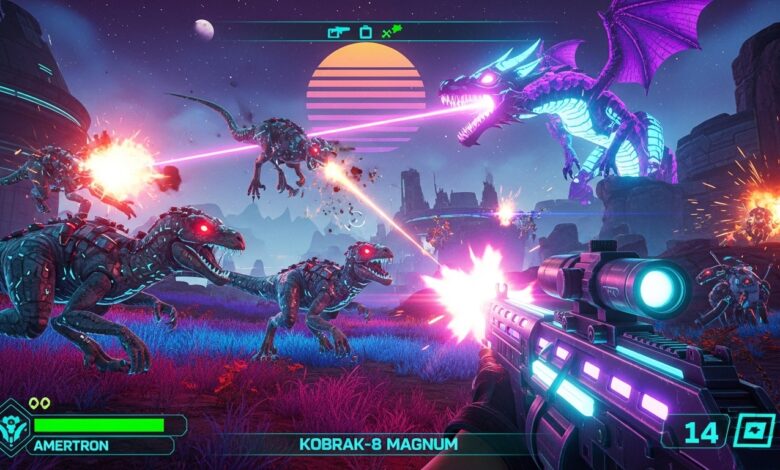
In the sprawling landscape of first-person shooters, where realism and tactical complexity often reign supreme, Far Cry 3: Blood Dragon stands as a glorious, neon-soaked anomaly. Released in 2013 as a standalone expansion to Far Cry 3, this title takes the established open-world formula of its predecessor and injects it with a massive dose of 1980s action movie steroids. The result is a gameplay experience that is less about survival and more about unstoppable, hilarious, and utterly chaotic empowerment. At its core, the gameplay of Blood Dragon is a fascinating case study of simplification done right, stripping away the survivalist mechanics of the original game and replacing them with a relentless power fantasy that prioritizes fun over frustration. Players step into the boots of Sergeant Rex “Power” Colt, a Mark IV Cyber Commando who begins the game as a force of nature and only grows more ridiculous from there.
The most immediate departure from the Far Cry 3 formula is the complete removal of any concept of vulnerability. In Far Cry 3, protagonist Jason Brody started as a terrified tourist who had to learn to sprint without getting tired and could die from a fall of just a few meters. Rex Colt, by contrast, has no such weaknesses. From the very first mission, the player can sprint at maximum speed indefinitely without ever losing breath. Fall damage is a concept that simply does not apply to a cybernetic commando; Rex can leap from the highest mountain or a hovering helicopter and land on his feet without a scratch. He can hold his breath underwater forever, eliminating any tension from aquatic exploration. This design choice is deliberate and brilliant. It immediately communicates that this is not a game about struggling against the environment or managing stamina bars. It is a game about action, and the only thing standing between Rex and his objective is the army of cybersoldiers and mutant creatures that the player is expected to annihilate with extreme prejudice.
This philosophy of empowerment extends directly into the game’s progression system, which has been radically streamlined from the complex skill trees of Far Cry 3. There are no branching paths or difficult choices to make here. Progression in Blood Dragon is linear and automatic. As players kill enemies, complete missions, and perform stylish takedowns, they earn Cyber Points, which function as experience points. Upon accumulating enough points, Rex levels up, and a new skill or perk is unlocked automatically . There is no menu to agonize over, no build to optimize. The game simply makes Rex more powerful as the player continues to play. This system ensures that the player is constantly being rewarded and that the power curve is always moving upward. By the time the final mission rolls around, Rex has multiple health bars, devastating melee capabilities, and access to every tool he needs to dominate the battlefield. It is a system designed to keep the player in a state of flow, removing any administrative barriers between the action and the reward.
The arsenal of weapons available to the player is another key pillar of the gameplay experience. The weapons in Blood Dragon are not merely functional tools; they are extensions of the game’s over-the-top personality. The standard pistol, the A.J.M. 9, is a solid starting weapon, but it quickly gives way to an array of more exotic and entertaining firearms . The Fazertron assault rifle is a laser weapon that feels futuristic and precise, while the Galleria 1991 shotgun is a love letter to cinematic action, featuring a reload animation where Rex lets shells fall into the chamber in a move reminiscent of Terminator 2 . The Terror 4000 sniper rifle, when upgraded with explosive rounds, transforms from a precision instrument into a long-range grenade launcher capable of detonating vehicles from hundreds of meters away . Perhaps the most significant addition is the Killstar, a minigun that the player acquires roughly halfway through the campaign. This weapon fundamentally changes the dynamics of combat. Its spinning barrels can tear through groups of enemies and even stagger the mighty Blood Dragons themselves, turning what were once terrifying encounters into manageable, and often hilarious, displays of overwhelming firepower . The weapon upgrade system, unlocked by completing side missions, encourages exploration and provides tangible, exciting improvements to these already impressive tools.
Despite the emphasis on high-octane, guns-blazing combat, the game does not entirely abandon the stealth mechanics that defined Far Cry 3. Players can still choose a more methodical approach, using the environment and Rex’s abilities to eliminate enemies without raising an alarm. The camera returns, allowing players to tag enemies and track their movements through walls. Takedowns are still a core mechanic, and they are more brutal and satisfying than ever. The Dragon Blade, a neon-infused tanto, is used for all close-quarters eliminations, and Rex can perform chain takedowns to silently dispatch multiple enemies in quick succession . He can also throw shurikens for silent, long-range kills. However, several reviews noted that the stealth systems saw little to no innovation from the base game . The tools for stealth are present and functional, but the new additions, like the laser-wielding dragons and the explosive weaponry, are so much more exciting that the silent approach often feels like a secondary consideration. The game does not punish the player for going loud; in fact, it actively encourages it through its level design and the sheer joy of its weaponry.
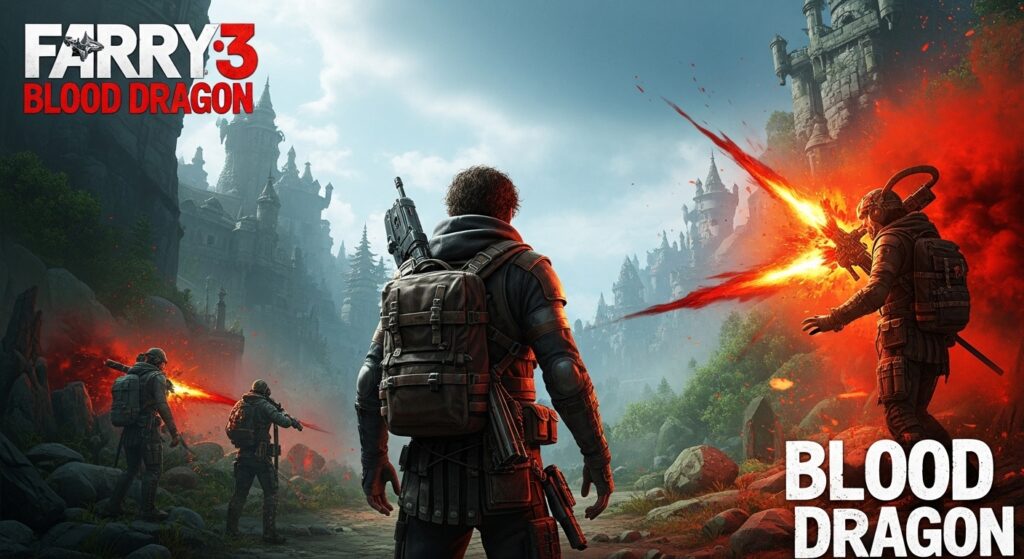
The most significant and memorable new gameplay mechanic, however, is the introduction of the Blood Dragons themselves. These massive, laser-eyed reptiles are the apex predators of the island and serve as both the game’s greatest threat and its most useful tool . Early encounters with a Blood Dragon are genuinely tense. They are fast, powerful, and their eye lasers can destroy vehicles and kill Rex in just a few hits. The player cannot simply trade bullets with a Blood Dragon and expect to win without taking heavy damage. This is where the game’s most creative mechanic comes into play. By ripping the glowing cyber-hearts from the corpses of fallen enemies, Rex can throw them as bait . A Blood Dragon will relentlessly chase a thrown cyber-heart, allowing the player to lure it directly into an enemy garrison. Once inside, the dragon will ignore Rex and begin attacking the Omega Force soldiers, creating utter chaos as the player can then pick off the survivors from a safe distance. This system brilliantly interweaves combat, resource management, and environmental manipulation. It never gets old to watch a majestic, terrifying laser-dinosaur tear through a heavily fortified military base on your behalf. This feature alone elevates the gameplay of Blood Dragon beyond a simple reskin, providing a unique strategic layer that was absent from the original game.
The open world itself, while smaller than the Rook Island of Far Cry 3, is perfectly sized for the game’s faster pace . The map is dense with activities and, more importantly, designed for rapid traversal. Rex’s infinite sprint means that players can cross the entire island in a matter of minutes, eliminating the need for the tedious long-distance travel that plagues many open-world games. The primary activities in this world are the liberation of 13 Omega Force garrisons, each protected by an energy shield that must be deactivated, and a handful of side mission types, including hostage rescues and mutated animal hunts . While these activities are undeniably repetitive in nature, their execution is kept fresh by the escalating power of the player. Liberating the first garrison with only a pistol and a sniper rifle is a tense stealth operation. Liberating the tenth garrison with a quad-barrel napalm shotgun and a pocket full of dragon hearts is a symphony of destruction. The side missions are also crucial for unlocking weapon upgrades, providing a tangible incentive to engage with all the content the game has to offer.
In conclusion, the gameplay of Far Cry 3: Blood Dragon is a masterclass in focused, unapologetic fun. By stripping away the survival mechanics and complex progression systems of Far Cry 3, Ubisoft Montreal created an experience that is pure, uncut action. The empowerment of the player is absolute, from Rex’s superhuman physical abilities to the absurdly powerful arsenal at his disposal. The introduction of the Blood Dragons as a manipulable environmental hazard adds a unique and hilarious strategic layer that sets the game apart from every other shooter in the franchise. While the stealth mechanics are undercooked and the side activities lack variety, these are minor quibbles in a game that is so clearly focused on delivering a specific, exhilarating experience. For the roughly six to eight hours it takes to see everything, Blood Dragon respects the player’s time and prioritizes their enjoyment above all else . It is a game that knows exactly what it is: a tribute to the loud, proud, and gloriously excessive action movies of the 1980s. It does not ask you to think about ammo conservation or tactical positioning. It asks you to rip out a heart, throw it to a laser dragon, and then mow down the survivors with a minigun. And in that simple, beautiful question lies all the answer any action fan could ever need.