Far Retro Gaming Guide: Why Far Cry 3 Blood Dragon Remains a Classic
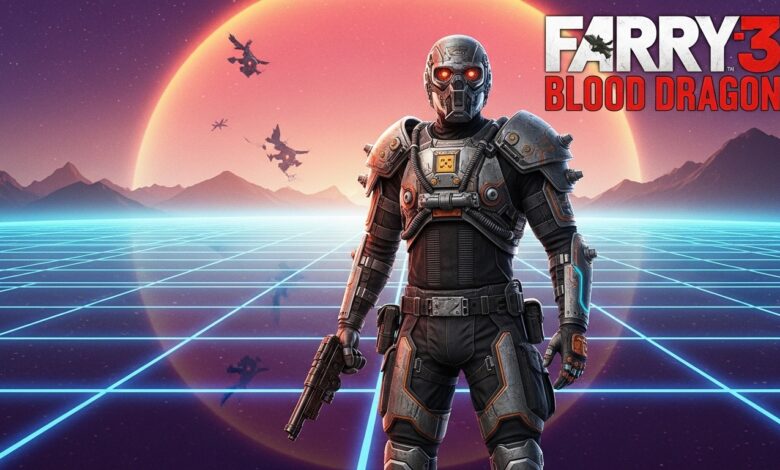
In the landscape of video game downloadable content, few titles have achieved the cult status and critical acclaim of Far Retro 3: Blood Dragon. Released in 2013 as a standalone expansion to the critically acclaimed Far Cry 3, this neon-soaked, 80s-inspired shooter emerged as a bold experiment that paid homage to action movies of a bygone era while delivering genuinely innovative gameplay. What began as a risky creative venture transformed into one of the most beloved entries in the entire Far Cry franchise, proving that sometimes the best gaming experiences come from unexpected places.
What Makes Retro Gaming So Popular in 2026?
Ubisoft Montreal’s decision to create Blood Dragon stemmed from a desire to explore something radically different from the serious tone of Far Cry 3. While the base game dealt with heavy themes of survival, insanity, and moral corruption in a tropical paradise, the development team envisioned a project that could embrace pure fun and nostalgia without the constraints of realism. The result was a love letter to 1980s action cinema, complete with over-the-top one-liners, synth-wave soundtracks, and a vision of the future that could only exist in the imagination of that era.
Dean Evans, the creative director behind Blood Dragon, drew inspiration from films like Terminator, RoboCop, Predator, and Escape from New York. The team wanted to capture the essence of VHS-era action movies—the grainy aesthetic, the exaggerated violence, the cheesy dialogue, and the unapologetic machismo that defined the genre. Rather than simply parodying these elements, Blood Dragon committed fully to the aesthetic, creating a world that felt authentically retro while remaining fresh and engaging for modern audiences.
The decision to release Blood Dragon as a standalone title rather than traditional DLC proved crucial to its success. Priced affordably and requiring no ownership of Far Cry 3, the game became accessible to a broader audience. This approach allowed players who might have been intimidated by the main game’s darker themes to experience the excellent Far Cry 3 gameplay mechanics in a more approachable, arcade-style package.
Retro Features That Make Blood Dragon a Timeless Classic
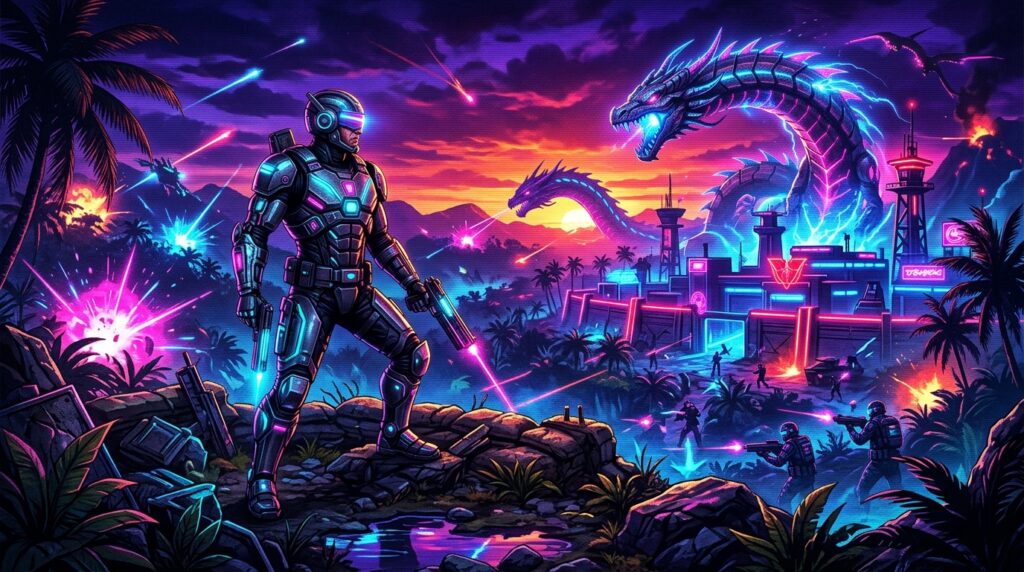
Blood Dragon transports players to the year 2007, but not the 2007 we remember. Instead, it presents an alternate future as imagined by 1980s pop culture—a world ravaged by nuclear war, where cybernetic soldiers battle mutated wildlife and the remnants of humanity struggle for survival. The setting is an unnamed island chain, rendered in perpetual twilight with a color palette dominated by deep purples, hot pinks, and electric blues.
The visual design of Blood Dragon represents one of gaming’s most distinctive art directions. Every frame looks like it could be the cover of a metal album or the poster for a direct-to-video action film. The user interface features scan lines and tracking errors, simulating the experience of watching a worn VHS tape. Even the loading screens embrace the aesthetic, featuring fake movie posters and cheesy taglines that perfectly capture the era’s marketing style.
Environmental storytelling plays a significant role in building this world. Abandoned research facilities, neon-lit military bases, and radiation-scarred landscapes tell the story of a world that went wrong. Collectible VHS tapes scattered throughout the island provide backstory through the lens of 80s educational films, complete with dated production values and earnest narration. These details demonstrate the development team’s commitment to the concept—nothing in Blood Dragon feels half-hearted or ironic in a cynical way.
Why Retro Fans Still Love Far Cry 3: Blood Dragon
At the center of Blood Dragon stands Sergeant Rex “Power” Colt, a Mark IV Cyber Commando voiced by Michael Biehn, the actor best known for his roles in The Terminator and Aliens. This casting choice represents perfect synergy between actor and material, as Biehn brings authentic gravitas to the deliberately absurd dialogue. Rex Colt embodies every action hero cliché imaginable: the gravelly voice, the troubled past, the unwavering commitment to justice, and the complete inability to speak without delivering a pun or one-liner.
The character of Rex Colt works because the game never winks at the audience or breaks character. Despite the ridiculous premise and over-the-top scenarios, Rex remains completely serious throughout his mission to stop the rogue Colonel Sloan from unleashing a doomsday weapon. This commitment to the bit elevates Blood Dragon above simple parody into something more substantial—a genuine celebration of a specific cultural moment in cinema history.
Rex’s cybernetic enhancements provide gameplay justification for the Far Cry mechanics players expect. His ability to see enemies through walls, survive tremendous damage, and perform brutal takedowns fits perfectly within the cyber-soldier narrative. The game even provides a tutorial framed as Rex’s “combat training simulation,” complete with a condescending AI voice that mocks the player for needing instructions.
Table of Contents
The Retro Aesthetic Behind Blood Dragon’s Success
Blood Dragon retains the core mechanics that made Far Cry 3 exceptional while streamlining and enhancing them for faster, more arcade-style play. The open world, while smaller than the main game, feels perfectly sized for the experience—dense with content but never overwhelming. Side missions, collectibles, and challenges are plentiful but designed with a lighter touch, respecting the player’s time while providing meaningful rewards.
The weapon roster embraces futuristic absurdity while maintaining functional variety. The standard assault rifle becomes a “Fazertron” with explosive rounds. The sniper rifle transforms into a “Predator Bow” that fires explosive arrows. Every weapon can be upgraded through side missions, encouraging exploration and experimentation. The game even includes a “scientist rescue” mechanic where players must liberate nerdy researchers from enemy bases, adding personality to the liberation system.
Blood Dragons themselves represent the game’s most distinctive feature. These massive, glowing creatures roam the island freely, attacking both players and enemies indiscriminately. Early in the game, they serve as terrifying obstacles that force creative navigation. As players upgrade their weapons and abilities, dragons become valuable allies—luring them into enemy bases can clear entire compounds without firing a shot. This ecosystem creates emergent gameplay moments that feel unique to Blood Dragon.
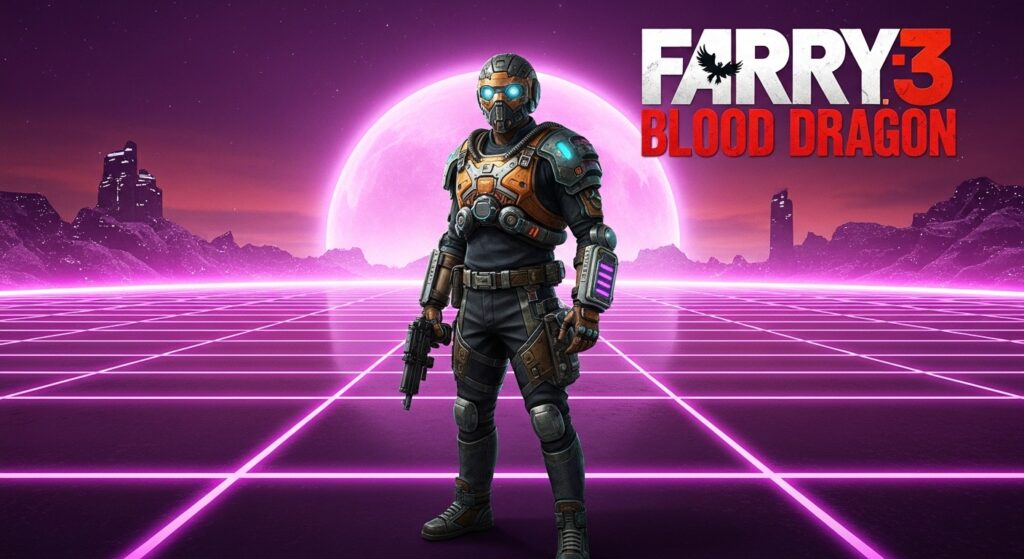
The leveling system streamlines Far Cry 3’s complex skill trees into straightforward cybernetic upgrades. Rather than choosing between stealth and combat paths, Rex automatically gains new abilities as he earns experience, ensuring players always feel increasingly powerful. This design choice eliminates the anxiety of “build optimization” and keeps the focus on action and exploration.
The Sound of the Future Past
Blood Dragon’s audio design deserves special recognition for its contribution to the overall experience. The soundtrack, composed by Australian electronic duo Power Glove, perfectly captures the synth-wave aesthetic that has experienced a resurgence in recent years. Pulsing bass lines, soaring synthesizer melodies, and driving beats accompany every mission, creating an audio landscape that feels simultaneously nostalgic and timeless.
The sound effects embrace 80s action movie conventions with gleeful abandon. Gunfire sounds exaggerated and impactful. Explosions rumble with theatrical bass. Even the ambient sounds of the island—the chirping of cyber-birds, the hum of neon lights, the distant roar of Blood Dragons—contribute to the immersive retro-future atmosphere.
Voice acting throughout the game maintains the high standard set by Michael Biehn. Supporting characters deliver their ridiculous lines with complete sincerity, never breaking the illusion. The antagonist Colonel Sloan chews scenery with villainous glee, while Rex’s sidekick Spider provides comic relief without becoming annoying. The script, filled with references to 80s pop culture and action movie tropes, rewards players familiar with the era while remaining accessible to newcomers.
Cultural Impact and Lasting Legacy
Blood Dragon’s influence extends far beyond its initial release. The game demonstrated that AAA developers could take creative risks with established franchises, producing experimental titles that didn’t need to appeal to everyone to be successful. This philosophy influenced subsequent Ubisoft projects and encouraged other developers to explore standalone expansions that diverged significantly from their base games.
The success of Blood Dragon also contributed to the mainstream recognition of synth-wave and retro-future aesthetics in gaming. What began as a niche musical genre and artistic style gained broader acceptance, influencing titles like Hotline Miami, Neon Drive, and even major releases like Cyberpunk 2077. Blood Dragon proved that nostalgia, when executed with genuine passion rather than cynical exploitation, could resonate deeply with audiences.
Critically, Blood Dragon received widespread acclaim upon release. Reviewers praised its commitment to the concept, its tight gameplay loop, and its ability to deliver a complete experience at a budget price point. The game earned numerous award nominations and appeared on many “Game of the Year” lists, remarkable achievements for downloadable content. Player reception was equally enthusiastic, with the game developing a dedicated fanbase that continues to celebrate its unique qualities years later.
The commercial success of Blood Dragon surprised even Ubisoft, selling over one million copies in its first few months. This performance validated the standalone expansion model and encouraged the company to consider similar projects for other franchises. While direct sequels to Blood Dragon never materialized despite fan demand, its DNA can be seen in subsequent Far Cry entries, particularly Far Cry New Dawn, which embraced similar neon aesthetics and post-apocalyptic themes.
Technical Excellence and Accessibility
From a technical standpoint, Blood Dragon represents an impressive achievement in efficient game development. Built on the foundation of Far Cry 3, the team could focus on content creation rather than engine development, resulting in a polished product completed in approximately six months. This rapid development cycle, combined with the smaller scope compared to full retail releases, allowed for creative experimentation that might be impossible in larger projects.
The game’s accessibility features and difficulty options ensure that players of various skill levels can enjoy the experience. The streamlined progression system eliminates the frustration of being underpowered for specific challenges, while the open world design allows players to approach objectives in multiple ways. Blood Dragon respects player intelligence while never punishing them for wanting to enjoy the power fantasy at the heart of the experience.
Performance optimization ensures smooth gameplay across various hardware configurations, important for reaching the broadest possible audience. The visual style, while distinctive, doesn’t require cutting-edge graphics cards to appreciate, making Blood Dragon playable on systems that might struggle with more demanding contemporary titles.
Conclusion: A Timeless Celebration of Excess
Far Cry 3: Blood Dragon stands as a testament to what happens when creative vision meets commercial opportunity. In an industry often criticized for playing it safe, Blood Dragon dared to be different, embracing a specific aesthetic with complete commitment and creating something that felt genuinely new despite its nostalgic foundations. The game proves that downloadable content can be more than just additional missions or cosmetic items—it can be a platform for artistic expression and creative risk-taking.
Years after its release, Blood Dragon remains essential playing for anyone interested in action games, 80s pop culture, or simply experiencing something unique. Its influence continues to resonate through the gaming industry, inspiring developers to explore unconventional concepts and trust audiences to appreciate passion projects. In a medium increasingly dominated by live-service games and perpetual updates, Blood Dragon represents a complete, self-contained experience that respects the player’s time and intelligence.
The legacy of Sergeant Rex “Power” Colt endures not because of irony or meme culture, but because Blood Dragon delivered on every promise it made. It offered players the chance to become the ultimate 80s action hero in a world that fully committed to the fantasy. For approximately eight hours of gameplay, players could save the world, defeat the villain, and walk into the neon sunset knowing they had experienced something special. In an era of endless content and never-ending games, Blood Dragon’s completeness feels increasingly precious—a reminder that sometimes the best experiences are those that know exactly when to end.
The Unique 1980s-Inspired Setting
One of the biggest reasons Far Cry 3: Blood Dragon remains a classic is its unforgettable 1980s-inspired world. Released as a standalone expansion to Far Cry 3, the game immediately stood out because it embraced the over-the-top action and science-fiction themes that defined many movies and television shows from the 1980s. Instead of focusing on realism, Blood Dragon celebrates neon colors, futuristic technology, giant cybernetic creatures, and explosive action sequences.
The game’s world is filled with glowing environments, retro-inspired technology, and humorous references to classic action films. This unique atmosphere gives players something completely different from traditional military shooters. Even in 2026, very few games manage to capture the same retro-futuristic style that makes Blood Dragon so memorable.
A Memorable Hero and Entertaining Story
Another reason the game continues to attract players is its unforgettable protagonist, Sergeant Rex Power Colt. As a cybernetic super-soldier, Rex perfectly fits the game’s exaggerated and humorous tone. Throughout the campaign, he delivers countless one-liners and witty comments that parody classic action heroes.
The story itself is intentionally over-the-top, featuring rogue military forces, futuristic weapons, and world-threatening conspiracies. While the plot may not be complex, it succeeds because it never takes itself too seriously. The game’s humor and self-awareness create an entertaining experience that keeps players engaged from beginning to end. Many fans still remember the dialogue and memorable moments years after completing the campaign.
Fast-Paced Gameplay That Still Feels Great
At its core, Blood Dragon uses the strong gameplay foundation established by Far Cry 3. Players can explore an open environment, complete missions, upgrade abilities, and use a wide variety of weapons. The shooting mechanics remain satisfying, and the game offers multiple ways to approach combat situations.
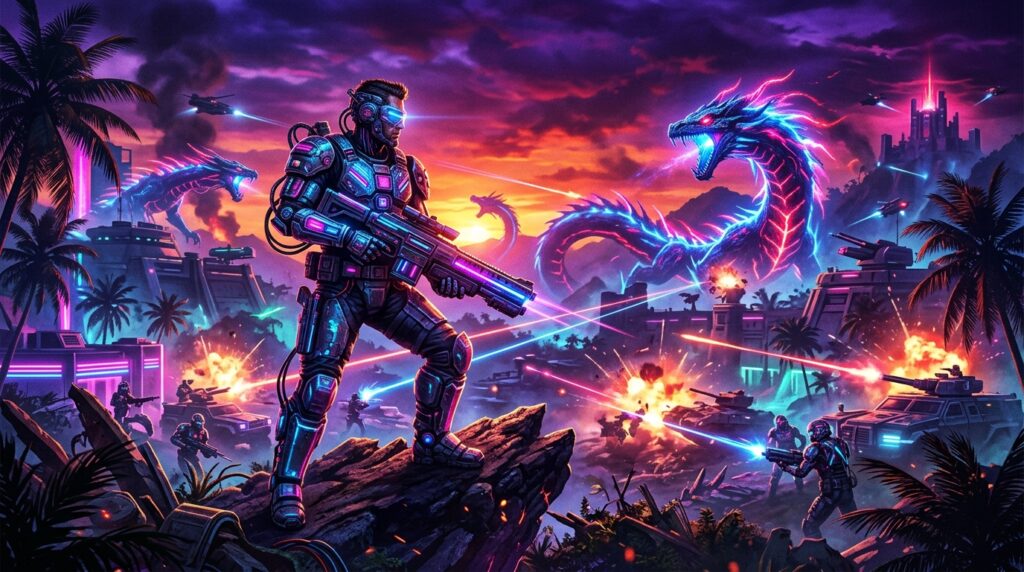
Players can choose stealth tactics, direct assaults, or creative strategies involving the game’s iconic Blood Dragons. These massive cybernetic reptiles can be used to distract enemies or create chaos across enemy bases. This freedom encourages experimentation and keeps gameplay fresh even during repeat playthroughs.
Unlike many modern games that rely heavily on complicated systems, Blood Dragon focuses on delivering straightforward fun. Its accessible gameplay makes it easy for both newcomers and veteran gamers to enjoy the experience.
A Visual Style That Never Gets Old
Graphics technology constantly evolves, but artistic design often has a greater impact on a game’s longevity. Blood Dragon is a perfect example of this principle. The game’s bright neon lighting, futuristic environments, and retro-inspired interface continue to look distinctive more than a decade after release.
Rather than chasing realistic visuals, the developers created a strong artistic identity that remains appealing today. The combination of glowing colors, cyberpunk aesthetics, and science-fiction designs helps the game stand out from countless other shooters.
This visual uniqueness is one of the reasons many retro gaming enthusiasts continue to recommend Blood Dragon. The game feels like an interactive tribute to an entire era of entertainment, making every mission visually engaging.
Why Blood Dragon Remains a Retro Gaming Classic
The lasting popularity of Far Cry 3: Blood Dragon comes from its ability to deliver something genuinely different. It combines exciting gameplay, memorable characters, a fantastic soundtrack, and a unique retro atmosphere into a single package. While many games attempt to follow trends, Blood Dragon succeeded by embracing its own identity and fully committing to its creative vision.
The game’s relatively short length is also a strength. Instead of stretching content unnecessarily, it provides a focused adventure packed with action and entertainment. This design allows players to revisit the game without investing dozens of hours.
Even in 2026, Blood Dragon remains a favorite among retro gaming fans because it represents a time when developers were willing to experiment with bold ideas. Its blend of humor, action, and nostalgia continues to attract both returning players and newcomers. For anyone interested in classic gaming experiences, Far Cry 3: Blood Dragon remains one of the most enjoyable and unforgettable titles ever created.
Frequently Asked Questions (FAQs)
1.What is Far Cry 3 Blood Dragon?
Far Cry 3: Blood Dragon is a standalone expansion of the Far Cry series that combines open-world action with a retro-futuristic 1980s science-fiction theme.
2. Why is Far Cry 3 Blood Dragon still popular?
The game is considered a classic because of its unique neon-inspired visuals, memorable humor, engaging gameplay, and strong tribute to 1980s action movies.
3. Is Far Cry 3 Blood Dragon worth playing in 2026?
Yes, it uses the gameplay foundation of Far Cry 3, but it features a completely separate story, setting, characters, and atmosphere.
4.What makes Blood Dragon unique?
Players take on the role of Sergeant Rex Power Colt, a cybernetic commando tasked with stopping a dangerous military threat in a futuristic world.
5.How long is Far Cry 3 Blood Dragon?
Most players can finish the main story in approximately 6 to 8 hours, while completionists may spend additional time exploring and collecting items.
6. What makes Blood Dragon different from other Far Cry games?
Unlike other Far Cry titles, Blood Dragon focuses on retro sci-fi themes, cybernetic enemies, neon visuals, and humorous storytelling inspired by classic action films.
7. Can new players enjoy Far Cry 3: Blood Dragon in 2026?
Absolutely. The game’s simple mechanics, entertaining story, and unique style make it enjoyable for both new and returning players.
8. What are Blood Dragons in the game?
Blood Dragons are giant cybernetic creatures that roam the island. They are powerful enemies and can also be used strategically against hostile forces.
9. Does Far Cry 3: Blood Dragon have replay value?
Yes. Players often replay the game to experience different combat approaches, unlock upgrades, and enjoy the nostalgic retro-futuristic atmosphere again.
10. Why do retro gaming fans still recommend Far Cry 3: Blood Dragon?
Retro gaming fans appreciate the game’s creativity, synthwave-inspired presentation, memorable characters, and its successful recreation of classic 1980s action and science-fiction entertainment.