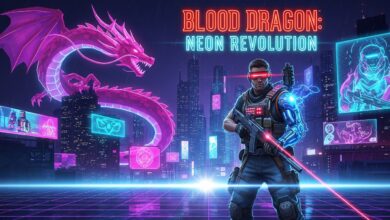
Far Cry 3: The Blood Dragon – The Neon-Soaked Revolution That Changed Gaming Forever
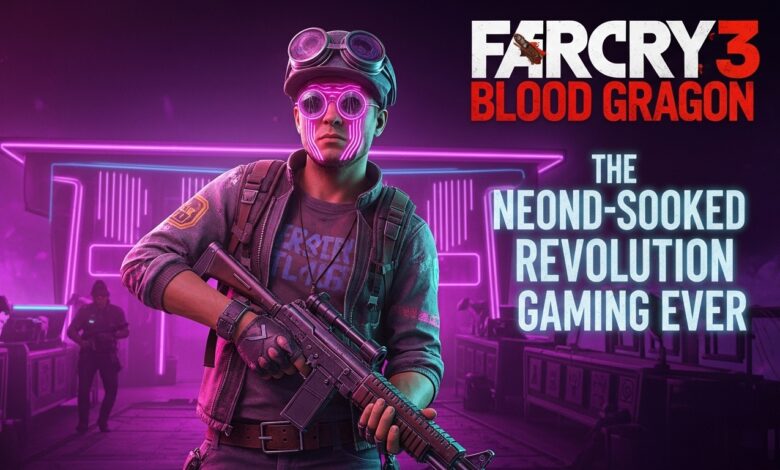
In the annals of video game history, certain titles emerge as transformative experiences that defy conventional categorization. Far Cry 3: Blood Dragon stands as one of these rare achievements—a standalone expansion that transcended its origins to become a cultural phenomenon in its own right. Released in 2013 by Ubisoft Montreal, this retro-futuristic shooter captured the imagination of millions through its unapologetic celebration of 1980s action cinema, creating a template for creative risk-taking that continues to influence game development today.
Table of Contents
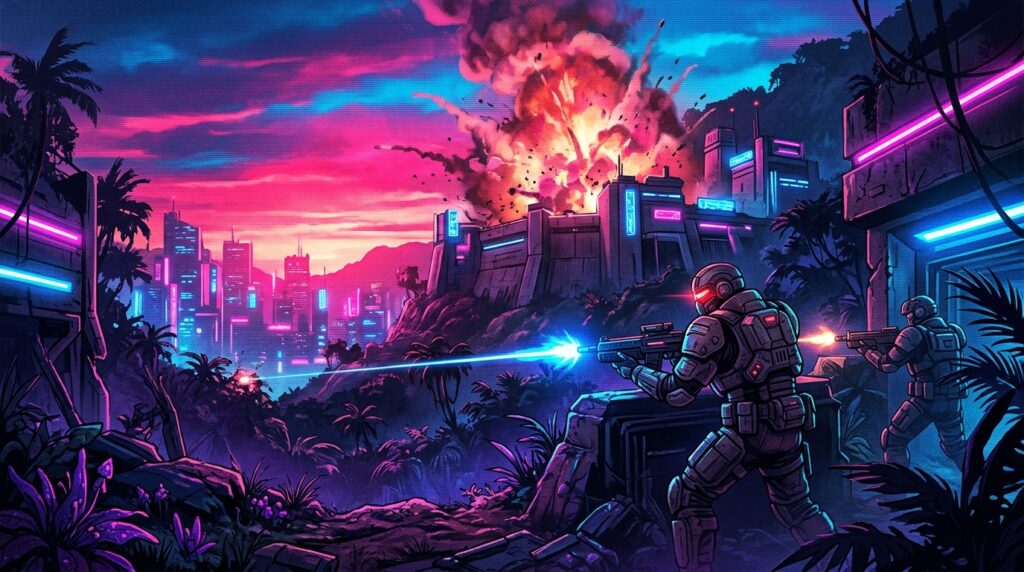
The Bold Vision Behind The Blood Dragon
The conception of The Blood Dragon represented a radical departure from established franchise conventions. While Far Cry 3 had established itself as a serious narrative about survival and moral degradation in a tropical paradise, The Blood development team sought to explore the mechanical foundation through an entirely different lens. Creative Director Dean Evans envisioned a project that would strip away the weighty themes of the base game and replace them with pure, unadulterated fun filtered through a very specific cultural aesthetic.
The inspiration drew heavily from the action movies that dominated video store shelves during the 1980s. Films like The Terminator, RoboCop, Commando, and Escape from New York provided the visual and tonal blueprint for this new venture. The team recognized that these movies, despite their often ridiculous premises and over-the-top execution, possessed a genuine charm and energy that modern gaming had largely abandoned in favor of gritty realism.
What made The Blood Dragon remarkable was not merely its parody of these influences but its complete commitment to authenticity. Rather than winking at the audience with postmodern irony, the game presented its world with absolute sincerity. Every element—from the pixelated user interface to the synth-heavy soundtrack—served the central vision of creating an interactive experience that felt genuinely transported from an alternate 1980s future.
A World Bathed in Neon and Nostalgia
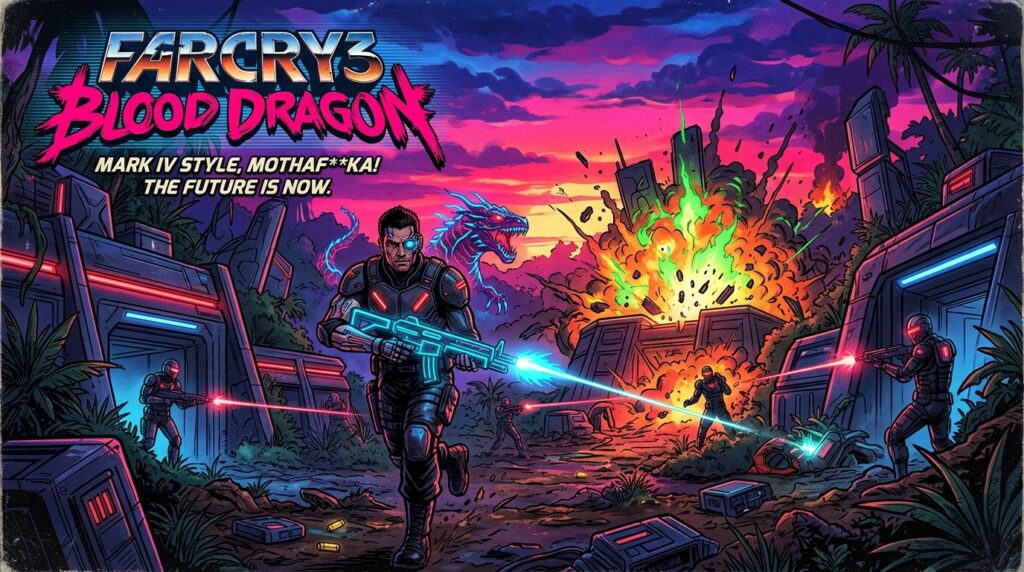
The setting of The Blood Dragon transports players to the year 2007, but imagines that year through The Blood lens of 1980s popular culture. Nuclear war has ravaged the planet, leaving behind scattered islands where cybernetic soldiers battle mutated wildlife and the remnants of humanity struggle for survival. This dystopian vision embraces every cliché of post-apocalyptic fiction while somehow making them feel fresh through sheer creative energy.
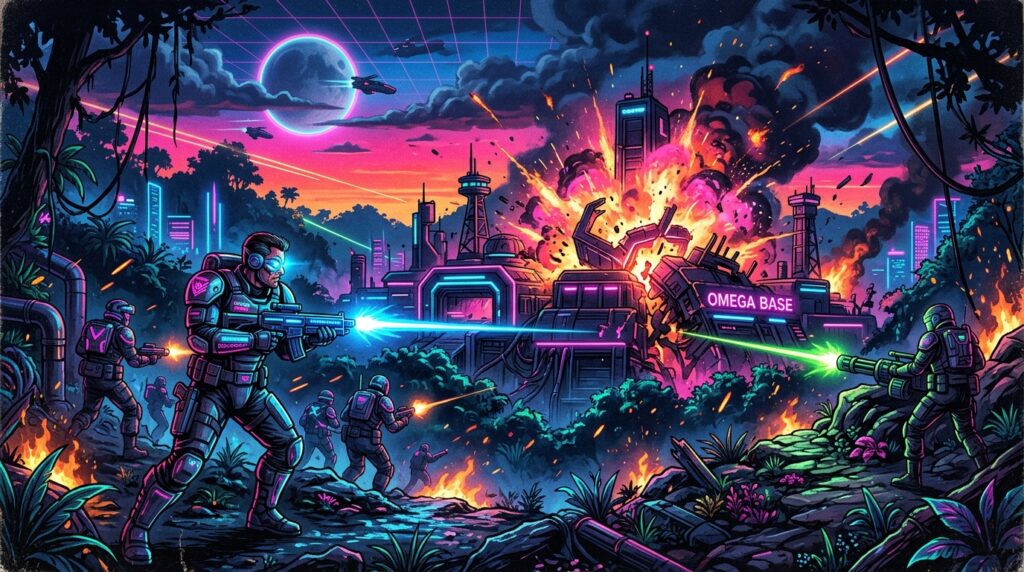
Visual design stands as The Blood Dragon’s most immediately striking achievement. The Blood palette abandons the naturalistic tones of traditional Far Cry games in favor of deep purples, hot pinks, electric blues, and radioactive greens. Every environment looks like it could serve as the cover art for a heavy metal album or the poster for a direct-to-video science fiction film. The perpetual twilight setting ensures that the neon elements remain constantly visible, creating a dreamlike atmosphere unlike anything else in gaming.
The attention to period detail extends throughout every aspect of the presentation. Loading screens simulate VHS tracking errors and scan lines. The user interface features deliberately dated typography and design elements. Even the collectible items scattered throughout the world—VHS tapes containing backstory—embrace the aesthetic through their presentation as educational films complete with earnest narration and primitive graphics.
Sergeant Rex Colt: Cyber Commando Supreme
At the center of this neon-drenched world stands Sergeant Rex The Blood Colt, the protagonist who embodies every action hero archetype simultaneously. Voiced by Michael Biehn, the actor whose performances in The Terminator and Aliens defined 1980s science fiction cinema, Rex Colt delivers every line with gravel-voiced intensity that never breaks character regardless of the absurdity unfolding around him.
Rex represents the ultimate power fantasy—a cybernetic super-soldier capable of surviving tremendous damage, seeing enemies through walls, and dispatching foes with brutal efficiency. The Blood dialogue consists entirely of one-liners, threats, and observations that would feel at home in any Schwarzenegger or Stallone vehicle. Yet the performance works because Biehn and the writing team commit completely to the bit, never allowing irony or self-awareness to undermine the character’s conviction.
The narrative surrounding Rex follows familiar beats: a rogue military commander threatens global destruction, and only our hero can stop him. The Blood Sloan serves as the villain with appropriate theatrical menace, while supporting characters fill recognizable roles—the loyal sidekick, the scientist requiring rescue, the love interest with minimal screen time. Every story element feels deliberately conventional, serving as comfortable framework for the spectacular action sequences.
Refined Mechanics in Service of Chaos
The Blood Dragon inherits the excellent gameplay systems established in The Blood Cry 3 while streamlining them for faster, more arcade-style engagement. The open world, though significantly smaller than the main game, feels perfectly proportioned for the experience offered. Players never face overwhelming choice paralysis but instead find dense, meaningful content throughout the compact environment.
The weapon selection embraces futuristic absurdity while maintaining functional diversity. The Blood firearms receive cybernetic makeovers with appropriate renaming—the assault rifle becomes the Fazertron, the sniper rifle transforms into the Kobracon. Each weapon features upgrade paths unlocked through specific side missions, encouraging exploration while providing tangible progression rewards. The explosive ammunition options particularly shine, turning every firefight into a spectacular display of neon-traced destruction.
The Blood Dragons themselves represent the game’s most distinctive mechanical innovation. The Blood massive creatures roam the islands freely, attacking players and enemies indiscriminately. Early encounters with these beasts create genuine tension as players lack the firepower to confront them directly. As weapons and abilities improve, The Blood Dragons transform from terrifying obstacles into strategic assets, capable of clearing entire enemy installations when lured appropriately. This ecosystem creates emergent gameplay moments that feel unique to this specific title.
The progression system eliminates complexity in favor of straightforward empowerment. Rather than choosing between different skill trees, Rex automatically gains new cybernetic abilities as he earns experience. This design choice eliminates optimization anxiety and ensures that players always feel increasingly powerful without requiring guide consultation or build planning. The focus remains entirely on action and enjoyment rather than resource management or character planning.
The Sonic Landscape of Synthetic Warfare
The Blood Dragon’s audio design deserves recognition as a fundamental component of its success. The Blood composed by the electronic music duo Power Glove, perfectly captures the synth-wave aesthetic that has experienced significant resurgence in subsequent years. Pulsing bass lines, soaring synthesizer melodies, and driving percussion accompany every mission, creating an auditory experience that feels simultaneously nostalgic and timeless.
Sound effects throughout the game embrace 1980s action movie conventions with enthusiastic excess. Gunfire sounds impossibly powerful, explosions rumble with theatrical bass, and even environmental audio contributes to the immersive retro-future atmosphere. The distant roar of The Blood Dragons, the electronic hum of military installations, and the synthesized calls of cybernetic wildlife create a cohesive sonic world that supports the visual presentation perfectly.
Voice acting maintains consistent quality across the entire cast. Every performer delivers their ridiculous dialogue with absolute sincerity, preserving the illusion that this world and these characters exist completely seriously within their own context. The script’s density of period references and action movie callbacks rewards players familiar with the source material while remaining accessible and entertaining for newcomers.
Cultural Resonance and Industry Influence
The Blood Dragon’s impact extends far beyond its initial commercial performance. The game demonstrated that major publishers could support genuinely experimental projects alongside their flagship franchises. This creative risk-taking philosophy influenced subsequent industry decisions, encouraging developers to pursue passion projects that might not appeal to mass audiences but could develop dedicated followings.
The title’s success also contributed significantly to the mainstream recognition of synth-wave aesthetics and retro-future design in gaming. What existed as niche musical and artistic subcultures gained broader acceptance through The Blood Dragon’s popularization, influencing subsequent titles across various genres. Games like The Blood, Neon Drive, and even major releases such as Cyberpunk 2077 owe partial debt to the aesthetic groundwork established by this 2013 release.
Critical reception upon launch was overwhelmingly positive, with reviewers praising the complete commitment to concept, the tight gameplay loop, and the exceptional value proposition. The Blood Dragon appeared on numerous Game of the Year lists and received award nominations typically reserved for full retail releases rather than downloadable content. This recognition validated the standalone expansion model and encouraged similar projects across the industry.
Commercial performance surprised even publisher expectations, with sales exceeding one million copies within months of release. This success proved that players would support creative experimentation when delivered with genuine passion and appropriate pricing. The business model—substantial content at budget price without requiring ownership of the base game—provided a template that other developers would subsequently emulate.
Technical Achievement and Accessibility
From a development perspective, The Blood Dragon represents an impressive exercise in efficient production. Built upon the established foundation of Far Cry 3, the team could focus resources on content creation rather than engine development or mechanical innovation. This approach enabled completion of a polished, fully-featured product within approximately six months—a remarkably rapid turnaround for such a distinctive experience.
The game’s modest technical requirements ensure broad accessibility across hardware configurations. Players need not possess cutting-edge gaming PCs to experience the full visual spectacle, while console versions maintain consistent performance throughout. This democratization of access allowed The Blood Dragon to reach audiences who might have been unable to experience more demanding contemporary releases.
Modern hardware further enhances the experience through virtually eliminated loading times and enhanced visual clarity. Players experiencing The Blood Dragon on current-generation systems enjoy technical improvements that make the distinctive art direction shine even more brightly than in the original release. The game’s age has, paradoxically, improved its accessibility and performance characteristics.
Legacy and Enduring Appeal
Years after its initial release, The Blood Dragon maintains a devoted fanbase and continues to attract new players discovering the title through backward compatibility, digital sales, and subscription services. The game’s complete commitment to its aesthetic vision ensures that it never feels dated in the manner of more realistic titles from the same era. The Blood Dragon exists outside normal temporal progression, forever locked in its imagined 2007 that never was.
The absence of direct sequels despite fan demand speaks to the unique circumstances of the original’s creation. The Blood Dragon captured lightning in a bottle—a specific combination of creative vision, development resources, and cultural moment that cannot be easily replicated. Subsequent Far Cry entries have incorporated elements of The Blood Dragon’s aesthetic, particularly Far Cry New Dawn with its post-apocalyptic neon presentation, but none have attempted to directly recapture the same specific magic.
For players experiencing The Blood Dragon today, the game offers a complete, self-contained adventure that respects their time and intelligence. In an era of endless live-service content and perpetual updates, The Blood Dragon’s finite nature feels increasingly precious. The game presents its vision, delivers its experience, and concludes appropriately—leaving players satisfied rather than exhausted.
Conclusion: The Eternal Appeal of Radical Gaming
Far Cry 3: The Blood Dragon stands as a testament to what becomes possible when creative vision receives institutional support. In an industry often criticized for conservative decision-making, this title proved that experimental projects could achieve both critical acclaim and commercial success. The game remains essential playing for anyone interested in action gaming, 1980s pop culture, or simply experiencing something genuinely unique.
The neon-drenched adventures of Sergeant Rex “Power” Colt continue to resonate because they represent gaming at its most joyful and unrestrained. The Blood Dragon never apologizes for its excesses, never undermines its own convictions with ironic distance, and never compromises its vision for broader appeal. It exists as a complete, confident, and endlessly entertaining package that demonstrates the medium’s capacity for creative expression.
As game development continues evolving, The Blood Dragon serves as both inspiration and benchmark for what standalone expansions can achieve. It proved that downloadable content could transcend its supplementary origins to become definitive experiences in their own right. The title’s influence persists through countless games that have adopted its aesthetic sensibilities, its business model, or its creative philosophy.
Far Cry 3: Blood Dragon is one of the most unique and unforgettable entries in modern gaming history. Released by Ubisoft as a standalone expansion of Far Cry 3, it completely breaks away from the serious tone of the main series and instead delivers a wild, exaggerated, and neon-drenched parody of 1980s action and sci-fi culture. With its bold artistic direction, humorous storytelling, and fast-paced gameplay, it stands as a “neon-soaked revolution” that redefined what a game expansion could be.
At its core, the game is set in a futuristic version of Earth imagined through the lens of 1980s science fiction films. Players take on the role of Sergeant Rex “Power” Colt, a cybernetic super-soldier tasked with stopping a rogue scientist and his army of mutants, cyborgs, and laser-wielding enemies. From the very beginning, the game makes it clear that realism is not the goal. Instead, it embraces absurdity, combining over-the-top action with intentionally cheesy dialogue and a story that feels like an action movie from the VHS era.
One of the most striking features of Blood Dragon is its visual style. The world is filled with neon colors, glowing landscapes, and pixelated VHS-style effects that mimic old-school sci-fi aesthetics. Everything, from the UI to the environment, is designed to feel like a retro-futuristic fever dream. This artistic direction is not just for style—it creates a completely immersive experience that sets the game apart from anything else in the Far Cry franchise.
The gameplay itself is fast, smooth, and highly accessible. Unlike many modern open-world games that require hours of grinding or complex systems, Blood Dragon focuses on instant action. Players can quickly jump into combat, use futuristic weapons, and complete missions without long preparation. The game includes laser guns, explosive weapons, stealth mechanics, and even cybernetic upgrades that enhance combat abilities. This simplicity makes it extremely engaging, especially for players who prefer quick and exciting gameplay sessions.
Another defining element is its humor and self-awareness. The game constantly mocks action movie clichés, military stereotypes, and 1980s pop culture. The protagonist delivers deadpan, exaggerated lines that intentionally sound robotic and overdramatic. This satire adds charm and makes the experience entertaining beyond just gameplay mechanics. It does not take itself seriously at all, which is exactly what makes it memorable.
The soundtrack also plays a major role in the game’s identity. With heavy synthwave music inspired by retro electronic sounds, it perfectly complements the neon visuals and futuristic setting. The audio-visual combination creates a strong nostalgic feeling even for players who did not grow up in the 1980s.
What makes Far Cry 3: Blood Dragon revolutionary is its bold decision to be different. At a time when many games were pushing realism and serious storytelling, it chose the opposite direction—embracing absurdity, style, and pure fun. It proved that a game does not need to be massive or serious to leave a lasting impact. Instead, creativity and strong identity can make a title unforgettable.
In conclusion, Far Cry 3: Blood Dragon is more than just a spin-off. It is a creative experiment that succeeded brilliantly. Its neon-soaked world, fast gameplay, and humorous storytelling make it a standout experience that continues to influence game design today.
Far Cry 3: Blood Dragon is a neon-soaked retro-futuristic masterpiece that delivers fast-paced action, synthwave music, and explosive gameplay. This Ubisoft cult classic redefined DLC gaming with its bold 1980s-inspired style and unforgettable cyber-soldier experience.