Weirwood Trees: The “Bleeding” Sacred Trees of Westeros 2026
Table of Contents
Introduction
In the world of Game of Thrones and A Song of Ice and Fire, few natural elements are as mysterious and symbolically powerful as weirwood trees. These ancient white-barked trees, with their blood-red leaves and carved faces, are more than just part of the landscape of Westeros. They are deeply connected to religion, magic, memory, and the forgotten history of the world.
Weirwoods are often called the “bleeding trees” because of the red sap that flows from them when cut, resembling blood. This visual symbolism is not accidental. It ties directly into the old gods, ancient rituals, and the supernatural presence that still lingers in the North. Over time, these trees have become sacred symbols for the children of the forest and the followers of the old gods.
This article explores the origin, meaning, powers, and symbolism of weirwood trees and explains why they are one of the most important mystical elements in Westeros.
The Origin of Weirwood Trees
Weirwood trees are believed to be ancient, predating even the earliest recorded human history in Westeros. They are closely associated with the Children of the Forest, the original inhabitants of the continent before the arrival of the First Men.
The Children of the Forest are said to have carved faces into weirwood trees as part of their spiritual practice. These faces were not merely decorative; they were believed to be a way of giving the trees awareness or allowing the old gods to “see” the world through them.
Weirwoods became central to the religion of the old gods, a belief system that worships nature, spirits, and unseen forces rather than structured deities.
Physical Characteristics of Weirwood Trees
Weirwood trees have a very distinct and unsettling appearance. Their most notable features include:
- Pale white bark that looks almost bone-like
- Deep red leaves that resemble blood
- Faces carved into the trunks
- Red sap that flows when the tree is cut
This sap is often described as looking like blood, which gives rise to the idea that the trees are “bleeding.” This imagery reinforces their mystical and sacred nature.
The contrast between white bark and red sap creates a powerful visual symbol of life, death, and sacrifice.
The Spiritual Significance of Weirwoods
Weirwoods are considered sacred to followers of the old gods. These trees are believed to serve as physical connections between the natural world and the spiritual realm.
Important spiritual beliefs include:
- The trees are living witnesses of history
- The carved faces allow the gods to observe the world
- Spirits or consciousness may reside within the trees
- They act as sacred sites for prayer and ritual
In this belief system, weirwoods are not just trees but divine instruments that connect humanity to ancient forces beyond understanding.
The Weirwood Network and Collective Memory
One of the most fascinating aspects of weirwood trees is their connection to memory and time. In the story, they are often linked to visions of the past, suggesting that they may store or reflect memories.
This creates the idea of a collective consciousness spread across the entire network of weirwood trees. Through this network, events from the past can be observed or experienced in some form.
The character Bran Stark discovers this connection through the Three-Eyed Raven, who teaches him to see through the trees. This ability reveals that weirwoods may function as a vast archive of Westeros’ history.
Blood and Sacrifice in Weirwood Worship
The idea of blood is central to weirwood symbolism. In many rituals associated with the old gods, blood sacrifices were made at the roots of weirwood trees.
This is where the concept of “bleeding trees” becomes especially significant. When the trees are cut, they release red sap, and when sacrifices are made, blood is spilled at their base.
This connection between sap and blood suggests a symbolic relationship between life force, memory, and spiritual energy.
Some interpretations suggest that weirwoods may require blood to maintain their power or connection to the spiritual world.
Appearance and Symbolism
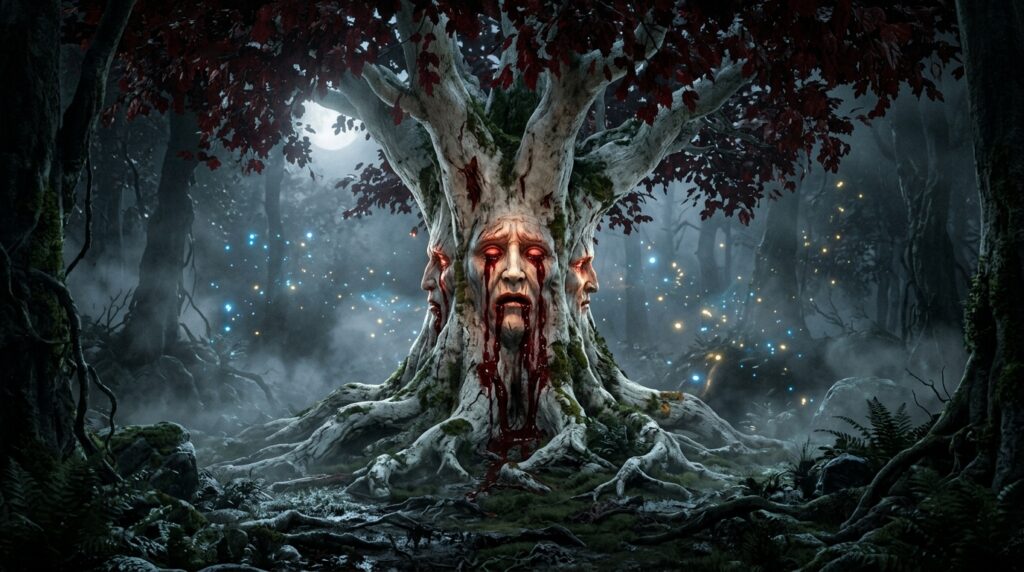
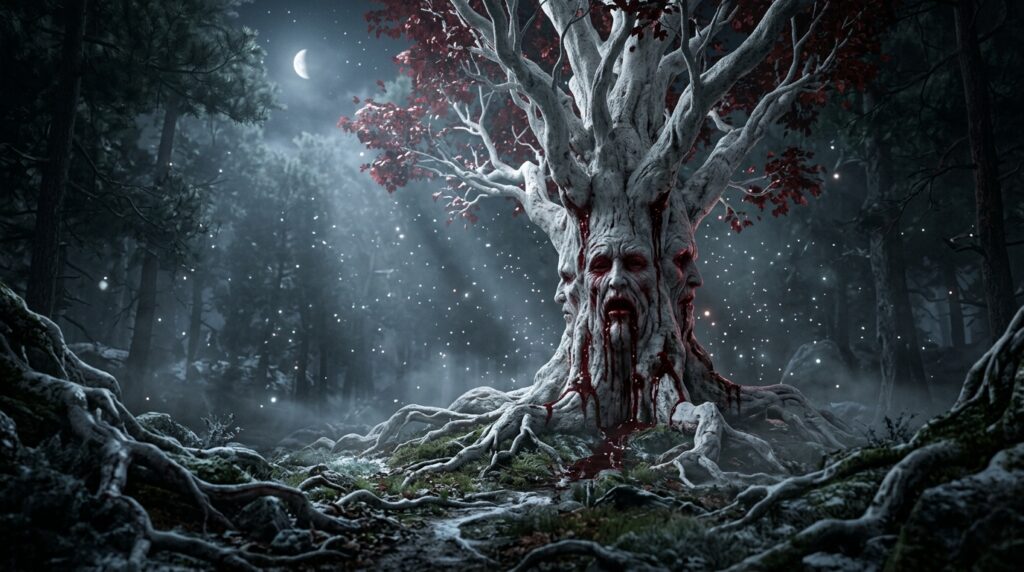
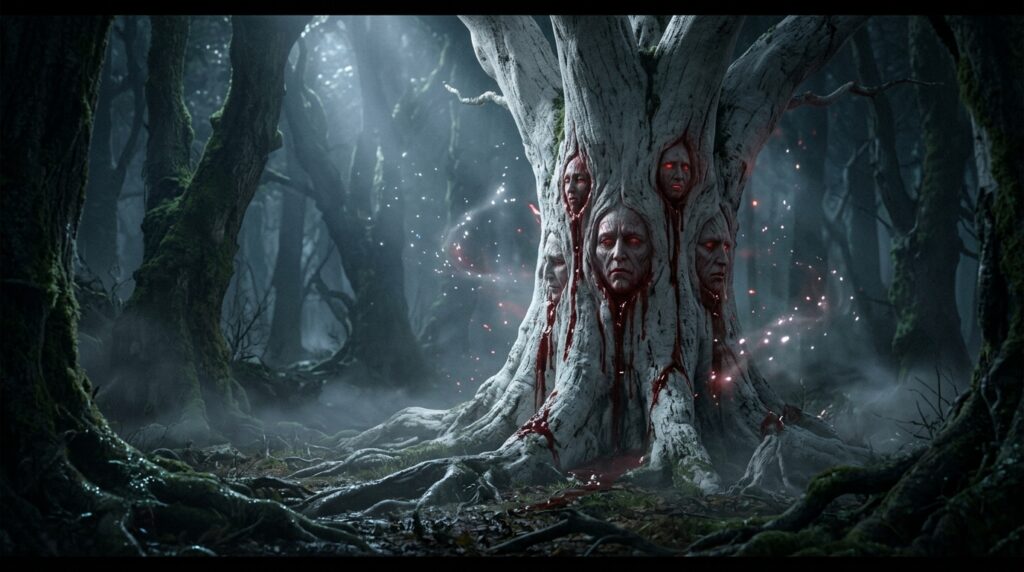
Weirwood trees have a striking and unsettling appearance. Their pale white trunks look almost like bone, while their leaves remain bright red throughout the year. The most disturbing yet iconic feature is the carved faces on their bark, created long ago by the Children of the Forest.
When a weirwood is cut, it releases a thick red sap that resembles blood. This is why they are often called “bleeding trees.” This visual effect is not just natural detail but a powerful symbol in the story. The contrast between white bark and red sap represents life and death, purity and sacrifice, and the thin line between nature and magic.
Religious Importance in the North
In the North of Westeros, weirwood trees are sacred to the religion of the old gods. Unlike the Faith of the Seven, which dominates the South, the old gods have no structured temples or idols. Instead, worship takes place in godswoods, where a single weirwood tree often stands at the center.
People go to these trees to pray, make vows, or seek guidance. The carved faces are believed to represent the eyes of the old gods, watching silently over the world. This belief gives weirwoods a spiritual role, making them more than just trees. They become living symbols of divine presence in nature.
Connection to the Children of the Forest
Weirwoods are closely tied to the Children of the Forest, the ancient inhabitants of Westeros who existed long before humans arrived. According to legend, they carved the faces into the trees to communicate with their gods or to give the forest a voice.
This connection suggests that weirwoods may hold ancient knowledge or spiritual energy. They are not just part of nature but part of a forgotten magical system that predates human civilization in Westeros.
Weirwoods and Memory
One of the most important ideas linked to weirwood trees is memory. In the story, they are associated with visions of the past, especially through characters like Bran Stark. Through greenseeing abilities, certain individuals can see events that happened long ago by connecting with the trees.
This suggests that weirwoods act as a kind of living memory network. They may store or reflect historical events, making them silent witnesses to everything that has happened in Westeros for thousands of years.
Blood, Sacrifice, and Magic
The idea of blood is central to weirwood symbolism. The red sap that flows from them looks like blood, reinforcing their connection to life force and sacrifice. In ancient rituals, blood sacrifices were sometimes made at the base of these trees.
This connection between sap and blood suggests that weirwoods may draw power from life energy. It also links them to magic in the world of Game of Thrones, especially the return of supernatural forces as the story progresses.
Role in Story and Mythology
Weirwood trees play an important role in shaping the mythology of Westeros. They represent the old world, ancient magic, and forgotten traditions. As political power shifts across kingdoms, the presence of weirwoods remains constant in the North, symbolizing stability and ancient truth.
Characters like Bran Stark demonstrate the deeper significance of these trees. Through his connection with them, he gains access to visions and knowledge beyond normal human understanding.
Weirwoods as Eyes of the Old Gods
The carved faces on weirwood trees are believed to serve as the “eyes” of the old gods. These faces allow the trees to observe the world and witness events across Westeros.
This belief is deeply rooted in the religion of the North, where gods are not separate beings but forces of nature.
The faces are often described as:
- Watching silently
- Expressionless yet aware
- Eternal and unchanging
This creates the feeling that the forests themselves are alive and aware of human actions.
The Role of Weirwoods in the North
In the North, weirwood trees are central to religious and cultural practices. Every godswood in Northern castles typically contains a weirwood tree, where characters pray, reflect, or make important vows.
These trees serve as sacred meeting points between humans and the old gods.
Important roles include:
- Places of prayer and reflection
- Sites of justice and oath-taking
- Symbols of ancestral tradition
- Connections to Northern identity
Even as the religion of the Seven dominates the south, the North continues to preserve the ancient reverence for weirwoods.
Weirwoods and Magic in Westeros
Weirwoods are also closely tied to magic in the Game of Thrones universe. As magic returns to the world, the influence of weirwoods becomes stronger.
They are associated with:
- Visions of the past and future
- Greenseeing abilities
- Spiritual communication
- Ancient magical forces of nature
Characters like Bran Stark demonstrate how weirwoods can serve as channels for magical perception and time-based visions.
This suggests that weirwoods are not just symbolic but actively connected to the magical structure of the world.
The Destruction of Weirwoods in the South
In the southern regions of Westeros, many weirwood trees have been cut down or destroyed over time. This reflects the decline of the old gods’ influence in those areas.
The Faith of the Seven, the dominant religion in the south, does not hold the same reverence for weirwoods. As a result, many of these sacred trees were removed or ignored.
This destruction symbolizes the loss of ancient knowledge and spiritual connection in favor of organized religion and political power.
Symbolism of Life, Death, and Memory
Weirwoods represent a complex combination of themes:
- Life: As living trees that grow and endure for centuries
- Death: Through blood-like sap and sacrificial rituals
- Memory: As vessels of historical and spiritual records
This triad makes them one of the most powerful symbolic elements in the series.
They represent the idea that nature itself remembers everything, even when human civilizations forget.
Weirwoods and Bran Stark’s Journey
Bran Stark’s transformation into the Three-Eyed Raven is one of the most important storylines connected to weirwoods.
Through his connection with the trees, Bran gains access to:
- Historical events
- Hidden truths
- Real-time observation of distant locations
This ability highlights the true power of weirwoods as more than symbolic objects. They become tools for understanding the past, present, and possibly the future.
The Mystery That Remains
Despite their importance, many aspects of weirwoods remain unexplained. The exact nature of their consciousness, the origin of their magical properties, and their true role in the world are still mysterious.
This uncertainty adds to their mythic quality. They are not fully understood even by characters within the story, which reinforces their ancient and otherworldly nature.
Game of Thrones and House of the Dragon do not feature any tree officially named “Dragon Blood Tree.” The phrase comes from fans noticing strong similarities between the show’s weirwood trees and the real-world Dragon Blood Tree (Dracaena cinnabari).
Weirwoods are ancient deciduous trees with smooth bone-white bark and blood-red, five-pointed leaves. Their sap is also deep crimson. In godswoods (sacred groves), many weirwoods are heart trees — large specimens with human-like faces carved into the trunk by the Children of the Forest (and later by followers of the Old Gods). The red sap often pools in the carved eyes and mouth, making the trees look as if they are weeping tears of blood.
These trees are deeply tied to the Old Gods of the North. They are said to “remember” everything that happens near them. Greenseers like Bran Stark can tap into the vast weirwood root network to see visions of the past. Weirwoods live for thousands of years if left undisturbed, and they symbolize memory, truth, sacrifice, and the ancient magic of Westeros. In the South, most were cut down by the invading Andals, which is why godswoods with living weirwoods are rare outside the North in the Game of Thrones timeline.
The “bleeding” appearance directly echoes the Targaryen motto “Fire and Blood” and the concept of dragon blood, creating a thematic link between Northern Old Gods magic and Valyrian fire-and-blood sorcery — even though they come from very different traditions.
The Real Dragon Blood Tree
The actual plant that fans compare to weirwoods is the Dragon Blood Tree (Dracaena cinnabari), which grows mainly on Socotra Island (Yemen). It has a unique umbrella-like shape with a thick trunk and dense crown of spiky leaves. When the bark or branches are cut or damaged, it oozes a vivid bright red resin historically called “dragon’s blood.”
Ancient people believed this resin was literally the blood of dragons that had fought and died. The resin was (and still is) used as a dye, medicine, varnish, and in rituals. Like weirwoods, these trees are slow-growing, ancient-looking, and feel otherworldly. They are now endangered due to climate change and overgrazing.
The visual parallel is striking: both “bleed” red when wounded, both have pale trunks, and both carry mythical, dragon-linked names and lore. Many articles and fan discussions point to the Socotra Dragon Blood Tree as likely real-world inspiration for the bleeding aesthetic of weirwoods, even if George R.R. Martin drew the core concept from European sacred groves, Yggdrasil (the Norse world tree), and pagan heart trees.
Why the Connection Matters in the Story
- Symbolism of Blood: Weirwood sap mimics blood, reinforcing themes of sacrifice. Ancient rituals sometimes involved hanging offerings or spilling blood before heart trees.
- Magic vs. Dragons: Weirwoods represent patient, rooted, memory-keeping magic of the Old Gods. Dragons represent raw, destructive “fire made flesh.” The contrast highlights the ice-and-fire duality of the entire saga.
- Visions and Watching: The carved faces “watch” silently, tying into greenseeing and the idea that the past is never truly gone.
- Show Details: In House of the Dragon, a weirwood appears in the Red Keep’s godswood (something not present in the original Game of Thrones series), adding an extra layer of ancient magic even in the heart of Targaryen power.
In short, while there is no “Dragon Blood Tree” canonically in Game of Thrones, the weirwood’s crimson sap and the real Dragon Blood Tree’s red resin create one of the most popular and visually poetic fan connections in the fandom. The bleeding motif ties together blood magic, sacrifice, ancient powers, and the lingering presence of older forces in a world dominated by fire-breathing dragons and political intrigue.
Frequently Asked Questions (FAQs)
1. What are weirwood trees?
Weirwood trees are ancient sacred trees with white bark, red leaves, and carved faces in Westeros.
2. Why are they called bleeding trees?
Because their red sap resembles blood when the tree is cut.
3. Who carved the faces on weirwoods?
The Children of the Forest are believed to have carved them.
4. What do weirwood faces represent?
They are believed to represent the eyes of the old gods.
5. Are weirwood trees magical?
Yes, they are strongly connected to magic and visions.
6. What is the significance of blood in weirwoods?
Blood symbolizes sacrifice and spiritual power linked to the trees.
7. Where are weirwood trees found?
They are mostly found in the North and in godswoods across castles.
8. What is a godswood?
A sacred area containing a weirwood tree used for worship.
9. Can weirwoods see the past?
In the story, they are linked to visions of past events through greenseeing.
10. Why are weirwoods important in the story?
They connect history, magic, religion, and memory in Westeros.
Conclusion
Weirwood trees are one of the most powerful and mysterious elements in Game of Thrones and A Song of Ice and Fire. With their white bark, red leaves, and carved faces, they serve as symbols of memory, spirituality, and ancient magic. Their connection to blood, sacrifice, and the old gods makes them central to the mythology of Westeros.
More than just trees, they represent the idea that the past is never truly gone. It lives on in nature, in memory, and in the hidden forces that shape the world.