Dragon’s Crown: The Masterpiece That Defined 2D Action RPG Excellence
A Visual Revolution in Hand-Painted Gaming
When Dragon’s Crown launched on July 25, 2013, for PlayStation 3 and PlayStation Vita, it didn’t merely enter the gaming market—it exploded onto the scene as a breathtaking demonstration of what 2D art could achieve in the high-definition era. Developed by the visionary team at Vanillaware, the studio renowned for Odin Sphere and Muramasa: The Demon Blade, this action role-playing game redefined expectations for hand-drawn animation in interactive entertainment
.
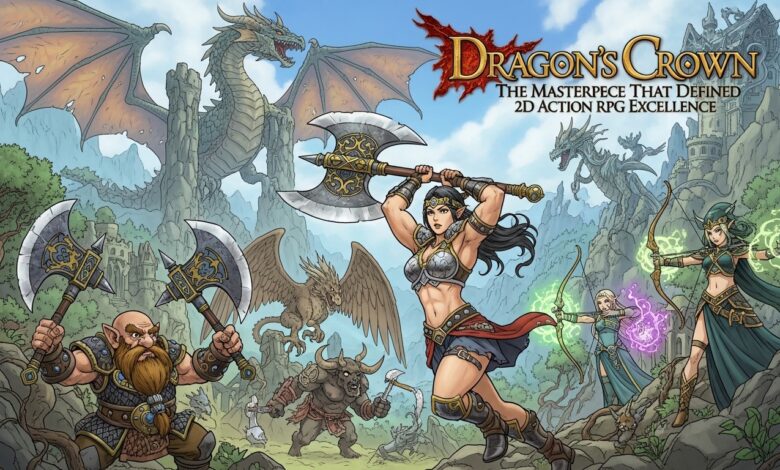
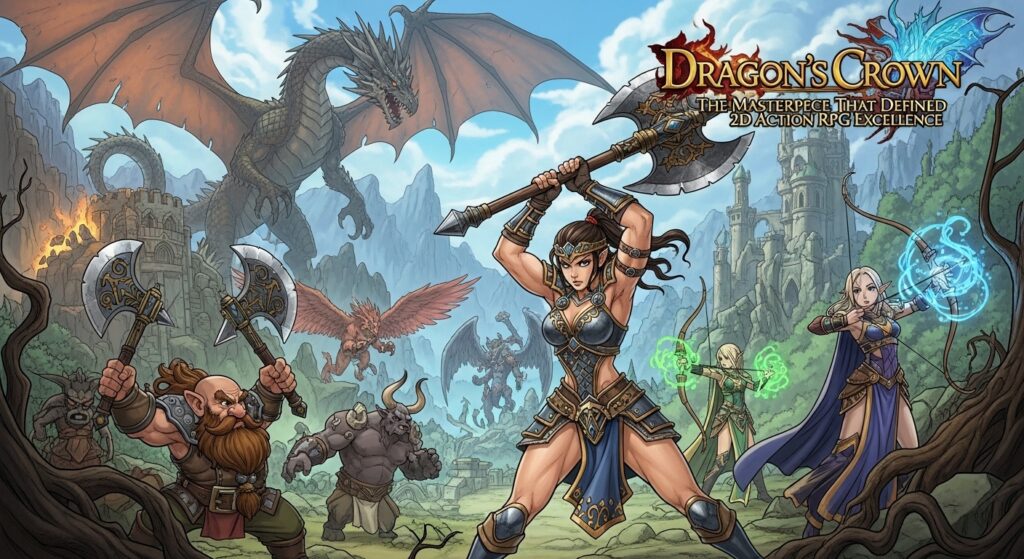
The game’s visual presentation stands as its most immediate and enduring achievement. Vanillaware’s artists painstakingly hand-painted every frame, creating what critics and players universally recognized as “the most beautiful 2D Action RPG in gaming history”
. Every character, monster, and environment bursts with vibrant color, fluid animation, and meticulous detail that transforms the fantasy kingdom of Hydeland into a living storybook. Dragons don’t merely appear—they dominate the screen with scales that shimmer and wings that cast shadows across meticulously rendered backgrounds.
Gameplay: Where Beat ‘Em Up Meets Dungeon Crawler
Beneath its artistic splendor, Dragon’s Crown delivers gameplay that merges multiple genres into a cohesive, addictive experience. Players choose from six distinct character classes, each offering fundamentally different approaches to combat and progression:
The Fighter serves as the balanced warrior, wielding sword and shield with equal proficiency, perfect for newcomers seeking straightforward melee combat.
The Amazon unleashes raw physical power through massive weapons and athletic maneuvers, trading defense for devastating offensive capabilities.
The Dwarf combines throwing mechanics with ground-shaking attacks, controlling crowds through knockback and area denial.
The Elf specializes in ranged combat and agility, requiring precision positioning and arrow management.
The Wizard commands elemental magic with devastating area-of-effect spells that demand strategic resource management.
The Sorceress wields dark magic, summoning skeletons and manipulating the battlefield through debuffs and crowd control
.
This class diversity ensures that no two playthroughs feel identical. The Fighter’s sword-and-shield approach fundamentally differs from the Wizard’s spell-weaving strategy, encouraging multiple completions to experience the full mechanical breadth.
The Loop: Combat, Loot, Progress, Repeat
Dragon’s Crown’s core gameplay loop follows the classic dungeon crawler formula refined through Vanillaware’s distinctive lens. Players navigate side-scrolling environments from a beat ’em up perspective, battling hordes of enemies through responsive combat systems that reward timing and positioning. Boss encounters—particularly the dragon battles that give the game its name—demand pattern recognition and strategic ability usage.
The loot system adds RPG depth to the arcade-inspired combat. Defeated enemies and treasure chests yield equipment of varying rarity, which players must have appraised to reveal their true properties. This identification mechanic creates tension and anticipation—will that unidentified weapon be a common blade or a legendary artifact? The randomization ensures that dungeon runs remain exciting even after dozens of completions.
Character progression occurs through skill points earned via leveling and quest completion. These points enhance both universal abilities and class-specific powers, allowing customization that supports individual playstyles. The skill tree system provides tangible growth that complements the equipment upgrades, creating satisfying power curves that keep players engaged across the lengthy campaign
.
Multiplayer Mayhem: Cooperative Adventure
Dragon’s Crown truly shines when experienced with companions. The game supports up to four-player cooperative multiplayer, both locally and online through PlayStation Network
. This social dimension transforms the experience from solitary dungeon crawling into chaotic, collaborative combat where class combinations and teamwork determine success.
The multiplayer design encourages repeated playthroughs. Each session generates different enemy placements, treasure locations, and dynamic events, ensuring that cooperative runs feel fresh rather than repetitive. The cross-platform functionality between PlayStation 3 and Vita (added through post-launch patches) expanded the player pool, though this feature required careful technical implementation by Vanillaware
.
Dragon’s Crown Pro: The Definitive Edition
On February 8, 2018, Vanillaware and Atlus unveiled Dragon’s Crown Pro, a high-definition remaster for PlayStation 4 that represented the studio’s first attempt at updating an existing title
. This release didn’t merely port the original—it comprehensively enhanced every aspect of the experience.
Visual Enhancements: The Pro version supports 4K resolution on PlayStation 4 Pro hardware, with redrawn high-resolution sprites that eliminate jagged edges while preserving the hand-painted aesthetic. Vanillaware spent six months refining assets to ensure the upgraded resolution maintained artistic integrity
.
Orchestral Soundtrack: The original score by legendary composer Hitoshi Sakimoto (Final Fantasy Tactics, Valkyria Chronicles) was completely re-recorded with a live orchestra. Arranger Azusa Chiba incorporated folk instruments and extensive percussion, creating a richer, more immersive audio experience that elevates the fantasy atmosphere
.
Complete Content: Dragon’s Crown Pro includes all previous patches, downloadable content (including the alternate narrator voice packs), and gameplay refinements developed over the original release’s lifespan. The Battle Hardened Edition even included physical skill tree cards and a steel case for collectors
.
The remaster achieved an 80/100 Metacritic score, with reviewers praising how the enhancements preserved the original’s charm while modernizing its presentation for contemporary displays
.
The PC Question: A Community’s Persistent Hope
Despite Dragon’s Crown’s acclaim and Vanillaware’s growing reputation, the game remains conspicuously absent from PC platforms including Steam. This absence has frustrated PC gaming enthusiasts since the original 2013 release, with community forums consistently requesting ports
.
The demand stems from legitimate compatibility concerns. As PlayStation 3 and Vita hardware ages, and even PlayStation 4 enters its twilight years, PC availability would ensure preservation and accessibility for future generations. The game’s 2D nature and relatively modest system requirements would theoretically make it an ideal candidate for PC adaptation.
Recent developments suggest potential hope. A February 2026 video titled “Why You Should Play Dragon’s Crown In 2026 (Now Also On PC)” indicates that the game has become playable on PC through various methods, with the creator noting cross-platform availability across four systems
. Additionally, Reddit discussions confirm that the game runs on Steam Deck through emulation, suggesting that PC gamers can experience this masterpiece through alternative means even without an official port
.
However, an official Steam release from Vanillaware and Atlus remains elusive. The studio’s small size and focus on new projects (including the critically acclaimed Unicorn Overlord) may explain this hesitation, though the commercial success of other Japanese PC ports suggests potential viability.
Critical Legacy: Enduring Excellence
Dragon’s Crown achieved remarkable critical validation throughout its lifespan. The original release earned an 82/100 Metacritic score for PlayStation 3 and 77/100 for Vita, with reviewers universally praising the visual design while debating certain design choices
.
Destructoid awarded the original a rare 9.5/10, calling it “a game that will be remembered for years to come.” IGN delivered an 8.5/10, noting that “Vanillaware has created one of the most beautiful games ever made.” GameTrailers scored it 9/10, emphasizing the addictive gameplay loop and cooperative multiplayer
.
The Pro remaster maintained this quality standard, earning 80/100 on Metacritic with Electronic Gaming Monthly praising how the enhancements “make a great game even better” without compromising the original vision
.
Commercially, the game exceeded expectations. It sold over 300,000 copies in its first Japanese week and reached 800,000 shipments globally by December 2013
. The Pro remaster and continued sales eventually pushed the franchise past one million copies worldwide, remarkable numbers for a niche 2D action RPG in an era dominated by 3D blockbusters
.
Cultural Impact and Controversy
Dragon’s Crown’s legacy extends beyond gameplay into broader gaming culture discussions. The game’s exaggerated character designs, particularly the Sorceress’s proportions, generated significant controversy regarding representation in fantasy art. Critics like Jason Schreier noted that such designs could alienate potential players, while defenders argued that the aesthetic consistency applied equally to the hyper-muscular Dwarf and other exaggerated heroes
.
This debate, while contentious, ultimately highlighted Dragon’s Crown’s willingness to embrace distinctive artistic vision rather than generic safety. The controversy never overshadowed the game’s mechanical excellence, and retrospective analysis suggests the discussion contributed to industry-wide conversations about character design diversity.
More positively, Dragon’s Crown demonstrated that “prestige” 2D gaming could thrive in the HD era. It influenced subsequent Vanillaware projects including 13 Sentinels: Aegis Rim and Unicorn Overlord, while inspiring other developers to invest in hand-drawn aesthetics rather than defaulting to 3D models.
The Complete Experience: Art, Music, and Lore
Beyond gameplay, Dragon’s Crown offers rich supplementary content. The official artbook showcases Vanillaware’s pre-production illustrations, revealing the evolution from concept to final implementation
. The manga adaptation by Yuztan expands the narrative universe, while the novelization explores character backstories in greater depth.
The soundtrack albums deserve particular mention. The original three-disc release through Basiscape Records includes exclusive piano arrangements, while the Pro orchestral version adds the “Dragon’s Crown Percussion Remix” and expanded instrumentation. Both albums became available for streaming worldwide in June 2025, ensuring musical accessibility for fans
.
Conclusion: A Crown Worth Seeking
Dragon’s Crown represents the pinnacle of 2D action RPG design—a game where every frame deserves appreciation, every combat encounter offers satisfaction, and every dungeon run promises discovery. Whether experienced on original PlayStation hardware, the enhanced Pro remaster, or through PC emulation methods, it delivers a fantasy adventure of rare quality.
For players seeking cooperative dungeon crawling with unmatched visual splendor, Dragon’s Crown remains essential. Its absence from official PC platforms is unfortunate, but the game’s quality justifies whatever platform access players can arrange. Vanillaware’s masterpiece proves that hand-drawn art, responsive combat, and addictive progression systems can create experiences that transcend hardware generations.