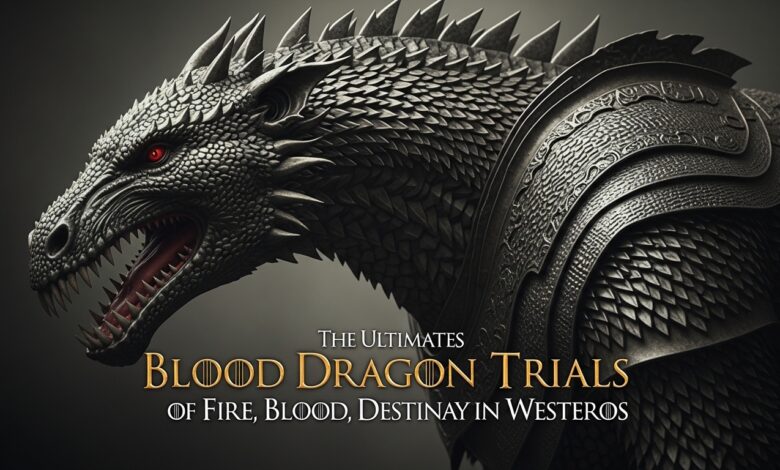
An In-Depth Exploration of the Perilous Ordeals That Determine Who Commands the Skies
April 2026 — In the brutal, fire-forged world of George R.R. Martin’s A Song of Ice and Fire and its HBO adaptations, power is never given—it is tested, earned through bloodshed, and proven through trials that separate the worthy from the damned. The Blood Dragon Trials represent the most dangerous and mystical ordeals in Westerosi history, encompassing everything from ancient Valyrian blood magic rituals to the lethal testing of potential dragonriders. These trials have shaped the destiny of empires, determined the fates of dynasties, and claimed the lives of countless souls who sought to harness the ultimate power: command of the dragons.
The Genesis of Blood Dragon Trials
The concept of testing one’s worth through blood and fire traces back to the ancient Valyrian Freehold, where forty noble dragonlord families ruled through sorcery, slavery, and the terrifying power of their winged mounts
. Unlike conventional medieval trials, Blood Dragon Trials operate on principles of magical inheritance, genetic predisposition, and supernatural selection that defy rational explanation.
According to Westerosi lore, the Targaryens—sole survivors of the Doom of Valyria—brought these trials to Westeros, where they evolved from esoteric Valyrian rituals into the political and military instruments that forged the Seven Kingdoms into a single realm
. The trials serve dual purposes: they identify those with sufficient “dragon blood” to bond with these lethal creatures, and they eliminate the unworthy through natural selection’s most brutal methodology.
The Dragonseed Trials: Blood Calling to Blood
The most dramatic Blood Dragon Trials in recent memory occurred during the Dance of the Dragons, as depicted in House of the Dragon Season 2. When Queen Rhaenyra Targaryen faced the devastating loss of dragonriders and the need to claim riderless dragons on Dragonstone, she authorized the recruitment of dragonseeds—bastards with Targaryen ancestry who might possess the bloodline necessary to bond with dragons
.
These trials proved “exceptionally bloody,” with many candidates dying or sustaining grievous injuries
. The testing was not merely a matter of claiming a dragon; it was a lethal lottery where blood heritage served as the entry ticket, but survival required something more intangible—an affinity that transcended genetics.
The trials followed a brutal protocol:
The Approach: Candidates with documented or suspected Valyrian bloodlines were permitted to approach riderless dragons in their lairs. This alone weeded out the obviously unworthy—dragons could sense blood purity and would incinerate imposters before they drew near.
The Bonding Attempt: Those who survived initial contact attempted to establish psychic and physical bonds with the dragons. Success meant claiming a weapon of mass destruction; failure meant death by flame, tooth, or claw.
The Survival Rate: Historical records indicate that for every successful dragonseed who claimed a mount, multiple others perished. Hugh Hammer’s claiming of Vermithor and Ulf White’s bonding with Silverwing represented rare successes in a field of corpses
.
Rhaenyra’s son Jacaerys articulated the fundamental tension of these trials when he questioned his mother about recruiting bastard dragonriders: the trials could empower commoners with weapons that challenged Targaryen supremacy, yet without them, the war was already lost
.
Trial by Combat: The Seven-Fold Judgment
While not exclusively dragon-related, the Trial of Seven represents another form of Blood Dragon Trial embedded in Westerosi legal and religious tradition. This Andal tradition, linked to the Faith of the Seven, demands that seven champions fight on each side, with the gods thus honored more likely to see justice done
.
The most famous Trial of Seven in Targaryen history involved Ser Duncan the Tall and Prince Aerion Targaryen. When Aerion attacked a puppeteer for depicting a dragon being slain, Duncan defended her and struck the prince, demanding trial by combat
. The resulting melee featured seven champions per side, including Prince Baelor Targaryen fighting alongside Duncan against his own kin.
The trial proved devastating: Baelor died from a wound accidentally inflicted by his brother Maekar, two other champions perished, and Aerion was exiled
. This case illustrates how Blood Dragon Trials extend beyond dragon-bonding to encompass the judicial and political mechanisms through which Targaryen power is contested and validated.
Blood Magic Rituals: The Dragon Rebirth Trials
The most mystical Blood Dragon Trials involve blood magic—the ancient Valyrian art of using sacrifice to achieve supernatural outcomes
. These rituals represent the highest stakes trials, where death literally pays for life and power.
Septon Barth’s theories, documented in The World of Ice & Fire, suggest that dragons themselves were created through blood magic—engineered by Valyrian sorcerers who combined wyverns with firewyrms using sorcerous blood rituals
. If true, every dragon in existence represents the successful outcome of ancient Blood Dragon Trials that blended biology with dark magic.
The modern era’s most significant blood magic trial occurred when Daenerys Targaryen walked into Khal Drogo’s funeral pyre. This trial by fire required:
Blood Sacrifice: Mirri Maz Duur’s death and the slaughter of Drogo’s horse provided the magical fuel
Personal Risk: Daenerys’s own willingness to embrace death by flame
Dragon Eggs: Three stone eggs that had resisted hatching for centuries
Instinctive Magic: As George R.R. Martin confirmed, Daenerys “made up the magic as she went along”—her success depended not on learned spells but on innate connection to dragon blood
The outcome—three living dragons hatched from stone, with Daenerys emerging unscathed—represents the most successful Blood Dragon Trial in recorded history. It validated not only her own dragon blood but the fundamental principle that these trials operate on: the worthy survive and are transformed; the unworthy are consumed.
The Red Sowing: Industrialized Dragon Testing
House of the Dragon Season 2’s “Red Sowing” episodes depicted the industrialization of Blood Dragon Trials. Where ancient Valyrians conducted individual rituals, Rhaenyra’s faction implemented systematic testing of dragonseed candidates—a process that historian Mushroom described as exceptionally lethal
.
This mass trial approach revealed critical insights about dragon blood mechanics:
Blood Dilution Effects: Some dragonseeds with minimal Targaryen ancestry succeeded where purebloods failed, suggesting that blood concentration is not the sole determinant of dragon affinity
Psychic Selection: Dragons appeared to choose riders based on temperament and will rather than genetics alone, explaining why some obviously Valyrian candidates died while bastards survived
Political Consequences: Successful dragonseeds like Addam of Hull (who claimed Seasmoke) and Nettles (who bonded with Sheepstealer) gained immediate status that challenged traditional Westerosi hierarchies
The Red Sowing trials demonstrated that Blood Dragon Trials are not merely tests of individual worth but mechanisms of social transformation—capable of elevating bastards to power and destabilizing established aristocracies.
The Genetic Trials: Stillbirths and Monstrous Births
Not all Blood Dragon Trials involve adult volunteers. Targaryen history documents tragic trials conducted by nature itself—stillbirths and monstrous births that test the limits of dragon blood compatibility with human biology
.
These involuntary trials have produced horrifying outcomes:
Rhaego: Daenerys’s son was born “inhuman, hideously deformed and covered in dragon-like scales” with “the stub of a tail [and] small leather wings, reminiscent of a bat”
Visenya: Rhaenyra’s daughter emerged “twisted and malformed, with a hole in her chest where her heart should have been and a stubby, scaled tail”
Maegor’s Wives: Multiple stillbirths attributed to the cruel king’s bloodline, some possibly sabotaged by sorcery, others representing natural genetic incompatibilities
These tragedies suggest that Blood Dragon Trials operate from conception onward—that the same blood that grants power can prove lethal when concentrations overwhelm human biological limits. The trials never truly end; every Targaryen pregnancy represents another test of bloodline viability.
The Psychological Trials: Madness and Greatness
Blood Dragon Trials extend beyond physical ordeals to encompass psychological testing. The Targaryen madness—epitomized by Aerys II, the Mad King—represents a form of trial by fire within the mind itself
.
Historical analysis suggests that the concentration of dragon blood required for dragon-bonding correlates with mental instability. The same genetic traits that enable supernatural affinity with magical creatures may compromise psychological stability—a trade-off that makes every Targaryen heir a potential conqueror or catastrophe.
The trials of madness include:
Prophetic Dreams: Many Targaryens experience dragon dreams that predict future events, but these visions often blur the line between insight and delusion
Obsessive Behavior: The Targaryen fixation on fire, blood, and dragons can manifest as destructive obsession, as seen in Aerion Brightflame’s belief that he could transform into a dragon by drinking wildfire
Greatness or Death: The Targaryen coin flip—every Targaryen born is either a genius or a madman, with no middle ground
Modern Interpretations: Trials in Gaming and Culture
The A Song of Ice and Fire Roleplaying Game by Green Ronin Publishing translates Blood Dragon Trials into mechanical systems where players must test their characters’ bloodlines, risk madness, and attempt dragon-bonding through dice-based ordeals
. The Blood of Dragons MUD (Multi-User Dungeon), operating since 2007 with George R.R. Martin’s approval, features over 2,800 characters who have undergone virtual Blood Dragon Trials in real-time progression from the Conquest of Dorne through the reign of King Aegon IV
.
These gaming implementations demonstrate the enduring fascination with trials that combine genetic destiny, magical testing, and lethal consequences—a formula that resonates across media because it taps into fundamental questions about merit, inheritance, and the price of power.
Conclusion: The Eternal Trial
Blood Dragon Trials represent more than historical curiosities or plot devices—they embody the central theme of the Game of Thrones universe: that power is never free, that heritage is both blessing and curse, and that those who would command dragons must first survive the fire.
From the ancient Valyrian blood mages who engineered dragons through sorcerous trials, to Daenerys’s miraculous pyre survival, to the bloody dragonseed testing of the Dance of the Dragons, these ordeals have determined who rules Westeros and who becomes ash. They are the crucible in which Targaryen destiny is forged—a never-ending cycle of fire, blood, and transformation that continues to shape the world of ice and fire.