When Motorcycle Mayhem Meets 80s Action Nostalgia
In the annals of video game history, certain titles stand out not merely for their quality, but for their sheer audacity—their willingness to defy convention, mash together incompatible genres, and create something memorably bizarre. Trials of the Blood Dragon, released by Ubisoft in 2016, represents exactly this kind of glorious experimentation. Part motorcycle stunt simulator, part 2D action platformer, part retro-futuristic shooter, and entirely wrapped in the neon-soaked, VHS-filtered aesthetic of 1980s action cinema, this game represents either a brilliant creative fusion or a beautiful disaster, depending on whom you ask. One thing remains undeniable: no player who experiences Trials of the Blood Dragon will ever forget it.
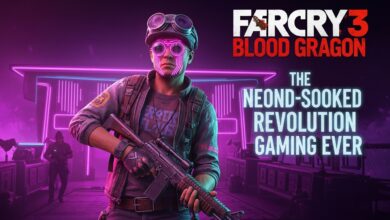
The game emerged from an unexpected collaboration between two distinct Ubisoft properties. The Trials series, developed by Finnish studio RedLynx, had built a devoted following through its precise physics-based motorcycle platforming, challenging players to navigate obstacle courses using realistic bike handling mechanics. Meanwhile, Far Cry 3: Blood Dragon, released in 2013, had become a cult classic—a standalone expansion that parodied 80s action movies with hilarious dedication, featuring cyborg soldiers, neon dinosaurs, and protagonist Rex “Power” Colt voiced by Michael Biehn of Terminator and Aliens fame. Trials of the Blood Dragon represents the unholy union of these two franchises, and the gaming world is infinitely stranger—and more entertaining—for it.
A Narrative Framework: Absurdity as Art
Trials of the Blood Dragon commits to its ridiculous premise with admirable dedication. Set in a dystopian future version of 2019—because the game was made in 2016 when 2019 still sounded like the distant future—the story follows Rex Power Colt’s children, Roxanne and Slayter, as they battle the forces of evil using motorcycles, guns, and attitude. The narrative unfolds through deliberately cheesy cutscenes featuring purposefully stilted voice acting, over-the-top dialogue, and visual filters that make everything look like it’s playing on a CRT television with tracking issues.
The plot serves as both homage and parody of 80s action movie tropes. Evil corporations, doomsday weapons, unnecessary romantic subplots, and gratuitous explosions appear with predictable regularity, each presented with a wink and nod that acknowledges the absurdity while celebrating it. The writing understands that the best parody comes from love, not contempt—every ridiculous moment feels crafted by people who genuinely adore the source material they’re mocking.
What elevates the narrative framework is its commitment to the bit. Where lesser games might have used the Blood Dragon aesthetic as a superficial skin, Trials of the Blood Dragon integrates it into every aspect of the experience. Loading screens feature fake VHS wear and tear. Menu interfaces mimic 80s computer graphics. Even the achievement notifications appear with appropriate retro flair. This thoroughness creates an immersive comedic experience that never breaks character.
Gameplay Fusion: Trials Meets Contra
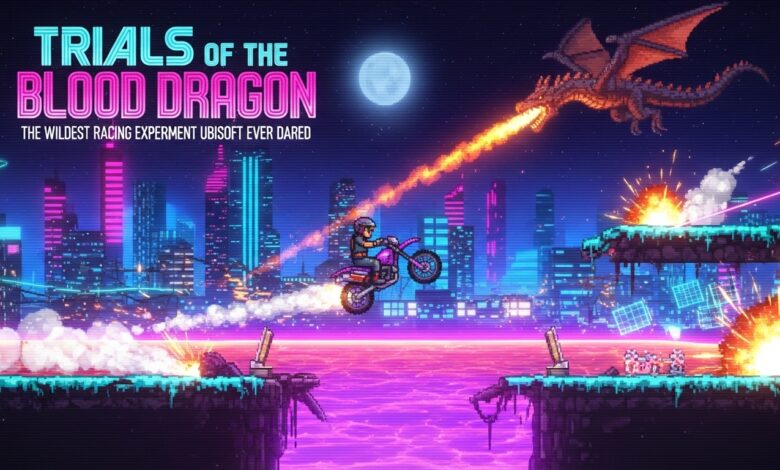
The core gameplay of Trials of the Blood Dragon represents an ambitious—some might say foolhardy—attempt to merge distinct genres. Approximately 70% of the game follows traditional Trials formula: players control motorcycles across physics-based obstacle courses, using careful throttle control, weight shifting, and momentum management to overcome ramps, explosives, and precarious platforms. These sections demand the precision and patience that Trials fans expect, with tracks ranging from straightforward beginner courses to nightmare-inducing challenges that require dozens of attempts to complete.
However, Trials of the Blood Dragon refuses to stop there. The remaining 30% introduces on-foot 2D action platforming sequences where players control Roxanne or Slayter using guns, grenades, and grappling hooks to battle enemies. These sections draw inspiration from classic run-and-gun games like Contra and Metal Slug, featuring side-scrolling combat against waves of cyborg soldiers and mutated creatures. The transition between motorcycle and on-foot sections occurs seamlessly within levels, creating a hybrid experience unlike anything else in either genre.
This fusion proves both the game’s greatest strength and its most divisive feature. When the elements combine successfully—launching from a ramp, ejecting from the bike mid-air, grappling to a platform, and opening fire on enemies before landing on another motorcycle—the result feels exhilarating and innovative. However, the on-foot controls lack the polish of dedicated platform shooters, with movement feeling floaty and combat occasionally devolving into repetitive button-mashing.
Level Design: Variety as Virtue
The 30+ levels spanning Trials of the Blood Dragon showcase impressive variety in both setting and mechanics. Players race through neon-lit cityscapes, blast through military installations, navigate alien landscapes, and even pilot unconventional vehicles including minecarts, jetpacks, and—because why not—unicorns that poop explosive rainbows. Each environment embraces the retro-futuristic aesthetic with glowing grid floors, palm tree silhouettes against purple skies, and architecture that screams “what people in 1985 thought 2019 would look like.”
The track design demonstrates RedLynx’s expertise in creating satisfying challenge curves. Early levels introduce basic mechanics gently, while later stages combine multiple elements into devilish gauntlets requiring perfect execution. Hidden collectibles and alternative routes encourage replayability, with completionists seeking every secret the game conceals.
Particular highlights include levels that break the fourth wall, sequences that parody specific 80s movies, and set-piece moments that escalate absurdity to previously unimagined heights. One memorable stage features a giant mechanized spider boss battle. Another includes a sequence where players must perform stunts while being chased by an explosion. The game constantly surprises, ensuring that boredom never becomes an issue even when frustration with difficulty spikes sets in.

Visual and Audio Presentation: Maximum Neon
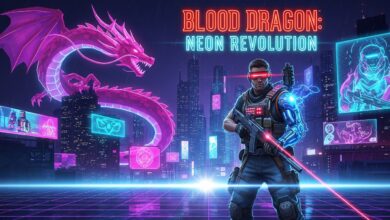
The aesthetic execution of Trials of the Blood Dragon deserves recognition as a masterclass in stylistic consistency. The visual design embraces every 80s sci-fi cliché with enthusiastic commitment: hot pink and cyan color schemes, lens flares everywhere, scan lines and chromatic aberration effects, and character designs featuring mullets, bandanas, and enough neon spandex to outfit an aerobics convention.
The musical score, composed by Power Glove, provides the perfect synthwave accompaniment to the on-screen chaos. Pounding electronic beats, distorted guitar riffs, and unmistakably 80s synthesizer sounds create an auditory experience that transports players directly into an action movie montage. The music dynamically responds to gameplay, intensifying during difficult sections and celebrating victories with appropriately triumphant fanfare.
Sound design completes the sensory package with satisfyingly crunchy explosions, exaggerated weapon effects, and voice acting that walks the precise line between genuinely bad and purposefully terrible. Every audio cue reinforces the game’s commitment to its aesthetic premise, creating cohesion between what players see, hear, and do.
The Trials Legacy: Physics Perfection
Beneath all the Blood Dragon window dressing lies the renowned Trials physics engine, refined through years of development and countless iterations. Motorcycle handling feels weighty and realistic, with every input producing predictable, logical results. Mastery comes not from memorizing patterns but from understanding momentum, balance, and the precise relationship between throttle control and body positioning.
This physics foundation provides the game with genuine mechanical depth that transcends its comedic presentation. Dedicated players can spend hours perfecting their runs, seeking the flawless performances necessary to earn platinum medals. Leaderboards and ghost systems facilitate competitive play, with friends challenging each other’s times and the global community pushing for world records.
The inclusion of a track editor extends longevity infinitely, allowing creative players to construct and share custom courses. The community has produced remarkable creations ranging from faithful recreations of real-world locations to impossible challenges that push the physics engine to its breaking point. This user-generated content ensures that even after completing the campaign, players have unlimited new experiences awaiting.
Reception and Cultural Impact
Upon release, Trials of the Blood Dragon received mixed but generally positive reviews from critics. Praise focused on the audacious creativity, faithful aesthetic execution, and the continued excellence of the core Trials gameplay. Criticism typically targeted the on-foot sections, which many reviewers found underdeveloped compared to the polished motorcycle mechanics. The game currently holds a metacritic score of 72, reflecting this divided but appreciative response.
Commercially, the game performed respectably, benefiting from strong brand recognition and the cult popularity of its Blood Dragon predecessor. Its release as a standalone title rather than expansion allowed players unfamiliar with either franchise to jump in without prerequisites, though understanding the references certainly enhanced appreciation.
Culturally, Trials of the Blood Dragon represents a fascinating case study in licensed crossover potential. It demonstrated that even seemingly incompatible franchises could combine into coherent, entertaining experiences when handled with creative courage. The game’s existence arguably paved the way for future Ubisoft experiments, proving that audiences would embrace bizarre genre combinations if executed with sufficient confidence and style.
Legacy and Availability
Six years after release, Trials of the Blood Dragon remains available across multiple platforms including PlayStation 4, Xbox One, and PC. Its relatively modest system requirements ensure accessibility for players with older hardware, while frequent sales make it an inexpensive addition to any library.
The game occupies a unique position in both the Trials and Blood Dragon legacies. For Trials purists, it represents an interesting but non-essential detour from the series’ core focus. For Blood Dragon enthusiasts, it provides welcome expansion of the universe’s lore and aesthetic. For players seeking something genuinely different from typical gaming fare, it offers an experience that defies easy categorization.
Conclusion: Beautiful Madness
So what is Trials of the Blood Dragon? It is a physics-based motorcycle platformer that demands precision and patience. It is a 2D action shooter with run-and-gun combat. It is an 80s nostalgia delivery system wrapped in neon and synthwave. It is a comedy experience that generates genuine laughter through committed parody. And somehow, against all logical expectations, it is a cohesive, entertaining, and memorable video game that could only exist in the modern era of creative risk-taking.
In an industry often criticized for playing it safe, Trials of the Blood Dragon stands as testament to the value of wild experimentation. Not every element works perfectly—the on-foot sections remain divisive, the difficulty spikes occasionally frustrate, and the humor doesn’t land for everyone. But the overall package delivers something that millions of players found worth experiencing, discussing, and remembering.
Roxanne and Slayter Power Colt await your assistance. The future of 2019—er, the past future—depends on your motorcycle skills and shooting prowess. Embrace the neon, crank the synthwave, and prepare for the most ridiculous ride of your gaming life.