The question of how long Far Cry 3 Blood Dragon takes to complete opens a fascinating window into one of the most distinctive and beloved experiments in modern gaming history. Released in 2013 as standalone downloadable content that required no ownership of the base Far Cry 3 this retro-futuristic shooter delivered a concentrated dose of 1980s action movie nostalgia wrapped around the polished mechanics of Ubisoft’s open-world formula. The answer to its length depends significantly on playstyle and completion goals with main story runs averaging between four to six hours while thorough explorers might invest eight to twelve hours achieving full completion. This deliberately compact scope represented a radical departure from the increasingly bloated open-world games of its era demonstrating that quality and density could triumph over sheer scale.
Blood Dragon emerged from a peculiar creative environment at Ubisoft Montreal where a small team led by Dean Evans sought to explore the boundaries of what downloadable content could achieve. Rather than simply extending Far Cry 3’s narrative or adding new maps to existing structures the team conceived an entirely separate experience that shared mechanical DNA but pursued wildly different aesthetic and tonal goals. The project began as an April Fools joke concept but gained such internal enthusiasm that it received approval for full development as a standalone release. This origin story explains the game’s irreverent attitude and concentrated vision it was created by passionate developers given unusual freedom to pursue a specific creative vision without the pressures of franchise maintenance or mass market appeal that typically constrain major releases.
The narrative structure of Blood Dragon embraces its B-movie inspirations with gleeful abandon presenting a story that knows exactly how ridiculous it is and refuses to apologize. Players assume the role of Sergeant Rex Power Colt a cybernetically enhanced super-soldier voiced with gravelly commitment by Michael Biehn known for his roles in The Terminator and Aliens. The setting is an alternate 2007 where nuclear war has transformed the world into a neon-soaked hellscape populated by mutated wildlife and the titular blood dragons massive creatures that shoot lasers from their eyes. The plot involves stopping Colonel Ike Sloan a rogue military commander threatening global stability with devastating weapons technology. This narrative framework provides just enough structure to justify the action while never pretending to greater significance than pure entertainment.
The main campaign consists of seven story missions that can be completed in approximately four hours by players focusing exclusively on progression. These missions follow a familiar structure of infiltration combat and set-piece moments but distinguish themselves through presentation and writing. Cutscenes employ deliberately crude pixel art that mimics 1980s computer aesthetics while dialogue overflows with action movie one-liners and knowing winks at video game conventions. The brevity of these missions prevents any single gameplay element from overstaying its welcome maintaining momentum through constant variation and surprise. Players who rush through the main story miss significant content but experience a complete narrative arc that satisfies on its own terms.
The open world of Blood Dragon though significantly smaller than Far Cry 3’s Rook Islands contains substantial optional content that extends playtime considerably. Twelve garrisons serve as enemy strongholds that can be liberated to establish safe zones and fast travel points mirroring the outpost system of the main game. These liberations offer tactical flexibility allowing stealth approaches or explosive assaults depending on player preference. Thirty-two collectible VHS tapes scattered throughout the environment provide world-building details presented as cheesy educational videos from the game’s fictional universe. Twelve side missions offer additional combat challenges and narrative vignettes that expand on the setting’s absurd mythology. Completing these optional objectives typically adds three to four hours to the total playtime while providing context and rewards that enhance the core experience.
The blood dragons themselves represent the game’s most distinctive mechanical and atmospheric element transforming the familiar Far Cry formula with unpredictable apex predators. These massive creatures roam specific territories marked by glowing neon boundaries creating dynamic danger zones that players must navigate carefully. Blood dragons can be lured using cyber hearts harvested from fallen enemies allowing creative players to turn these beasts against enemy installations. Alternatively players can engage dragons directly using heavy weapons and vehicles though such confrontations demand preparation and skill. The presence of these creatures ensures that even routine travel across the compact map maintains tension and possibility preventing the open world from feeling like mere connective tissue between missions.
The progression systems of Blood Dragon streamline the complex upgrade trees of Far Cry 3 into a more direct and satisfying format. Experience points unlock automatic upgrades to health weapon capacity and abilities eliminating the need to hunt specific animals for crafting materials. Weapons become available through story progression and garrison liberation rather than economic accumulation ensuring that players access the full arsenal through natural play rather than grinding. This approach respects player time recognizing that the compact experience works better when systems facilitate rather than gate content. The result allows players to feel increasingly powerful throughout the brief campaign reaching maximum capability without excessive investment.
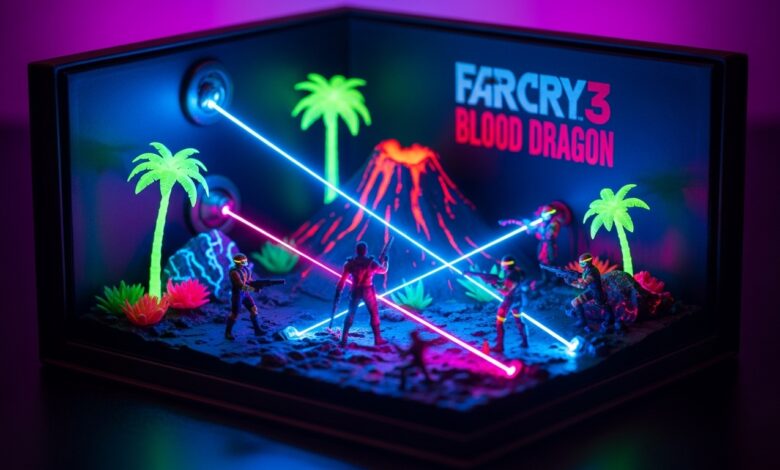
The visual and audio design of Blood Dragon represents perhaps its most significant achievement creating an immersive aesthetic experience that transcends its modest scope. The color palette abandons naturalistic tones for saturated purples pinks and blues that evoke 1980s sci-fi movie posters and arcade game cabinets. The sky features permanent aurora effects and twin moons while the terrain glows with radioactive luminescence. The soundtrack by Power Glove synthesizer duo perfectly captures the era’s electronic music with pounding bass lines and soaring melodies that intensify action sequences. These elements combine to create a cohesive world that feels fully realized despite its obvious artificiality demonstrating how strong art direction can compensate for limited technical resources.
The humor of Blood Dragon operates on multiple levels simultaneously appealing to players who lived through the 1980s and those encountering its tropes for the first time. The writing satirizes action movie conventions the excesses of macho military culture and the absurdity of video game logic with equal enthusiasm. Tutorial messages mock the very concept of tutorials while loading screen tips offer deliberately unhelpful advice. The game acknowledges its own ridiculousness without descending into mere parody maintaining genuine affection for the material it mocks. This tonal balance ensures that the humor enhances rather than undermines the action creating an experience that is simultaneously funny and genuinely engaging.
The reception of Blood Dragon upon release surprised both Ubisoft and industry observers demonstrating substantial market appetite for experimental mid-sized games. Critics praised the concentrated vision and polished execution with many noting that the compact scope prevented the fatigue that often accompanied longer open-world experiences. Commercial success exceeded expectations establishing a template for standalone downloadable experiences that could compete with full-priced releases through distinctive identity rather than equivalent scale. This success influenced subsequent industry developments including the growth of indie publishing and the acceptance of shorter premium experiences that prioritized quality over quantity.
The legacy of Blood Dragon extends through its influence on how developers approach downloadable content and experimental releases. The game proved that established franchises could support radical tonal departures without damaging brand integrity. Its success encouraged other major publishers to greenlight unusual projects that might have seemed too risky for full development. The specific aesthetic of 1980s retro-futurism experienced a revival in gaming and broader popular culture partly attributable to Blood Dragon’s influential presentation. These impacts demonstrate how a relatively small project can shape industry trends when it captures collective imagination through distinctive creative vision.
The question of appropriate length for Blood Dragon remains contentious among players with opinions divided between those who appreciate its brevity and those who wish for more content. Some players report completing everything the game offers in under eight hours and feeling satisfied by the concentrated experience. Others express disappointment that the world cannot sustain longer engagement wishing for additional story missions or expanded endgame content. This division reflects broader debates about game value and whether duration or density should determine pricing and expectations. Blood Dragon’s continued positive reputation suggests that for many players quality of experience outweighs raw quantity of hours.
Speedrunning communities have embraced Blood Dragon for its potential for optimized playthroughs with current records for main story completion hovering around thirty minutes. These runs exploit movement techniques weapon selection and routing knowledge to minimize time while maintaining completion requirements. The compact nature of the game makes it accessible for speedrunning newcomers while offering sufficient depth for competitive optimization. This community engagement extends the game’s lifespan beyond its original release with new strategies and discoveries emerging years after launch. The presence of an active speedrunning scene indicates that Blood Dragon’s design supports mastery beyond initial completion.
The technical performance of Blood Dragon across platforms has aged remarkably well with the stylized graphics proving more durable than realistic visuals from the same era. The game runs smoothly on modern hardware with loading times significantly reduced from original release specifications. Console versions maintain consistent frame rates while PC versions support enhanced resolutions and modding communities that extend visual possibilities. This technical stability ensures that new players discovering the game experience it as intended without the degradation that affects many older titles. The preservation of Blood Dragon’s playability supports its status as a cult classic that remains accessible to curious players.
The narrative conclusion of Blood Dragon provides satisfying closure while leaving narrative space for potential continuation that has never materialized. Despite fan enthusiasm and commercial success Ubisoft has not developed a direct sequel though references and Easter eggs have appeared in subsequent Far Cry installments. The standalone nature of the experience arguably benefits from this lack of continuation preserving its unique identity from dilution through franchise expansion. Players seeking similar experiences must look to independent developers who have drawn inspiration from Blood Dragon’s approach creating spiritual successors that capture aspects of its appeal without direct replication.
The value proposition of Blood Dragon at its original release price of fifteen dollars established a benchmark for what players might expect from mid-tier downloadable experiences. This pricing positioned the game as premium content rather than budget release reflecting confidence in its quality and distinctiveness. Modern sales frequently reduce this price to five dollars or less making the game accessible to virtually any interested player regardless of budget constraints. At these prices the hours of entertainment provided represent exceptional value particularly when compared to other entertainment media like films or concerts. This accessibility supports the game’s continued relevance as an entry point for players curious about the Far Cry formula or 1980s nostalgia.
The replayability of Blood Dragon stems from its flexible systems and difficulty options rather than branching narrative or randomized content. Players can approach encounters with different weapon combinations tactical strategies or restrictions creating varied experiences across multiple playthroughs. Higher difficulty settings transform the game’s challenge requiring more careful resource management and combat precision. Achievement and trophy hunting provides additional motivation for thorough exploration and specific playstyle challenges. These elements extend engagement beyond single completion without requiring the massive time investments demanded by contemporary live-service games.