Rex Power Colt: A Postcolonial Reading of Cybernetic Masculinity and Imperial Violence in Far Cry 3: Blood Dragon
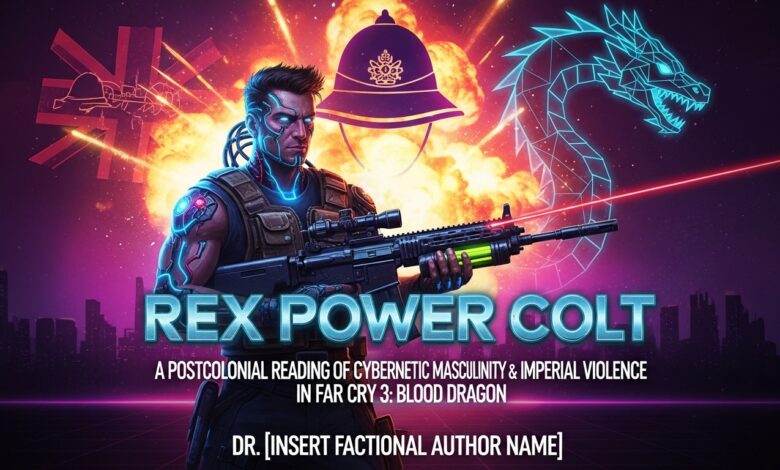
Ubisoft’s 2013 standalone expansion Far Cry 3: Blood Dragon introduced players to Sergeant Rex “Power” Colt, a cybernetically enhanced Vietnam veteran whose very name announced the hypermasculine excess that would define both his character and the game’s satirical engagement with 1980s action cinema. Voiced by Michael Biehn, known for his roles in The Terminator and Aliens, Rex embodied a specific cultural moment when American cinema processed the trauma of imperial defeat through fantasies of technological enhancement and masculine regeneration. This article examines how Rex functions as a postcolonial figure, analyzing how his cybernetic body, his narrative arc, and his relationship to the game’s Southeast Asian setting encode complex anxieties about American imperial power, the legacy of the Vietnam War, and the persistence of colonial violence in contemporary popular culture. Rather than reading Rex merely as parody or homage, this analysis treats him as a symptom of ongoing colonial imaginaries that continue to structure Western media representations of military intervention and masculine heroism.
Rex’s status as Vietnam veteran immediately positions him within the most significant trauma of American imperial history in the twentieth century, a conflict that resulted in the deaths of approximately three million Vietnamese civilians and military personnel alongside fifty-eight thousand American soldiers. The Vietnam War represented a crisis of American imperial legitimacy, exposing the limits of military power against determined anti-colonial resistance and generating cultural narratives of veteran victimhood that obscured Vietnamese agency and suffering. By 2013, this narrative had been thoroughly processed through American cinema, transforming defeat into moral redemption through films that emphasized American soldiers’ psychological wounds while marginalizing Vietnamese perspectives. Rex’s cybernetic enhancement literalizes this cultural process of regeneration, replacing damaged flesh with superior technology that restores and exceeds his original martial capacity. His mechanical arm, his ocular implants, and his enhanced reflexes represent the fantasy of imperial regeneration through technological advancement, the belief that American military power can be renewed and improved despite historical failure. This cybernetic rehabilitation mirrors the actual development of American military technology in the decades following Vietnam, where investment in drone warfare, precision targeting, and special operations sought to overcome the political limitations revealed by the war.
The temporal setting of Rex’s narrative, a futuristic 2007 imagined from a 1980s perspective, creates a complex engagement with historical memory that serves specific ideological functions in the circulation of imperial nostalgia. This retrofuturism does not merely reference the 1980s but actively reconstructs them as a period of uncomplicated American dominance, erasing the complex political struggles of the decade including the anti-apartheid movement, Central American solidarity campaigns, and ongoing indigenous resistance to settler colonialism. Rex’s presence in this reconstructed future, still fighting Vietnamese enemies decades after the actual war’s conclusion, reveals the persistence of imperial fantasy in American culture—the inability to accept defeat, the compulsive return to the scene of trauma, the reimagining of colonial war as endless adventure. His cybernetic body enables this temporal suspension, rendering him immortal and eternally combat-ready, capable of continuing the fight that historical reality had foreclosed. The postcolonial critic recognizes in this figure the colonial obsession with timelessness, the denial of historical change and indigenous agency that characterizes imperial ideology. Rex cannot age, cannot learn, cannot develop beyond his initial programming; he is pure instrument of violence, preserved in eternal readiness for deployment against whatever enemy the narrative requires.
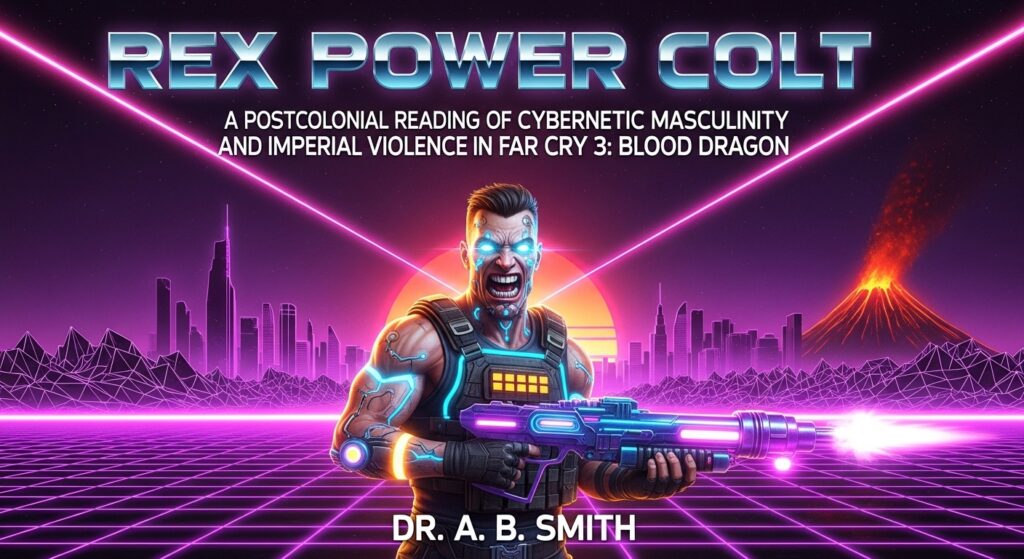
Rex’s relationship to the game’s Southeast Asian setting, an unnamed island that serves as stage for his violent activities, reproduces the colonial geography that structured the original Vietnam War and its cinematic representation. This island exists purely as terrain for Rex’s heroism, its inhabitants reduced to enemies, victims, or background texture for his narrative. The game’s deliberate invocation of Apocalypse Now and other Vietnam films through its river journey structure and its depiction of American military presence in tropical wilderness acknowledges this colonial genealogy while claiming ironic distance from it. Yet this irony does not prevent the reproduction of the underlying power dynamics, where Southeast Asian space remains available for American military adventure and technological demonstration. Rex’s cybernetic enhancements allow him to survive and dominate this environment in ways that exceed human limitation, literalizing the technological supremacy that American military doctrine has consistently claimed over colonial territories. His ability to see in the dark, to track enemies through walls, to withstand damage that would kill ordinary soldiers, represents the fantasy of total surveillance and control that drives contemporary imperial warfare through drone technology and data collection. The postcolonial subject recognizes in these capabilities the extension of colonial vision, the demand to render colonized space fully transparent and available for imperial management.
The narrative of Rex’s transformation from human soldier to cybernetic weapon, presented through flashbacks and environmental storytelling, engages with questions of consent and bodily autonomy that resonate with colonial histories of medical experimentation and biological warfare. The game implies that Rex’s enhancement occurred without his full informed consent, that he was rebuilt as weapon rather than healed as person, yet this critique of military biotechnology remains limited by its framing as necessary response to enemy threat. His cybernetic body, partially composed of technologies derived from Soviet and enemy sources, represents the colonial anxiety about racial contamination and the fear that imperial power depends upon incorporation of the colonized other. Rex’s struggle to maintain his humanity against his mechanical components mirrors the colonial discourse of civilizational maintenance, where exposure to colonial territories threatens to degrade the metropolitan subject. His ultimate victory, achieved through full integration of human and machine, suggests that proper imperial masculinity requires absolute subordination of body to military function, the transformation of the soldier into pure instrument of state violence. This transformation is presented as heroic sacrifice rather than dehumanization, obscuring the actual experience of veterans who find their bodies and minds permanently marked by imperial warfare.
Rex’s relationship with the game’s female characters, particularly the scientist Dr. Elizabeth Veronica Darling, reveals the gendered dimensions of his cybernetic imperial masculinity. Dr. Darling functions primarily as helper and reward, her scientific knowledge enabling Rex’s missions while her physical attraction to him confirms his masculine status. This dynamic reproduces the colonial feminism that positioned white women as requiring protection from racialized masculine threat while celebrating their capacity for supportive contribution to imperial projects. Rex’s cybernetic body, simultaneously threatening and attractive, represents the technological sublime that colonial feminism has historically celebrated as masculine achievement. His inability to engage in genuine emotional intimacy, attributed to his mechanical components, reflects the emotional impoverishment of imperial masculinity that subordinates all personal relations to military function. The postcolonial critic recognizes in this characterization the historical role of white women in empire, simultaneously privileged by racial status and constrained by gender expectations, complicit in colonial violence yet denied full participation in its rewards. Dr. Darling’s ultimate fate, which involves transformation into similar cybernetic form, suggests that imperial femininity requires adoption of masculine technological enhancement to achieve narrative agency.
The game’s antagonist, Colonel Iza, a rogue military officer seeking to unleash biological warfare, completes the colonial framing of Rex’s narrative through his embodiment of imperial excess. Iza represents what happens when colonial violence escapes institutional control, when the technologies of imperial domination are turned against imperial interests. His plan to deploy the blood dragon serum as weapon of mass destruction mirrors the actual development of chemical and biological weapons by American military research, including the testing of such weapons on Southeast Asian populations during the Vietnam War. Rex’s opposition to Iza thus appears as defense of imperial legitimacy against its own excesses, the restoration of proper colonial violence against improper application. This narrative structure allows players to experience imperial warfare as moral crusade against rogue elements rather than systemic practice, obscuring the continuity between Rex’s sanctioned violence and Iza’s condemned extremism. The postcolonial subject recognizes in this framing the historical pattern of representing colonial atrocities as aberrations rather than constitutive features of imperial rule, the isolation of individual villains to protect systemic innocence.
The visual and sonic construction of Rex’s character, dominated by neon coloration, synthesizer soundtrack, and exaggerated physical proportions, creates aesthetic distance that enables ironic engagement with his colonial violence. This retrofuturist styling signals to players that Rex represents past fantasy rather than present reality, that his actions occur within quotation marks that suspend ethical judgment. Yet this irony does not prevent the reproduction of colonial enjoyment, the pleasure of dominating racialized others through superior technology that the game continues to offer. Rex’s one-liners, delivered in Biehn’s gravelly monotone, reference the action cinema that trained American audiences to experience imperial violence as entertainment, transforming historical trauma into consumable spectacle. The postcolonial critique must attend to this persistence of colonial pleasure through ironic framing, recognizing that irony often serves to protect enjoyment rather than to enable critical reflection. Rex’s absurdity does not diminish his violence but rather renders it more palatable, more available for uncritical consumption under the guise of nostalgic appreciation.
The commercial and cultural afterlife of Rex Power Colt, including his appearance in subsequent games and his influence on alternative fashion and internet culture, demonstrates the persistence of colonial imaginaries beyond their original textual contexts. The character has been embraced by online communities that celebrate 1980s action cinema without critical engagement with its political assumptions, transforming Rex into icon of masculine nostalgia divorced from historical reference. Killstar and similar brands have incorporated Blood Dragon aesthetic elements into clothing and accessories, commodifying the visual language of imperial violence for personal expression. This circulation reveals how colonial media products continue to structure contemporary cultural production, their ironic framing enabling appropriation that maintains underlying power relations. Rex’s cybernetic body, originally symbol of imperial regeneration through technology, becomes available for identification by subjects who may not recognize its colonial genealogy. The postcolonial critic must trace these circuits of cultural production, recognizing how colonial figures migrate across contexts while retaining their structuring assumptions.
The limitations of Rex as postcolonial figure appear most clearly in what the game cannot imagine beyond his cybernetic imperial masculinity. The narrative offers no genuine alternative to Rex’s violent domination of Southeast Asian space, no possibility of solidarity with the island’s inhabitants against the superpower conflict that destroys their home. The game’s Vietnamese enemies remain faceless hordes, their perspectives inaccessible, their agency limited to threatening Rex’s mission. Even the blood dragons, presented as victims of military experimentation, appear primarily as resources for Rex’s enhancement or obstacles to his progress. This narrative foreclosure reflects the actual limitations of American political imagination regarding Vietnam and Southeast Asia, where defeat has not produced genuine reckoning with colonial violence but rather its displacement onto technological fantasy. Rex cannot develop beyond his programming, cannot recognize the humanity of his enemies, cannot imagine peace rather than combat; he is pure instrument of imperial will, preserved in eternal readiness for the next deployment.
The postcolonial potential of Rex Power Colt lies not in his narrative resolution but in the critical intervention his excess enables. The game’s deliberate exaggeration of action cinema conventions creates space for recognition of their absurdity, their distance from any sustainable ethical framework. Rex’s cybernetic body, presented as enhancement, reveals itself as damage, the transformation of human capacity into mechanical function. His eternal combat readiness appears as curse rather than blessing, the inability to imagine existence beyond imperial warfare. The postcolonial reader can seize these elements for critical purpose, reading Rex against the grain of his heroic framing to expose the dehumanization that imperial masculinity requires. His ultimate sacrifice, presented as redemption, can be recognized as the logical endpoint of cybernetic imperialism, the consumption of the soldier’s body and soul in service of state violence. This critical reading does not require rejecting the game or its pleasures but rather inhabiting them differently, recognizing the colonial violence that structures even the most ironic and self-aware media products.
Rex Power Colt stands as a complex figure in the postcolonial analysis of video games and popular culture, embodying the persistence of imperial imaginaries in contemporary media while offering resources for their critique. His cybernetic body literalizes the technological enhancement that American military culture has pursued since Vietnam, his narrative arc reproduces the compulsive return to colonial trauma that characterizes American historical memory, and his relationship to Southeast Asian space reflects the ongoing availability of the global South for imperial adventure. Yet his excess, his absurdity, his ultimate disposability also create openings for critical recognition and alternative imagination. The postcolonial critic must navigate between the Scylla of uncritical celebration and the Charybdis of dismissive rejection, engaging Rex as symptom of ongoing colonial violence that demands transformation rather than mere repetition. The blood that flows through his mechanical veins, the dragon’s blood that enables his transformations, connects him to longer histories of colonial extraction and indigenous resistance that exceed his narrative framing. To read Rex postcolonially is to recognize these connections, to refuse the isolation of media texts from the material histories they reference, and to demand forms of cultural production that move beyond the cybernetic imperialism his figure so powerfully embodies.