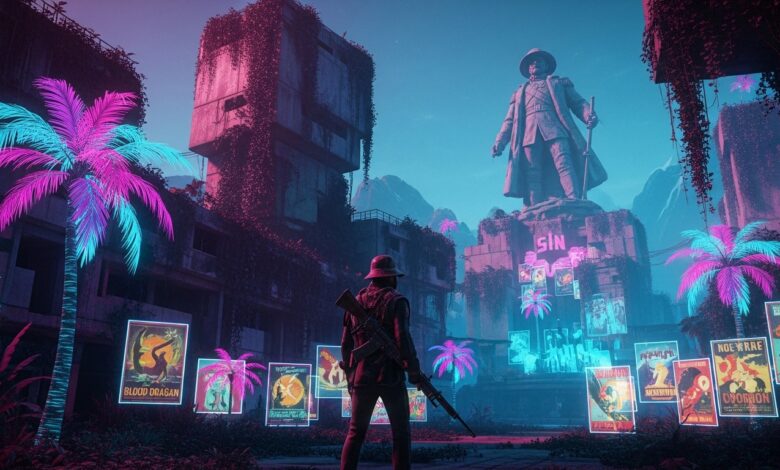
The intersection of Ubisoft’s Far Cry 3: Blood Dragon (2013) and the alternative fashion brand Killstar presents a fascinating case study in how colonial imaginaries circulate across media platforms and commercial contexts, transforming the visual language of 1980s action cinema into contemporary aesthetic commodities. While Blood Dragon operates as a standalone expansion to the Far Cry franchise, offering a satirical take on retrofuturist action tropes, Killstar’s incorporation of similar aesthetic elements into gothic and alternative fashion reveals the persistence of imperial nostalgia in contemporary consumer culture. This article examines how both texts deploy the figure of the blood dragon and associated visual motifs to negotiate questions of imperial violence, orientalism, and the commodification of Cold War anxiety, arguing that the seemingly ironic distance of retrofuturist aesthetics often masks rather than critiques the colonial logics embedded in their source materials.
Far Cry 3: Blood Dragon establishes its postcolonial coordinates through its deliberate invocation of 1980s American action cinema, a genre deeply implicated in the cultural reproduction of Cold War imperial ideology. The game casts players as Sergeant Rex “Power” Colt, a cybernetically enhanced Vietnam veteran voiced by Michael Biehn, whose very name and physical presence evoke the hypermasculine archetypes that populated films like Commando, Rambo: First Blood Part II, and American Ninja. The choice to center a Vietnam veteran as protagonist is particularly significant given the war’s status as the defining trauma of American imperial overreach in Southeast Asia, a conflict that resulted in millions of Vietnamese casualties and widespread environmental devastation through chemical warfare. By 2013, the Vietnam War had been thoroughly processed through American popular culture into a narrative of veteran victimhood and military redemption, obscuring the war’s origins in French colonialism and its function as anti-communist intervention in the global South. Blood Dragon both reproduces and satirizes this cultural amnesia, presenting Rex’s cybernetic enhancement and continued military service as natural extensions of American martial identity while simultaneously exaggerating this identity to the point of absurdity through neon-soaked visuals and deliberately stilted dialogue.
The blood dragons themselves function as complex postcolonial symbols that merge orientalist fantasy with ecological anxiety, their presence on an unnamed Southeast Asian island evoking the real-world history of American nuclear testing in the Pacific. These creatures, massive reptilian beasts that shoot laser beams from their eyes, represent the monstrous other that emerges from the intersection of nuclear technology and tropical wilderness, a fusion that recalls the actual environmental devastation wrought by American military activities in the region. The game’s presentation of blood dragons as both threats to be eliminated and resources to be harvested mirrors the colonial logic of extraction that characterized European and American engagement with Asian and Pacific territories, where indigenous populations and ecosystems were simultaneously constructed as dangerous and valuable, requiring containment while offering profit to those bold enough to exploit them. Players can lure blood dragons to attack enemy installations and collect their blood for upgrades, literalizing the colonial fantasy of using indigenous resources against indigenous resistance while maintaining the moral high ground of technological superiority.
The visual aesthetic of Blood Dragon, dominated by neon pink and cyan color schemes, VHS distortion effects, and synthesizer soundscapes, creates a temporal dislocation that serves specific ideological functions in the circulation of imperial nostalgia. This retrofuturist style does not merely reference the 1980s but actively reconstructs them as a period of uncomplicated masculine heroism and clear moral binaries, erasing the complex political struggles of the decade including the anti-apartheid movement, Central American solidarity campaigns, and ongoing indigenous resistance to settler colonialism. The game’s island setting, presented as simultaneously futuristic and primitive, reflects the colonial temporalities that positioned non-Western spaces as lagging behind or jumping ahead of proper historical development, never achieving the synchronous present of metropolitan modernity. The blood dragon’s presence disrupts this temporal order, representing a primordial power that exceeds technological control yet remains vulnerable to cybernetic weaponry, embodying the anxiety of imperial powers confronting the limits of their own dominance.
Killstar’s appropriation of Blood Dragon aesthetic elements into alternative fashion reveals how colonial imaginaries migrate across commercial contexts, losing even the minimal critical framing provided by the game’s satirical intent. The brand’s incorporation of neon colorways, occult symbolism, and retrofuturist graphics into gothic and streetwear collections demonstrates the commodification of imperial nostalgia, where the visual language of Cold War violence becomes available for personal expression without reference to historical context. Killstar’s marketing materials frequently invoke “dark” and “edgy” aesthetics that draw directly from 1980s action cinema’s portrayal of the Soviet Union, Vietnam, and other sites of American intervention as zones of barbaric violence requiring civilized containment. The blood dragon motif, when translated into clothing and accessories, becomes purely decorative, its colonial resonances submerged beneath appeals to individual style and subcultural identification. This transformation exemplifies what postcolonial theorists identify as the persistence of colonial discourse through cultural commodification, where critical engagement is replaced by aesthetic appreciation that leaves underlying power structures intact.
The gender politics of both Blood Dragon and Killstar’s aesthetic appropriation reveal the intersection of colonial and patriarchal violence in retrofuturist imagery. Rex Power Colt’s hypermasculinity, presented as both ridiculous and aspirational within the game, finds echo in Killstar’s marketing of “empowering” feminine aggression through similar visual vocabulary. The female models in Killstar campaigns frequently adopt poses and expressions derived from 1980s action cinema, wielding symbolic weaponry against unseen threats in compositions that reproduce the colonial feminism of the original texts. This colonial feminism positioned white women as requiring protection from racialized masculine violence while simultaneously celebrating their capacity for violent retaliation, a dynamic that justified imperial intervention as feminist liberation. The blood dragon, as symbol of primordial masculine threat, enables this narrative by providing an external enemy against which gendered solidarity can be constructed, obscuring the complicity of white women in colonial and imperial projects. Killstar’s aesthetic celebration of female aggression thus risks reproducing the very structures of domination it claims to subvert, substituting individual empowerment for collective liberation.
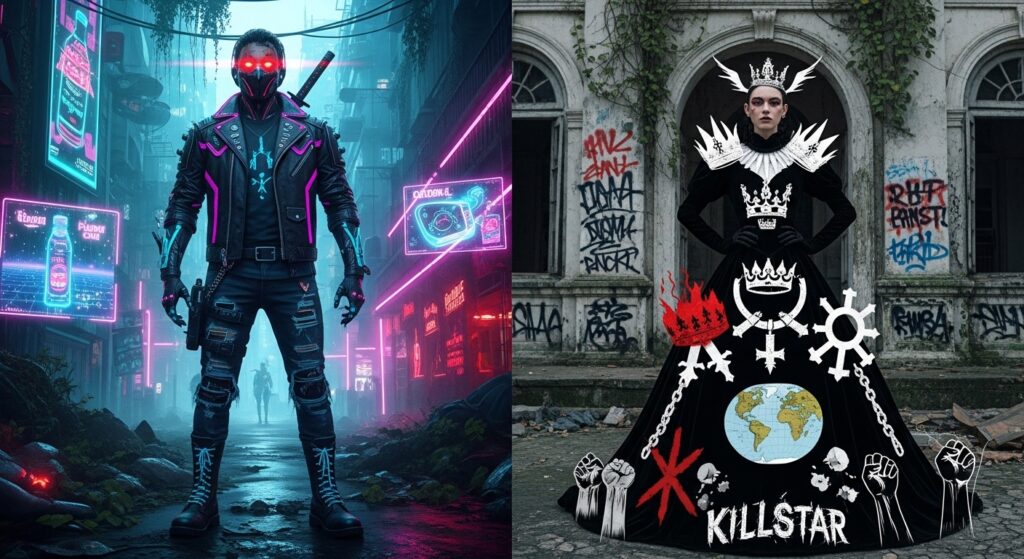
The ecological dimensions of the blood dragon motif carry particular urgency in the context of contemporary climate crisis and its disproportionate impact on postcolonial territories. The game’s presentation of nuclear-mutated creatures roaming a poisoned landscape reflects the real-world legacy of American nuclear testing in the Marshall Islands, French testing in Algeria and Polynesia, and British testing in Australia, where indigenous populations bore the environmental and health costs of superpower competition. Killstar’s aesthetic appropriation of these mutated forms, transforming them into desirable fashion symbols, exemplifies the commodification of environmental racism that characterizes late capitalist consumer culture. The blood dragon becomes cute, collectible, wearable, its origins in colonial violence forgotten in the pleasure of aesthetic consumption. This forgetting is not accidental but structural, enabled by the temporal distance of retrofuturism and the spatial distance of global supply chains that separate consumers from the material conditions of production. The postcolonial critique must attend to these material connections, recognizing how aesthetic appreciation of imperial imagery participates in the ongoing exploitation of the territories and populations that inspired it.
The sonic dimensions of Blood Dragon and their absence in Killstar’s visual commodification reveal the importance of multimedia context in the circulation of colonial imaginaries. The game’s synthesizer soundtrack, composed by Australian musician Power Glove, creates an immersive auditory environment that references 1980s film scoring while establishing emotional distance through its exaggerated retro styling. This music enables the player’s ironic engagement with the game’s violent content, providing affective cues that signal satirical intent without requiring explicit critical statement. Killstar’s purely visual appropriation loses this sonic framing, presenting static images that reference Blood Dragon aesthetic without its temporal or tonal context. The blood dragon on a t-shirt or hoodie cannot wink at the viewer, cannot exaggerate its own absurdity through musical commentary, and thus functions more directly as celebration than critique. This transformation illustrates the vulnerability of satirical media to appropriation that strips away contextual markers, leaving only the visual residue of colonial fantasy available for uncritical consumption.
The labor politics of both texts’ production further complicate their postcolonial analysis through the global division of creative and material labor that enables their existence. Blood Dragon was developed by Ubisoft Montreal, a studio located in a former colonial power that continues to benefit from the exploitation of Francophone Africa and the Caribbean, while relying on production facilities and voice acting talent distributed across global markets. Killstar’s clothing is manufactured through supply chains that extend from design offices in the United Kingdom to textile factories in South and Southeast Asia, reproducing the colonial economic relationships that the blood dragon aesthetic references. The postcolonial critic must acknowledge this complicity, recognizing that analysis of representational violence in media texts occurs within material conditions structured by the same colonial logics being critiqued. The blood dragon that appears on a Killstar garment manufactured in Bangladesh carries multiple layers of imperial extraction, from the original nuclear testing that inspired its mutation to the wage labor that produced its material form.
The reception history of Blood Dragon and Killstar’s aesthetic appropriation reveals the limitations of ironic distance as a strategy for negotiating colonial media legacies. Critics and players widely recognized Blood Dragon as satire, praising its exaggerated visuals and stilted dialogue as commentary on 1980s action cinema’s political assumptions. Yet this recognition rarely translated into sustained analysis of how the game reproduced the colonial structures it claimed to mock, with most commentary focusing on surface aesthetic elements rather than underlying ideological functions. Killstar’s customers, for their part, frequently express appreciation for the brand’s “dark” and “unique” aesthetic without reference to its source materials, suggesting successful detachment of visual style from historical context. The blood dragon thus circulates through contemporary culture as free-floating signifier, available for multiple appropriations that need not acknowledge its colonial resonances. This circulation exemplifies the persistence of colonial discourse through what postcolonial theorist Homi Bhabha identifies as mimicry, where the colonizer’s culture is repeated with difference that ultimately reinforces rather than subverts original power relations.
The theological and occult dimensions of Killstar’s aesthetic, which extend beyond Blood Dragon reference to encompass broader gothic and esoteric traditions, introduce additional postcolonial complications through the appropriation of non-Western spiritual practices. The brand’s marketing frequently invokes “mystical” and “otherworldly” imagery drawn from Hindu, Buddhist, and indigenous American traditions, combining these with the retrofuturist elements derived from 1980s cinema. This spiritual bricolage reflects the colonial history of religious appropriation, where indigenous practices were extracted from their contexts and recombined in forms that served imperial interests. The blood dragon, as originally conceived in the game’s narrative, represents a kind of false god or demon requiring extermination by cybernetic Christian soldiers, a theological framing that echoes the colonial demonization of non-Western religions. Killstar’s aesthetic celebration of occult and mystical imagery, while apparently subverting this demonization, risks reproducing it through commodification that treats spiritual traditions as aesthetic resources rather than living practices. The postcolonial critique must navigate between the Scylla of colonial demonization and the Charybdis of neoliberal commodification, seeking forms of engagement that respect the autonomy of non-Western spiritual traditions.
The future of the blood dragon as cultural symbol depends on the development of critical practices capable of recognizing and contesting its colonial resonances while acknowledging its aesthetic power. Far Cry 3: Blood Dragon and Killstar’s appropriation represent two moments in an ongoing process of cultural circulation that transforms imperial violence into consumer pleasure, a process that requires active interruption through postcolonial critique and creative intervention. The blood dragon need not remain merely a vehicle for nostalgia or a resource for fashion; it can become a site of memory and mourning for the environmental and human costs of Cold War imperialism, a reminder of the ongoing struggles of Pacific islanders and Southeast Asian communities against nuclear colonialism. Such transformation requires moving beyond the ironic distance that characterizes current engagement with retrofuturist aesthetics toward genuine solidarity with the populations whose histories these aesthetics reference. The dragon’s blood, spilled across neon landscapes and printed on synthetic fabrics, demands recognition as material connection to material violence, not merely as style or as joke. Only through this recognition can the postcolonial potential of these texts be realized, transforming imperial nostalgia into critical memory and aesthetic consumption into political consciousness.