Far Cry 3: Blood Dragon: The Perfect Game Time Experience for Modern Players

How Ubisoft’s Cult Classic Delivers Maximum Impact in Minimum Hours
In an era where games increasingly demand endless commitment, Far Cry 3: Blood Dragon stands as a refreshing testament to concentrated excellence. This standalone expansion’s carefully calibrated game time—approximately 6 to 8 hours for main campaign completion—represents a masterclass in respectful player scheduling, proving that memorable experiences need not consume weeks of dedicated attention.
As gaming demographics evolve and adult players balance entertainment against professional responsibilities, Blood Dragon’s efficient design philosophy feels more relevant than ever. The title demonstrates how developers can deliver complete, satisfying narratives without padding, repetition, or artificial extension through grind mechanics.
Table of Contents
Understanding the Game Time Breakdown
Blood Dragon’s campaign structure divides elegantly across its runtime, creating natural session boundaries ideal for busy schedules. The main story encompasses seven primary missions, each requiring 45 to 75 minutes depending on player approach and difficulty selection.
Act One: Introduction and Awakening (90-120 minutes)
The opening establishes Sergeant Rex “Power” Colt’s cyber-commando credentials through explosive tutorial sequences. Players acquire foundational weapons, encounter first blood dragons, and understand the expansion’s unique tone. This section refuses to overstay its welcome, rapidly transitioning from setup to genuine player agency.
Act Two: Island Exploration and Power Accumulation (180-240 minutes)
The middle portion offers open-world freedom within contained scope. Players liberate garrisons, hunt collectibles, and upgrade abilities while advancing narrative through optional side missions. This section provides flexibility—completionists can extend significantly through thorough exploration, while story-focused players maintain brisk progress.
Act Three: Climactic Confrontation (90-120 minutes)
The final missions escalate intensity appropriately, culminating in spectacular set-piece encounters that justify accumulated preparation. The conclusion delivers emotional payoff and mechanical satisfaction without the bloated finales plaguing contemporary releases.
This structure respects player time through transparent pacing. Blood Dragon never pretends to be longer than it is, never inserts filler content to justify price point, and never demands engagement beyond its natural conclusion.
The 6-Hour Sweet Spot: Why Shorter Can Be Better
Industry analysis increasingly recognizes that game time and player satisfaction share complex rather than linear relationship. Blood Dragon’s concentrated 6-8 hour experience often generates higher completion rates and more enthusiastic recommendations than 40-hour competitors.
Psychological research supports this phenomenon. Peak-end theory suggests experiences are judged by their most intense moments and conclusion rather than cumulative duration. Blood Dragon’s density ensures consistent high points and memorable finale, creating positive overall impression despite modest total hours.
Adult players with limited leisure time particularly appreciate this efficiency. Completing Blood Dragon across two weekend evenings delivers genuine sense of accomplishment unavailable from titles requiring month-long commitments that often end in abandonment. The satisfaction of finishing—seeing credits roll, understanding complete narrative—provides psychological reward that fragmented partial progress cannot replicate.
Streaming and content creation economies similarly benefit from Blood Dragon’s duration. Creators can produce complete playthrough series within manageable production schedules, while viewers appreciate narrative resolution without indefinite subscription demands. The game time enables satisfying content arcs rather than endless episodic grinding.
Replayability: Extending Value Without Extending Hours
Blood Dragon’s modest initial game time conceals substantial replay value through design choices that encourage rather than mandate return visits. New Game Plus, included in contemporary releases, allows completed campaigns to restart with retained equipment against heightened challenge—essentially doubling content value for engaged players.
Difficulty escalation transforms familiar encounters into fresh tactical puzzles. Enemies hit harder, move faster, and demonstrate more aggressive AI, requiring genuine adaptation rather than simple repetition. Blood dragons become genuinely terrifying threats rather than manageable obstacles, fundamentally altering exploration dynamics.
Achievement and trophy hunting provides structured motivation for alternative approaches. Speedrun optimization, stealth-only completion, and collectible thoroughness offer distinct playstyle challenges within identical narrative framework. These self-directed extensions respect player autonomy rather than demanding compliance.
The expansion’s brevity actually enhances replay appeal. Committing 6 hours to revisit Blood Dragon feels reasonable annually; committing 60 hours to replay bloated contemporaries feels impossible. Many players report returning to Blood Dragon more frequently than longer games in their libraries, generating superior cost-per-enjoyment-hour despite lower initial price.
Comparison: Blood Dragon vs. Contemporary Game Time Standards
The gaming industry’s game time expectations have shifted dramatically since Blood Dragon’s 2013 release. Contemporary AAA releases frequently demand 30-50 hour minimum commitments, with service games extending indefinitely through seasonal content and battle pass progression.
This expansion represents deliberate alternative philosophy. While Far Cry 3 proper offered 15-20 hour campaigns with extensive side content, Blood Dragon’s team consciously rejected scope expansion. Creative Director Dean Evans famously prioritized “all killer, no filler” design, cutting content that didn’t meet quality thresholds regardless of schedule implications.
The comparison reveals industry tension between value perception and actual satisfaction. Publishers fear players rejecting shorter experiences as poor value, despite evidence that completion rates and recommendation enthusiasm favor concentrated quality. Blood Dragon’s enduring cult status—sustained a decade post-release—demonstrates that player memory favors impact over duration.
Independent developers increasingly reference Blood Dragon as permission model. The success proves that modest scope, appropriately priced, can achieve commercial and critical success without competing against bloated competitors. This influence appears throughout contemporary indie landscape where 4-12 hour experiences dominate critical favorites lists.
The Game Pass Implication: Subscription Model Compatibility
Blood Dragon’s game time characteristics make it exceptionally suited for subscription services like Xbox Game Pass. Players sampling multiple titles monthly benefit from experiences that conclude satisfactorily without demanding exclusive attention.
Subscription economics particularly favor Blood Dragon’s approach. Service providers want players discovering new favorites regularly rather than permanently occupying single title. Blood Dragon’s efficiency enables positive discovery experiences—players finish, remember fondly, and seek similar recommendations—advancing platform goals.
The game time also suits contemporary consumption patterns. Mobile and portable gaming sessions increasingly fragment attention across multiple titles. Blood Dragon accommodates this through discrete mission structures completable within single sittings, unlike narrative games requiring extended immersion for comprehension.
Cloud gaming implementation enhances these advantages. Players can initiate Blood Dragon sessions during brief availability windows without lengthy downloads or update installations. The modest total size—approximately 3GB—enables near-instantaneous access compared to 100GB+ contemporary releases.
Session Design: The Micro-Structure of Game Time
Beyond total duration, Blood Dragon excels in individual session architecture. Each mission functions as self-contained narrative and mechanical unit, providing satisfaction even when players cannot continue immediately.
Checkpoint placement demonstrates particular intelligence. Blood Dragon never extends sequences beyond 10-15 minutes without save opportunity, respecting real-world interruption possibility. Players can engage during uncertain availability without progress loss anxiety.
The open world structure enables natural stopping points. Garrison liberation—Blood Dragon’s primary side activity—requires 10-20 minutes depending on approach, creating perfect session boundaries. Players complete one objective, evaluate available time, and decide continuation organically.
Even the legendary blood dragon encounters respect scheduling. These massive creature confrontations, while spectacular, resolve within manageable durations rather than extending into multi-phase endurance tests. The excitement concentrates rather than dilutes through repetition.
Player Testimonials: Time Well Spent
Community response consistently emphasizes appreciation for Blood Dragon’s respectful game time. Forum discussions and social media commentary reveal patterns in player satisfaction that contradict industry assumptions about duration requirements.
“I finished it in two sittings and loved every minute,” represents typical player report. “No padding, no fetch quests, just pure fun.” This enthusiasm contrasts with common complaints about contemporary releases: “beautiful but empty,” “could lose ten hours easily,” “stopped caring before the end.”
Professional reviewers with limited availability particularly praise the efficiency. Games journalists facing constant release pressure appreciate experiences that respect their scheduling constraints without sacrificing quality. Blood Dragon frequently appears in “games you can actually finish” recommendation lists targeting busy adults.
Parent gamers report particular gratitude. The predictable duration enables planning around family responsibilities, with completion possible during children’s single sleepover absence. The satisfaction of genuine finish—rare in hobby dominated by perpetual engagement—provides psychological restoration that incomplete longer experiences cannot.
The Development Perspective: Intentional Efficiency
Blood Dragon’s game time resulted from deliberate production decisions rather than resource limitations. The development team, while smaller than mainline Far Cry production, possessed capability for scope expansion. They consciously rejected this path.
Post-release interviews reveal philosophical commitment to density over sprawl. Every mission received individual attention ensuring distinct identity and memorable moments. The team accepted that this thoroughness limited total mission count, prioritizing player memory quality over quantity metrics.
This approach required publisher trust unusual in AAA environment. Ubisoft’s support for concentrated experience—priced appropriately below full retail—demonstrated confidence that quality would generate sustainable returns through reputation and recommendation.
The decision proved correct. Blood Dragon achieved profitability quickly through modest sales volume and minimal production costs. Long-tail digital sales, sustained by persistent positive word-of-mouth, generated returns exceeding many higher-budget contemporaries that faded from discussion after launch marketing concluded.
Future Implications: The Blood Dragon Model
As industry grapples with player burnout and completion rate decline, Blood Dragon’s example offers proven alternative. The template—focused scope, appropriate pricing, concentrated quality—applies across genres and scales.
Ubisoft itself has referenced Blood Dragon when discussing project greenlighting. The success validates experimental, smaller-scope productions alongside blockbuster franchises. Subsequent releases including Far Cry Primal and Assassin’s Creed Rogue demonstrate application of these lessons, though none matched Blood Dragon’s perfect efficiency.
Independent developers particularly embrace the model. The permission to create 6-hour experiences without apology, knowing audience exists for concentrated excellence, liberates creative decision-making from artificial extension requirements. Critical and commercial success of recent short-form titles confirms market viability.
Subscription services increasingly curate specifically for game time diversity. Blood Dragon’s inclusion alongside 100-hour RPGs and infinite service games demonstrates platform recognition that player needs vary across contexts and availability. The efficiency becomes feature rather than limitation.
Conclusion: The Value of Your Time
Far Cry 3: Blood Dragon’s enduring relevance stems partly from game time philosophy increasingly rare in contemporary gaming. Its 6-8 hour commitment delivers complete, satisfying experience without the abandonment, fatigue, or guilt accompanying longer unfinished titles.
For players discovering Blood Dragon through modern platforms, this efficiency represents revelation. The game respects their time absolutely—every minute contributes to narrative momentum, mechanical mastery, or atmospheric immersion. No padding, no repetition, no artificial extension.
Sergeant Rex “Power” Colt’s adventure proves that gaming memories depend on impact rather than duration. Players remember the blood dragon encounters, the one-liners, the synthwave soundtrack—not the hours invested but the moments experienced.
In a world of infinite content competing for finite attention, Blood Dragon’s concentrated excellence feels like gift. It offers permission to complete, to appreciate, and to move on satisfied. That completion—rare and precious—makes the game time invested feel genuinely worthwhile.
The dragon’s blood flows briefly but brilliantly. And in that brief brilliance, it delivers everything gaming promises.
Far Cry 3: Blood Dragon delivers a perfectly paced gameplay experience, packing 6–8 hours of intense neon-drenched action, retro-futuristic combat, synthwave-infused music, and highly memorable gameplay without any unnecessary filler or repetition.
Far Cry 3: Blood Dragon – The Perfect Game Time Experience for Modern Players (Explained)
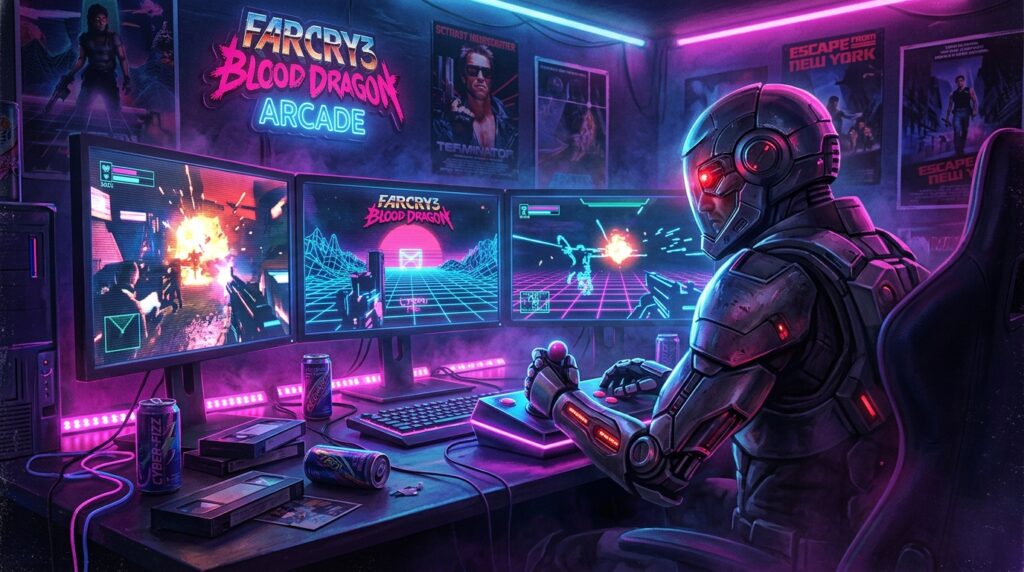
Far Cry 3: Blood Dragon is a standalone spin-off of the Far Cry series developed by Ubisoft. Unlike the main series, which focuses on realism and survival, this game embraces a retro-futuristic style inspired by 1980s sci-fi action films. It features neon visuals, exaggerated storytelling, and fast-paced combat that prioritizes fun over realism.
What Makes It a “Perfect Game Time Experience”?
The phrase “perfect game time experience” refers to a game that is ideal for short, enjoyable play sessions without requiring long-term commitment or complex preparation.
1. Fast and Immediate Action
The game drops players into action quickly without long tutorials or slow introductions. Players can immediately:
- Engage in combat
- Use futuristic weapons
- Complete short missions
This makes it suitable for quick gaming breaks.
2. Short Mission Structure
Missions are designed to be completed in a relatively short time. This allows players to:
- Play in short sessions
- Stop and continue easily
- Avoid long grinding or repetitive tasks
3. Simple Gameplay Design
Unlike complex open-world RPGs, Blood Dragon keeps mechanics straightforward:
- Easy-to-learn combat
- Simple objectives
- Light progression systems
This simplicity reduces learning time and increases immediate enjoyment.
4. Retro Sci-Fi Style
The game uses a strong 1980s aesthetic:
- Neon-colored environments
- Synth-style soundtrack
- Over-the-top dialogue and humor
This nostalgic design makes the experience unique and entertaining even in short sessions.
Modern gamers often do not have long uninterrupted time to play games. That is why games like Far Cry 3: Blood Dragon fit perfectly into today’s lifestyle.
First, the game does not force players to stay in long sessions. You can play for a short period, complete a mission, enjoy a combat sequence, or explore an area, and then stop without feeling like you are missing something important. This makes it flexible for people with busy schedules.
Second, progress in the game can be made in short bursts. Even if you only play for 15–30 minutes, you can still complete objectives, unlock upgrades, or advance the story. The game is designed in a way that every small session feels meaningful.
Finally, it provides instant entertainment. There is no long setup or waiting period. You are quickly placed into action with fast-paced gameplay, strong visuals, and engaging missions. This gives immediate satisfaction without pressure to play for hours.
Session design refers to how a video game organizes its experience into small, manageable play sessions that fit naturally into a player’s available time. In Far Cry 3: Blood Dragon, this micro-structure is carefully crafted to ensure that every gameplay session feels complete, satisfying, and meaningful, even if the player only has 15 to 30 minutes.
Unlike modern open-world games that often require long, uninterrupted playtime, Blood Dragon breaks its gameplay into compact, self-contained segments. Each mission, outpost, or encounter is designed to function as a “mini-experience” with a clear beginning, middle, and end. This allows players to jump in, complete a task, and feel a sense of progression without needing extended commitment.
The game’s mission structure plays a major role in this design. Primary story missions are tightly paced, usually lasting between 10 to 20 minutes, while side activities like liberating enemy bases or hunting collectibles are equally short and focused. This creates a rhythm where action, reward, and progression are constantly balanced.
Checkpoints and autosaves are also strategically placed to support short sessions. Players can pause or stop almost anywhere without losing meaningful progress, making the game highly accessible for busy schedules. This design respects the modern player’s limited time and avoids frustration caused by long, unskippable sequences.
Another key element is mechanical clarity. Each session introduces or reinforces one or two core mechanics—combat, stealth, or exploration—without overwhelming the player. As a result, every session feels purposeful and easy to re-engage after breaks.
Ultimately, Blood Dragon’s session design proves that strong game structure is not about length, but about density. By maximizing impact within short play windows, it delivers a consistently rewarding experience that fits perfectly into modern gaming lifestyles.