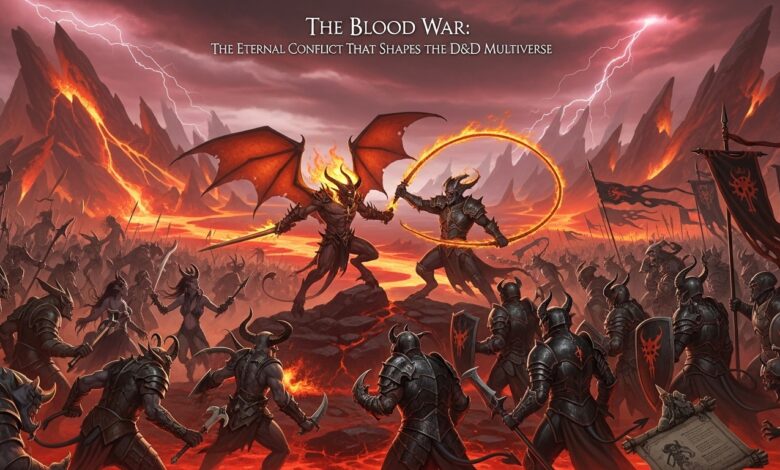
An In-Depth Analysis of the Cosmic Struggle Between Demons and Devils
April 2026 — In the vast, interconnected planes of the Dungeons & Dragons multiverse, few conflicts have shaped reality as profoundly as the Blood War. This aeons-old struggle between the chaotic demons of the Abyss and the lawful devils of the Nine Hells represents more than mere warfare—it is the fundamental clash between entropy and order, a conflict so vast that its cessation would threaten existence itself. As the D&D 2024 Monster Manual brings fresh attention to these fiendish factions, understanding the Blood War has never been more crucial for players and Dungeon Masters alike
.
Origins: How the Blood War Began
The true origins of the Blood War remain shrouded in myth and speculation, fitting for a conflict that predates mortal memory. Most scholars believe it to be a remnant of the primordial war between Law and Chaos, waged by the Wind Dukes of Aaqa against the forces of the Queen of Chaos
. Others suggest the yugoloths—neutral evil fiends who profit from both sides—engineered the war as an experiment in the nature of evil, one they would ultimately end on their own terms
.
One particularly compelling theory involves Asmodeus himself. According to this account, the future Lord of the Nine was once an angel who traveled into the heart of the Abyss and plucked a single shard from the “seed of evil”
. This act of cosmic theft—stealing a piece of the Abyss’s black heart—created an eternal hunger in Asmodeus for the rest, while the Abyss and its demon inhabitants craved the return of the stolen piece
. This mutual desire for completion may have ignited the conflict that has burned across millennia.
The war truly began when exploratory parties of baatezu (devils) and tanar’ri (demons) discovered each other’s home planes and “immediately burst into violent, rabid hatred”
. The yugoloths, seeing opportunity, offered their mercenary services to both sides, betraying employers and escalating the conflict until it engulfed the Lower Planes
.
The Nature of the Conflict: Chaos vs. Law
At its core, the Blood War represents the fundamental philosophical opposition between two forms of evil. As the D&D 2024 Monster Manual clarifies: “Devils are Lawful Evil. They want to wheel and deal for your soul and corrupt any semblance of order that exists. Demons are Chaotic Evil. They want to eat your face and/or just watch the world burn”
.
This distinction shapes every aspect of the conflict:
Demonic Strategy: The tanar’ri rely on overwhelming numbers and individual power. The Abyss is infinite in its layers, each ruled by a demon lord who constantly wars against rivals. When demons attack the Nine Hells, they do so through sheer chaotic force—unorganized, uncoordinated, but terrifyingly numerous
.
Devilish Strategy: The baatezu deploy smaller, regimented forces using ruthless tactics and brilliant generals. Their discipline and hierarchy allow them to punch above their weight, holding the line against demonic hordes through superior strategy rather than numbers
.
The Balance: Despite their vast differences, the two sides remain surprisingly balanced. Whenever one gains advantage, the other exploits weaknesses elsewhere. This violent equilibrium has kept the war burning for countless ages
.
Key Battlegrounds: Where the Blood War Rages
The Blood War spans multiple planes, but several locations have become iconic battlegrounds:
Avernus: The first layer of the Nine Hells serves as the primary defensive line. Here, the archdevil Zariel commands legions of devils against endless demonic incursions. By 1492 DR (the Year of Three Ships Sailing), Zariel was “plucking cities from the world of Toril, using their citizens as fodder against the demonic hordes”
. The Descent into Avernus adventure allows players to experience this frontline hellscape firsthand
.
The Blood Rift: An unusual plane that directly connects the Abyss with the Nine Hells, bringing the fiends closer to their enemies and intensifying the conflict
.
The River Styx: Flowing through both lower planes, the Styx acts like “blood vessels that circulate the conflict throughout the Lower Planes”
. Its waters cause memory loss, making it both a strategic resource and a hazard for combatants.
Asmodeus: The Architect of Eternal Conflict
No discussion of the Blood War is complete without examining Asmodeus, the Lord of the Nine Hells and arguably the most sophisticated villain in D&D lore. Asmodeus’s relationship with the Blood War is complex—he recognizes it as “meaningless” yet understands it serves as a “convenient diversion, keeping his enemies distracted while he carried out his own secret plans”
.
His ultimate goal transcends the war itself: Asmodeus seeks to heal wounds suffered from his ancient fall from grace, regain his full divine power, and instigate Armageddon—a conflict that would end the Great Wheel cosmology
. The Blood War provides the perfect cover for these ambitions, occupying both his devilish rivals and the demon lords who might otherwise threaten his schemes.
The archdevil’s cunning was demonstrated during the Reckoning of Hell, when opposing factions of archdevils sought to overthrow him. Asmodeus orchestrated a betrayal that eliminated his enemies while paradoxically reinstating most of them, ensuring continued division among his vassals and preventing unified opposition to his rule
.
The Armistice That Wasn’t: Asmodeus’s “Victory”
In a shocking development that reshaped the multiverse, Asmodeus achieved divine apotheosis by absorbing the power of Azuth, god of wizards. With this newfound divinity, he “professedly ended the Blood War by pushing the Abyss to the bottom of the Elemental Chaos”
.
For the inhabitants of Realmspace, this appeared as a devilish victory. However, observers across the multiverse recognized it as “no more than an uneasy truce”
. Demons, consumed by infighting, couldn’t muster strength to resume the conflict, while devils focused on strengthening their realms, aware that attacking the Abyss might unify the demon lords against them.
By 1486 DR, the demons had regrouped sufficiently that “many devils feared the war would begin again”
. By 1492 DR, the Blood War was “raging in full force on the battlefield of Avernus”
, demonstrating that no single being—not even a god—could truly end this fundamental conflict.
Player Impact: How the Blood War Shapes Campaigns
The Blood War isn’t merely background lore—it provides rich opportunities for player engagement:
Moral Complexity: Unlike straightforward “good vs. evil” conflicts, the Blood War forces players to choose between two evils. Supporting either side has consequences, while attempting to remain neutral risks becoming collateral damage.
Planar Adventures: The conflict provides natural gateways to planar travel. Players might venture to Avernus to retrieve a soul, negotiate with yugoloth mercenaries, or prevent a demon lord’s apotheosis.
Cosmic Stakes: The war’s potential end represents an existential threat. Should one side achieve true victory, “the multiverse as a whole would have been in great danger”
. This provides epic-level campaign motivation.
Fiendish Intrigue: Devils constantly seek mortal souls through contracts, while demons attempt to possess or corrupt the living. Every interaction with fiends carries the weight of the Blood War.
Recent Developments: The 2024 Monster Manual and Beyond
The D&D 2024 Monster Manual reaffirms the Blood War’s centrality to the game, presenting demons and devils as “setting-agnostic foes” who “are at home anywhere in the Multiverse”
. This design philosophy allows Dungeon Masters to introduce Blood War elements regardless of campaign setting—whether Greyhawk, Dragonlance, Forgotten Realms, or Spelljammer.
The manual emphasizes that “if a Dungeon Master needs an enemy that the players don’t have to think twice about destroying, Fiends are a great way to go”
. Yet it also notes that some creatures “play against type, even in the middle of the endless Blood War,” suggesting opportunities for unexpected alliances or betrayals
.
The Yugoloth Factor: Merchants of War
No analysis of the Blood War is complete without examining the yugoloths, neutral evil fiends who have positioned themselves as the ultimate war profiteers. These creatures “liked to entertain the notion that the War was their own personal experiment into the nature of evil, one which they created and would ultimately end on their own terms”
.
The yugoloths’ mercenary nature makes them simultaneously useful and treacherous. They sell their services to both sides, often betraying employers mid-battle. Their presence ensures the Blood War continues indefinitely, as they have no interest in seeing either side achieve true victory.
Conclusion: The War Without End
The Blood War represents Dungeons & Dragons at its most philosophically sophisticated—a conflict where good and evil take a backseat to law and chaos, where the “villains” are fighting each other, and where the stakes transcend any single world or plane. It is a war that cannot end without threatening reality itself, yet cannot continue without consuming countless souls.
For players, the Blood War offers endless adventure possibilities: fighting on the frontlines of Avernus, outwitting devilish contract lawyers, surviving demonic incursions, or navigating the treacherous politics of the Lower Planes. For Dungeon Masters, it provides the ultimate backdrop for epic storytelling—a cosmic conflict that shapes the multiverse while remaining intimately personal for every soul caught in its path.