From Video Game Character to Animated Legend
In the vast pantheon of heroes that populate the DOTA universe, few names resonate as powerfully as Davion, the Dragon Knight. What began as a playable character in Defense of the Ancients—the iconic mod that spawned an entire genre—has evolved into one of gaming’s most richly developed protagonists, thanks to the Netflix animated series DOTA: Dragon’s Blood. This transformation from simple game avatar to complex, tragic hero represents one of the most successful character developments in video game history, captivating millions of viewers and players alike with a story of sacrifice, identity, and the eternal struggle between humanity and monstrosity.
Davion’s journey from obscurity to legend didn’t happen overnight. For years, he existed primarily as a melee strength hero in DOTA 2, known to players for his straightforward gameplay: breathe fire, stun enemies, transform into a dragon. His backstory, detailed in game lore, spoke of a dragon slayer who had absorbed the blood of a powerful wyrm, gaining the ability to take draconic form. It was compelling enough for a multiplayer game but remained largely unexplored—until Netflix and Valve decided to unlock its full potential.
The Animated Transformation: A Hero Reborn
When DOTA: Dragon’s Blood premiered on Netflix in March 2021, audiences met a fundamentally different Davion than the one they knew from games. This version remained a dragon hunter of renowned skill, but the series immediately established him as something far more complex: a man haunted by his past, driven by duty, and destined for supernatural transformation that would challenge everything he believed about himself.
The series’ opening episodes establish Davion as a professional dragon hunter working for the kingdom of Dragon Hold. Unlike the glory-seeking adventurers of typical fantasy tales, this Davion approaches his dangerous profession with weary professionalism. He understands that dragons aren’t merely monsters to be slaughtered—they’re ancient, intelligent creatures with their own motivations and societies. This nuanced perspective immediately distinguishes him from one-dimensional action heroes.
The inciting incident that drives the series’ plot occurs when Davion encounters Slyrak, an elder dragon of fire and one of the mythical Eldwurms that represent fundamental forces of creation. Rather than a simple battle to the death, this meeting results in a supernatural bonding that merges Slyrak’s essence with Davion’s human form. This possession grants Davion incredible power—the ability to transform into a dragon himself—but at tremendous personal cost.
The Duality of Davion: Man and Monster
What elevates Davion from competent fantasy protagonist to genuinely compelling character is the series’ exploration of his internal struggle. The merging with Slyrak creates a constant tension between Davion’s human consciousness and the dragon’s ancient, alien perspective. He doesn’t simply gain new abilities; he inherits Slyrak’s memories, emotions, and instincts—including the dragon’s burning hatred for the cosmic forces threatening reality itself.
This duality manifests physically and psychologically. When Davion transforms, he risks losing control to Slyrak’s more aggressive nature. The dragon’s voice speaks in his mind, offering power while demanding surrender. Davion must constantly fight to maintain his humanity while accepting that he needs Slyrak’s strength to protect those he loves. It’s a sophisticated treatment of the “hero with a dark side” trope that avoids easy answers or simple resolutions.
The psychological toll becomes increasingly apparent across the series’ three seasons. Davion experiences blackouts during his draconic transformations, waking to destruction he doesn’t remember causing. He struggles to form close relationships, fearing the danger his dual nature presents to others. His professional identity as a dragon hunter becomes ironic and then tragic—he is simultaneously the thing he once hunted and the hunter himself, caught between two worlds that both reject him.
Relationships That Define a Hero
Davion’s character development relies heavily on his relationships with other series protagonists, particularly Princess Mirana of the Dark Moon. Their initial meeting occurs under violent circumstances, with Mirana’s quest to recover the stolen Lotuses of Mene intersecting with Davion’s dragon-hunting activities. What begins as reluctant alliance gradually evolves into mutual respect, trust, and eventually romantic connection.
This relationship proves crucial to Davion’s humanity. Mirana sees him not as a monster or a weapon, but as a man struggling with impossible circumstances. Her faith in his essential goodness provides anchor against Slyrak’s influence. Their bond demonstrates that Davion’s humanity isn’t determined by his physical form but by his choices and connections to others.
Equally important is Davion’s relationship with the Invoker, the millennia-old wizard who serves as both mentor and manipulator throughout the series. The Invoker understands the cosmic stakes of Davion’s situation better than anyone, having orchestrated events across centuries to prepare for the coming conflict. Their interactions crackle with tension—Davion recognizes he’s being used but accepts the guidance because he desperately needs to understand his transformation. Troy Baker’s performance as the Invoker and Yuri Lowenthal’s Davion create verbal sparring matches as thrilling as any physical battle.
Davion’s connection to Fymryn, the mysterious elf who stole the Lotuses, adds further complexity. Their shared status as outsiders—beings caught between worlds and identities—creates unexpected empathy. Where Mirana offers hope and the Invoker offers knowledge, Fymryn offers understanding born of similar struggle.
The Voice of a Hero: Yuri Lowenthal’s Performance
Much of Davion’s animated success stems from Yuri Lowenthal’s exceptional voice performance. A veteran of countless video game and animation roles, Lowenthal brings remarkable range to the character, capturing Davion’s professional competence, dry wit, growing desperation, and ultimate acceptance of his destiny.
The performance shines particularly in moments of transformation. Lowenthal modulates his voice to suggest Slyrak’s presence without resorting to obvious vocal effects—subtle shifts in tone and cadence communicate the dragon’s influence growing or receding. During full draconic transformations, the voice work becomes genuinely chilling, conveying ancient power and alien perspective.
Lowenthal’s chemistry with co-stars elevates every scene. His interactions with Lara Pulver’s Mirana balance combat banter with genuine emotional intimacy. The respect and tension in exchanges with Troy Baker’s Invoker suggest complex history despite limited screen time together. This vocal performance ensures that Davion remains relatable and sympathetic even when his actions become morally questionable.
Visual Design: From Concept to Screen
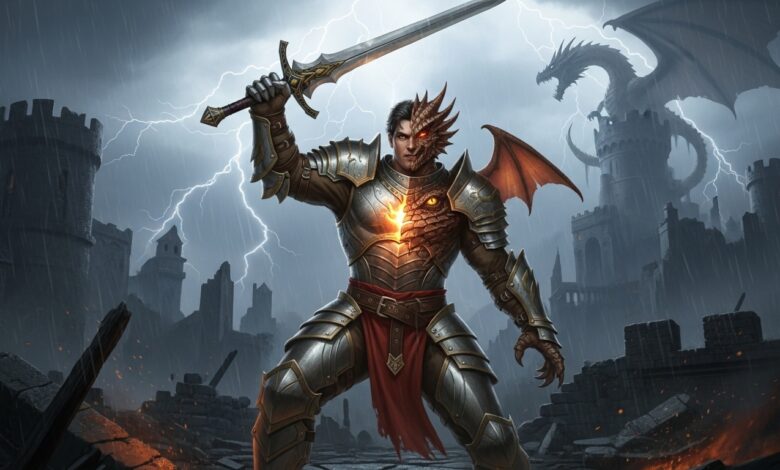
The animated Davion required careful visual design to balance recognizability with narrative needs. His human form appears as a capable warrior in practical armor—distinguished but not ostentatious, reflecting his professional rather than noble status. This grounded appearance makes his draconic transformations more visually striking by contrast.
When Davion transforms, Studio Mir’s animation achieves spectacular results. The transformation sequences emphasize pain and physical restructuring—this isn’t a magical costume change but a violent metamorphosis. The resulting dragon form combines humanoid elements with classic wyrm features, creating a unique silhouette that distinguishes Davion-Slyrak from other dragons in the series.
Animation details reinforce character themes. Davion’s human movements become increasingly dragon-like as Slyrak’s influence grows—subtle changes in posture, eye movement, and breathing patterns that attentive viewers notice before characters do. These visual storytelling choices demonstrate the production’s commitment to character-driven narrative.
Legacy and Impact
Davion’s animated portrayal has fundamentally changed how players and fans perceive the Dragon Knight. Where once he was simply another DOTA hero with straightforward mechanics, he is now recognized as the protagonist of one of gaming’s most ambitious narrative adaptations. This transformation demonstrates the potential for rich storytelling within competitive multiplayer games—potential that Valve and Netflix successfully unlocked.
The character’s popularity extends beyond the animated series. DOTA 2 players who watched Dragon’s Blood report renewed appreciation for the Dragon Knight hero, with cosmetic items referencing the show becoming highly sought after. Fan art, fiction, and discussion communities continue exploring Davion’s story years after the series concluded, testament to the character’s lasting impact.
For the broader gaming industry, Davion represents a blueprint for successful character adaptation. The approach—respecting source material while adding psychological depth and emotional complexity—provides a model for future game-to-screen transitions. His success helped establish that video game protagonists could support sophisticated television narratives without sacrificing the elements that made them popular originally.
The Complete Arc: A Hero’s Journey
Across DOTA: Dragon’s Blood‘s three seasons, Davion undergoes a complete hero’s journey that satisfies narratively while leaving room for future exploration. He begins as a skilled but unremarkable professional, gains tremendous power through unwanted transformation, struggles against corruption and control, finds strength in human connection, and ultimately accepts his unique nature as asset rather than curse.
The series finale provides resolution while acknowledging ongoing challenges. Davion doesn’t simply defeat his inner dragon or reject his human side—he integrates both aspects into a unified identity. This synthesis represents genuine character growth, transforming him from man fighting monster into something new: a dragon knight in truth as well as title.
This arc resonates because it mirrors universal experiences of identity formation and self-acceptance. Davion’s struggle to reconcile seemingly incompatible aspects of himself speaks to anyone who has felt torn between different roles, expectations, or natures. The fantasy wrapping makes the message palatable; the emotional truth makes it memorable.
Conclusion: The Dragon Knight Eternal
Davion stands as proof that video game characters can achieve the same narrative depth as protagonists of literature and film. Through careful writing, exceptional voice performance, stunning animation, and genuine creative vision, the Dragon Knight transcended his origins to become something greater—a symbol of struggle, sacrifice, and the possibility of finding humanity even in monstrous form.
Whether experienced through DOTA 2’s competitive matches or Dragon’s Blood’s emotional narrative, Davion offers something rare: a hero who earns every ounce of his legend. His story reminds us that the greatest battles often occur within, that strength comes from acceptance rather than denial, and that even dragon fire cannot consume a determined human spirit.