Trial of the Blood Dragon: A Postcolonial Reading of Ubisoft’s B-Movie Satire
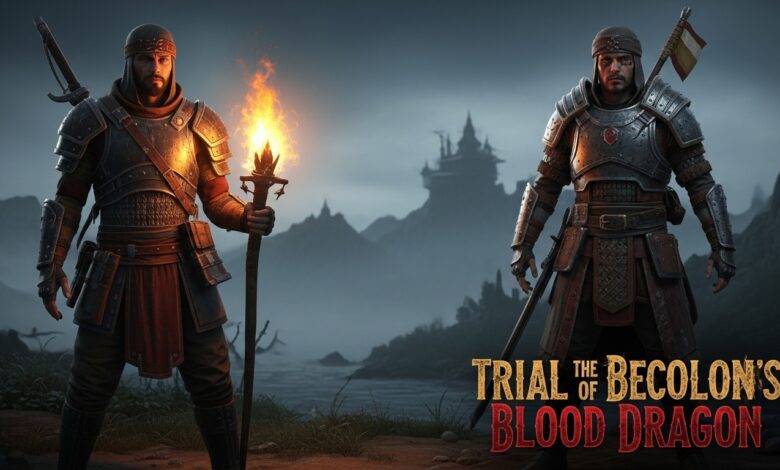
Ubisoft’s Trials of the Blood Dragon (2016) stands as one of the most peculiar entries in the publisher’s catalog, a bizarre fusion of RedLynx’s motorcycle platforming mechanics with the neon-soaked aesthetic of 1980s action cinema and the over-the-top mythology of the Far Cry universe. While critics and players alike struggled to categorize this unexpected hybrid, the game offers fertile ground for postcolonial analysis through its appropriation of Asian martial arts tropes, its depiction of Cold War geopolitics, and its satirical engagement with American imperial nostalgia. This article examines how Trials of the Blood Dragon deploys the figure of the blood dragon—a creature that serves as both literal monster and metaphor for the violence of superpower conflict—to interrogate the cultural legacies of colonialism, the commodification of the oriental other, and the persistence of hegemonic masculinity in popular media.
The game’s narrative premise immediately establishes its postcolonial coordinates through its deliberate invocation of 1980s American action cinema, a genre deeply implicated in the cultural reproduction of Cold War imperial ideology. Players assume control of Rex Power Colt, a cybernetically enhanced Vietnam veteran voiced by Michael Biehn, whose very name evokes the hypermasculine archetypes that populated films like Commando, Rambo, and American Ninja. The choice to center a Vietnam veteran as protagonist is particularly significant given the war’s status as the defining trauma of American imperial overreach in Southeast Asia. By 2016, the Vietnam War had long been processed through popular culture into a narrative of American victimhood and military redemption, obscuring the war’s origins in French colonialism and its devastating impact on Vietnamese civilians. Trials of the Blood Dragon both reproduces and satirizes this cultural amnesia, presenting Rex’s cybernetic enhancement and continued military service as natural extensions of American martial identity while simultaneously exaggerating this identity to the point of absurdity.
The blood dragons themselves, imported directly from Far Cry 3: Blood Dragon, function as complex postcolonial symbols that merge orientalist fantasy with ecological anxiety. These creatures, massive reptilian beasts that shoot laser beams from their eyes, represent the monstrous other that emerges from the intersection of nuclear testing and tropical wilderness. Their presence on an unnamed Southeast Asian island evokes the real-world history of American nuclear testing in the Pacific, which displaced indigenous populations and transformed pristine environments into radioactive wastelands. The game’s presentation of blood dragons as both threats to be eliminated and resources to be harvested—players can lure them to attack enemy installations and collect their blood for upgrades—mirrors the colonial logic of extraction that characterized European and American engagement with Asian and Pacific territories. The dragons are simultaneously dangerous and valuable, exotic and commodifiable, demanding containment while offering power to those bold enough to harness their essence.
The setting of Trials of the Blood Dragon, a futuristic 2019 imagined from a 1980s perspective, creates a temporal dislocation that serves postcolonial analytical purposes. This retrofuturistic aesthetic, with its VHS distortion effects and synthwave soundtrack, does not merely indulge nostalgia but actively interrogates how the future was imagined during the height of American military intervention in Asia. The game’s Vietnam, presented as still contested territory decades after the actual war’s conclusion, reveals the persistence of imperial fantasy in American popular culture—the inability to accept defeat, the compulsive return to the scene of trauma, the reimagining of colonial war as endless adventure. The cybernetic enhancement of Rex Power Colt literalizes the postcolonial concept of the cyborg soldier, where technological augmentation serves to extend American military capacity while simultaneously erasing the human costs of imperial violence. Rex’s mechanical upgrades render him simultaneously superhuman and posthuman, a weapon that happens to retain human consciousness.
The game’s treatment of Asian characters and cultures, while ostensibly satirical, reproduces many of the orientalist tropes it claims to mock. The presence of ninja enemies, martial arts masters, and mystical Asian wisdom throughout the campaign reflects the long history of Western appropriation and simplification of Asian cultural traditions. These elements are presented with ironic distance—players are meant to recognize the absurdity of white American protagonists mastering ancient Asian fighting techniques overnight—yet the irony does not prevent the reproduction of the underlying power dynamics. The Asian characters in Trials of the Blood Dragon remain largely voiceless, functioning as obstacles, mentors, or background texture for Rex Power Colt’s heroic journey. This representational violence, even when framed as parody, contributes to the ongoing erasure of Asian subjectivity in Western media, reducing complex cultural traditions to aesthetic resources for American narrative consumption.
The motorcycle trial mechanics, inherited from the broader Trials franchise, introduce a peculiar dimension to the game’s postcolonial analysis through their emphasis on balance, momentum, and repeated failure. Players must navigate increasingly complex obstacle courses, crashing dozens or hundreds of times before achieving the perfect run that allows progression. This iterative process of failure and mastery mirrors the pedagogical violence of colonial education, where indigenous subjects were required to repeatedly demonstrate competence in foreign systems before being granted limited recognition. The physics-based difficulty of the motorcycle sequences, which demand precise control over a vehicle that often seems to have its own will, evokes the experience of operating within colonial institutions that were never designed for non-Western participation. Rex Power Colt’s cybernetic enhancements, which grant him enhanced control and resilience, thus represent the fantasy of mastery over these hostile systems—the dream of the exceptional native or the perfectly assimilated subject who can navigate colonial structures without crashing.
The game’s villain, Colonel Iza, a rogue Russian cyborg commander seeking to unleash nuclear devastation, completes the Cold War geopolitical framing that structures Trials of the Blood Dragon‘s narrative. This choice of antagonist reproduces the binary logic of superpower conflict that dominated twentieth-century international relations, obscuring the agency of non-aligned and postcolonial nations in favor of a world-historical struggle between American and Soviet imperialisms. The Southeast Asian setting becomes merely the stage for this great power competition, its inhabitants reduced to collateral damage in a conflict not of their making. This narrative structure reflects what postcolonial theorists have identified as the continued subordination of the global South to Northern powers, where local histories and struggles are absorbed into frameworks determined by former colonial metropoles. Even in satire, Trials of the Blood Dragon cannot imagine a Southeast Asian protagonist or a narrative centered on Southeast Asian concerns, instead returning compulsively to American military heroism.
The commodification of 1980s nostalgia that drives Trials of the Blood Dragon‘s aesthetic choices carries its own postcolonial implications. The 1980s, remembered in American popular culture as a decade of triumph and excess, was also the period of intensified neoliberal globalization that saw the acceleration of capital extraction from postcolonial territories and the imposition of structural adjustment programs that devastated developing economies. The game’s celebration of this era’s action cinema, with its muscular white heroes dispatching waves of non-white enemies, thus connects to broader patterns of cultural imperialism whereby American media products dominate global markets and normalize American perspectives as universal. The blood dragon, as commodity and collectible, literalizes this extractive relationship—players consume the game, which itself consumes the cultural production of a decade defined by imperial resurgence, creating nested levels of appropriation that extend from the fictional to the economic.
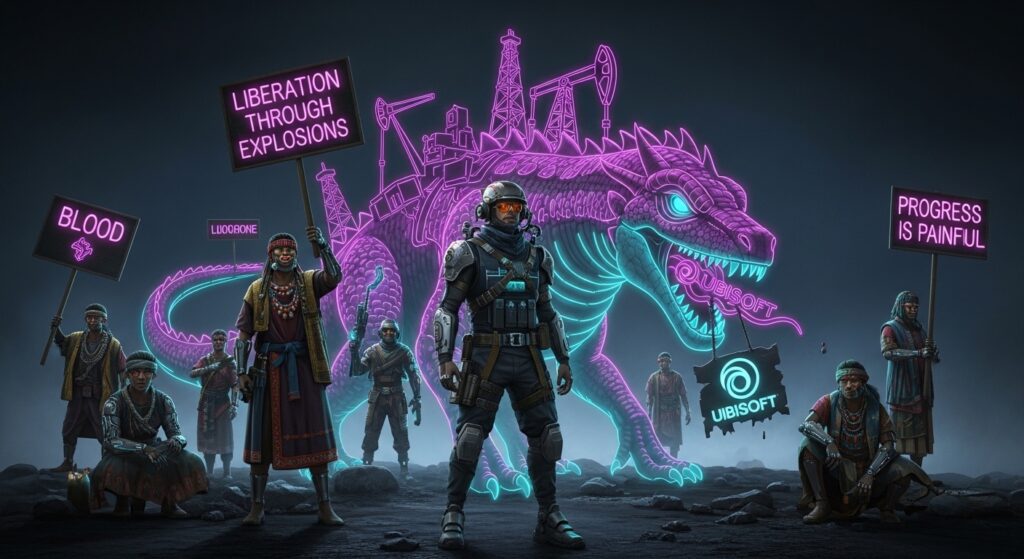
The gender politics of Trials of the Blood Dragon, while seemingly peripheral to postcolonial concerns, actually reinforce the colonial dimensions of its narrative. Rex Power Colt’s hypermasculinity, presented as both ridiculous and aspirational, connects to the historical role of colonialism in producing and policing gender categories. The muscular white male body, displayed in action cinema and reproduced in the game’s box art and promotional materials, served as a visual justification for imperial rule—the strong protecting the weak, the civilized dominating the primitive. Rex’s relationship with his female partner, who functions primarily as voice in his ear and motivation for his violence, reproduces the colonial domestic ideology that positioned white women as requiring protection from threatening native masculinities. The absence of substantial female characters, Asian or otherwise, from the game’s narrative further emphasizes the masculine focus of imperial adventure, where women appear only as objects of rescue or prizes for successful conquest.
The reception history of Trials of the Blood Dragon offers a final dimension for postcolonial analysis, as the game’s commercial and critical performance reveals the limitations of satirical intervention in colonial media traditions. Many reviewers found the game’s humor grating, its mechanics frustrating, and its premise incomprehensible, suggesting that the very excess that made the game potentially subversive also rendered it inaccessible to audiences expecting coherent narrative and polished gameplay. This reception mirrors the fate of many postcolonial cultural productions that attempt to work within and against colonial genres, finding themselves rejected by mainstream audiences for failing to satisfy conventional expectations while being dismissed by critics for not being radical enough. The blood dragon, too much and not enough, becomes a figure for the impossible position of postcolonial cultural production in global markets dominated by imperial centers.
The environmental design of Trials of the Blood Dragon, with its neon jungles and radioactive wastelands, visualizes the ecological devastation that accompanies imperial warfare and resource extraction. The game’s Southeast Asian island, transformed by nuclear testing and cybernetic experimentation into a surreal nightmarescape, reflects the real-world environmental racism that sees toxic industries and military installations concentrated in postcolonial territories. The blood dragons themselves, mutated by radiation into creatures of destructive power, embody the unintended consequences of imperial technological application—the monsters that return to haunt the colonizers. Yet the game’s treatment of this environment remains primarily aesthetic, offering visual pleasure in the depiction of devastation rather than genuine engagement with environmental justice. The postcolonial critique of ecological imperialism, which emphasizes the disproportionate impact of climate change and pollution on formerly colonized peoples, finds only partial expression in the game’s spectacular presentation of radioactive wilderness.
The sound design and musical score of Trials of the Blood Dragon, dominated by synthwave compositions that evoke 1980s action cinema, contribute to the game’s temporal and political dislocation. This music, itself a contemporary revival of a past decade’s futurism, creates multiple layers of nostalgia that complicate any straightforward reading of the game’s historical references. The synthwave aesthetic, popular among internet subcultures that often embrace ironic distance from political commitment, enables Trials of the Blood Dragon to engage with serious postcolonial themes while maintaining plausible deniability through its overt satirical framing. The blood dragon’s roar, processed through electronic distortion, becomes indistinguishable from the synthesizer’s wail, suggesting the technological mediation that separates contemporary players from the historical violence the game references. This sonic layering reproduces the experience of postcolonial subjects encountering their own histories through imperial media archives, where the sounds of trauma are transformed into entertainment.
The game’s conclusion, which sees Rex Power Colt defeating Colonel Iza and presumably saving the world, offers no genuine resolution to the postcolonial tensions it has invoked. The blood dragons remain, their blood still available for extraction, the island still occupied by cybernetic soldiers and ninja clans. The Cold War continues in perpetual suspension, the Vietnam War never truly ending, the future forever trapped in the imaginative horizons of the 1980s. This narrative stasis reflects the persistence of colonial structures despite formal decolonization, the way imperial powers maintain influence over former territories through economic, military, and cultural means. Trials of the Blood Dragon cannot imagine a world beyond American military adventure because its genre conventions and commercial imperatives demand the endless reproduction of this adventure. The trial of the blood dragon is never truly completed, only repeated with variations, much like the cycles of intervention and extraction that characterize neocolonial global politics.
Ultimately, Trials of the Blood Dragon presents a case study in the challenges of postcolonial cultural production within mainstream gaming industries. The game’s genuine satirical intelligence, its recognition of the absurdity of 1980s action cinema and its political implications, struggles against the constraints of genre, audience expectation, and commercial viability. The blood dragon, simultaneously monster and resource, threat and opportunity, colonized other and exotic spectacle, embodies the contradictions of representing postcolonial themes through the conventions of imperial entertainment. While the game fails to fully escape these contradictions, its very failure illuminates the depth of colonial embeddedness in popular media and the difficulty of imagining alternatives. The trial continues, the dragon bleeds, and players consume, caught in cycles of repetition that mirror the persistent structures of global power.