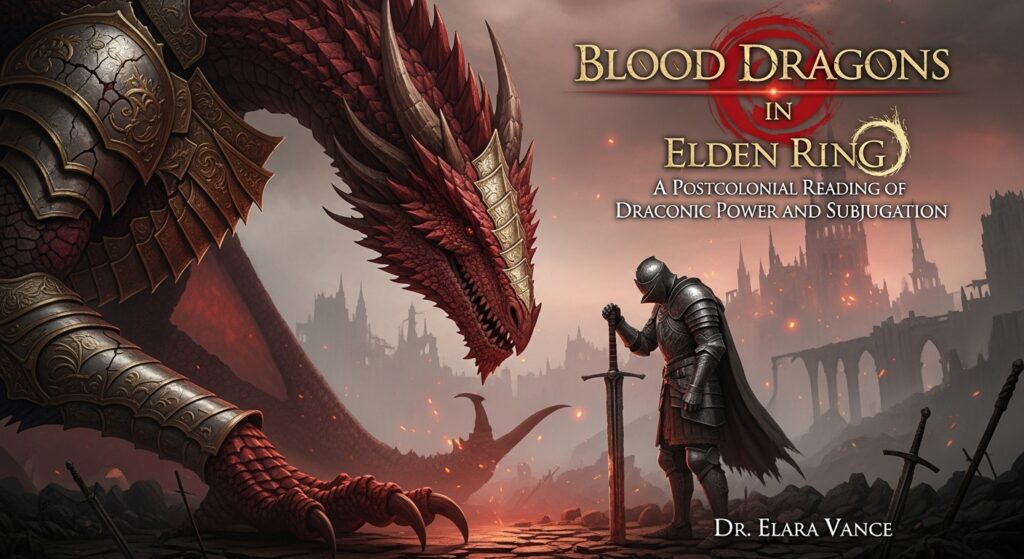
Blood Dragons in Elden Ring: A Postcolonial Reading of Draconic Power and Subjugation
FromSoftware’s Elden Ring (2022) emerges as a landmark achievement in interactive storytelling, weaving together Hidetaka Miyazaki’s signature environmental narrative design with George R.R. Martin’s mythic worldbuilding to create the Lands Between—a realm haunted by fallen empires, shattered hierarchies, and the lingering trauma of colonial domination. Among the game’s most formidable adversaries stand the dragons, ancient beings whose blood carries transformative power and whose presence in the narrative encodes complex postcolonial anxieties about conquest, cultural erasure, and the persistence of subaltern resistance. This article examines how Elden Ring deploys the figure of the blood dragon to interrogate the legacies of imperial violence, the commodification of indigenous power, and the fractured identities produced by colonial encounter.
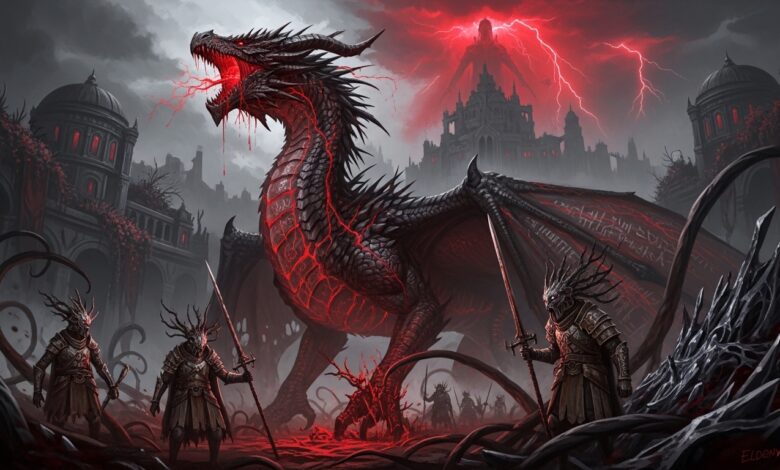
The dragons of the Lands Between occupy a liminal position in the game’s mythohistory, simultaneously representing primordial sovereignty and colonized otherness. Before the establishment of the Golden Order under Queen Marika and the Elden Ring, dragons ruled the skies as undisputed masters of the crucible—the primordial form of matter from which all life emerged. Placidusax, the ancient Dragonlord, sat at the heart of Farum Azula, a floating city suspended outside conventional time, embodying an alternative cosmology that predated and resisted the imposition of the Greater Will’s hegemony. The subsequent war between the dragons and the Golden Order, culminating in the defeat of Gransax and the sacking of Leyndell, represents the foundational colonial violence upon which the game’s present political order rests. This historical trajectory mirrors the experience of indigenous peoples globally, whose pre-colonial sovereignties were systematically dismantled through military conquest and replaced with imported cosmological frameworks that delegitimized native ways of knowing and being.
The concept of dragon communion introduces the central postcolonial problematic of the game: the literal consumption of the colonized other as a pathway to power. The dragon communion churches scattered throughout the Lands Between offer players the opportunity to consume dragon hearts—organs saturated with ancient draconic power—in exchange for incantations that replicate draconic abilities. This mechanic operates as a grotesque allegory for colonial extraction, where the organs, resources, and cultural practices of subjugated peoples are harvested and repurposed to enhance imperial subjects. The visual and narrative framing of this consumption is deliberately unsettling; players must actively seek out dragons, creatures already driven to near-extinction by the crusades of the Golden Order, and extract their still-beating hearts to feed an insatiable hunger for power. The communion’s promise of transformation—of becoming dragon-like through the consumption of dragon flesh—echoes the colonial fantasy of going native while maintaining imperial privilege, a desire to absorb the perceived vitality of the other without surrendering the structural advantages of the colonizer.
The theological dimensions of dragon communion further complicate this postcolonial reading. The practice is explicitly framed as heresy against the Golden Order, a transgressive alternative to the sanctioned worship of the Greater Will that nevertheless operates within the same logic of consumption and domination. The dragon cult that facilitates this communion represents not a genuine return to pre-colonial draconic sovereignty but rather a parasitic attachment to colonial power structures. By consuming dragon hearts, the player does not restore draconic rule but instead appropriates draconic power for personal advancement within the very system that exterminated the dragons. This dynamic reflects what postcolonial theorist Gayatri Spivak identifies as the impossibility of the subaltern speaking—the dragon cult, like subaltern resistance movements co-opted by colonial frameworks, cannot articulate its demands outside the language of the colonizer. The dragons themselves remain largely voiceless in the narrative, their subjectivity accessible only through archaeological traces and the distorted transmissions of their appropriated power.
The figure of Ekzykes, the Decaying Black Blade Dragon, and his counterparts in Caelid embody the environmental devastation wrought by colonial warfare and its lingering toxic legacies. These dragons, corrupted by the scarlet rot unleashed during Malenia’s desperate battle with Radahn, represent the ecological dimension of postcolonial trauma. The rot that consumes their flesh and drives them mad originates in the very conflicts that established Golden Order dominance, yet its effects disproportionately impact the non-human inhabitants of the Lands Between. Caelid itself stands as a monument to the scorched-earth policies of imperial war, a landscape where the toxic aftermath of conquest has rendered habitation impossible and transformed the dragons from sovereign beings into suffering monsters. This environmental postcolonialism connects Elden Ring to contemporary ecological critiques of colonialism, which emphasize how imperial resource extraction and military conflict produce lasting environmental damage that continues to harm indigenous communities long after formal political independence.
The ancient dragon Lansseax and her mortal lover Vyke introduce a crucial complication to the binary of colonizer and colonized that structures much of the game’s dragon lore. Their forbidden relationship, hinted at through archaeological traces and item descriptions, suggests the possibility of genuine hybridity beyond the parasitic consumption of dragon communion. Vyke, the closest contender to become Elden Lord before the player’s arrival, apparently learned ancient dragon incantations through intimate connection with Lansseax rather than through the violent extraction of communion. This alternative pathway to draconic power—based on relationship rather than consumption, on mutual transformation rather than unilateral appropriation—offers a glimpse of what postcolonial theorist Homi Bhabha terms the “third space” of hybrid identity, where colonial binaries break down and new forms of belonging become possible. Yet this possibility remains unrealized in the game’s narrative present; Vyke’s descent into madness and Lansseax’s death suggest that such hybrid intimacies cannot survive within the totalizing structures of Golden Order hegemony.
The player character’s own relationship to draconic power navigates these postcolonial tensions without resolving them. Through the course of the game, the Tarnished may choose to pursue dragon communion, mastering incantations that summon glintstone breath and lightning spears—abilities that mimic the dragons’ elemental dominion. This progression mirrors the colonial subject’s negotiation of imposed identity categories; the player becomes simultaneously more powerful and more complicit, accumulating draconic abilities while participating in the continued erasure of draconic sovereignty. The endgame choices available to the Tarnished—whether to restore the Golden Order, embrace the Frenzied Flame, or pursue the various other conclusions—each represent different responses to colonial legacy, yet none fully escape the structural violence that established the Lands Between’s political order. Even the most radical endings, which promise to dissolve existing hierarchies, rely on the power accumulated through the consumption of dragons and other subjugated beings.
The architectural and environmental design of Farum Azula reinforces these postcolonial themes through its representation of temporal displacement and cultural preservation. The floating city exists outside the normal flow of time, its crumbling structures maintained in a state of eternal decay by the temporal manipulation of the Ancient Dragons. This suspension represents both resistance to colonial temporality—the imposition of linear, progressive history that justifies imperial expansion as civilization’s forward march—and the impossibility of genuine return to pre-colonial conditions. Farum Azula is not a living culture but a mausoleum, its dragons reduced to guardians of their own extinction. The Beastmen who inhabit the city, themselves remnants of an earlier order predating even draconic rule, further complicate any simple narrative of indigenous sovereignty, suggesting that the Lands Between’s history consists of successive waves of colonization and displacement extending back beyond accessible memory.
The theological conflict between the Ancient Dragons’ crucible cosmology and the Golden Order’s erdtree-centered theology encodes a profound postcolonial critique of religious imperialism. The Greater Will’s establishment of the Elden Ring and the Erdtree represents not merely political conquest but ontological colonization—the replacement of one cosmological framework with another that delegitimizes alternative ways of understanding reality. The crucible, with its emphasis on mixture, transformation, and organic becoming, offers a radically different metaphysics from the hierarchical, law-centered order imposed by the Golden Order. That the crucible’s adherents are systematically persecuted as heretics, their practices driven underground or eradicated entirely, reflects the historical experience of indigenous religious traditions under Christian and other imperial missionary projects. The dragons, as the primary surviving representatives of crucible theology, bear the burden of this suppressed knowledge, their bodies literally containing the memory of an alternative world.
The late-game revelation regarding Placidusax’s waiting—his suspended anticipation of the return of his missing god—introduces eschatological dimensions to the postcolonial reading of draconic identity. The Dragonlord’s patience, his willingness to exist in eternal stasis until the restoration of his divine consort, represents a form of resistance through refusal, a rejection of the temporalities imposed by colonial conquest. Yet this resistance is also a form of death, a withdrawal from the world that cedes all political territory to the colonizer. The player’s choice to challenge and defeat Placidusax, accessing the heart of his temporal sanctuary, thus becomes an ambiguous act—liberating the dragon from his endless waiting while simultaneously completing the colonial project of eradicating indigenous sovereignty. The rewards gained from this victory, including the ability to wield Placidusax’s own ruinous power, literalize the postcolonial dynamic whereby the colonizer’s strength derives from the appropriation of colonized resources.
The various dragon-related endings available to the player—particularly the Lord of Frenzied Flame conclusion that promises to melt all distinction and return the world to primordial unity—offer different resolutions to the postcolonial condition that resist simple categorization as progressive or reactionary. The Frenzied Flame’s apocalyptic vision, which echoes the dragons’ own crucible cosmology in its emphasis on undifferentiated becoming, represents a radical rejection of colonial order that nevertheless reproduces colonial violence in its totalizing scope. To burn everything is indeed to eliminate the hierarchies established by the Golden Order, but it is also to destroy the particularity of indigenous cultures, including the dragons’ own ancient traditions. This apocalyptic impulse reflects what postcolonial critics have identified as the danger of romanticizing pre-colonial purity; the return to an undifferentiated past is as violent as the colonial imposition of order, erasing the specific histories and identities forged through struggle against domination.
The blood that flows through Elden Ring‘s dragons—manifested in the crimson hearts of communion, the scarlet rot of corrupted wyrms, and the golden flames of ancient incantations—thus carries multiple significations that converge in a complex postcolonial allegory. This blood represents the life force of indigenous sovereignty, extracted and consumed by imperial powers; the toxic legacy of colonial warfare, continuing to poison landscapes and bodies; the possibility of hybrid transformation, opening toward futures beyond colonial binaries; and the persistence of alternative cosmologies, surviving in fragments and traces despite systematic eradication. The game’s refusal to resolve these tensions into clear moral frameworks—its insistence on the complicity of all pathways to power, including those pursued by the player—reflects the genuine difficulty of postcolonial existence, where ethical action must navigate structures of violence that precede and exceed individual choice.
FromSoftware’s design philosophy, with its emphasis on environmental storytelling and interpretive ambiguity, proves particularly suited to postcolonial themes that resist straightforward narrative resolution. The dragons of the Lands Between do not deliver lectures on imperial injustice; they suffer, they rage, they withdraw, they die, leaving behind only the material traces of their existence and the power that others extract from their bodies. The player, as Tarnished outsider returning to a homeland that never fully belonged to them, occupies a position analogous to the postcolonial subject negotiating layered histories of displacement and domination. In consuming dragon blood, in wielding draconic power, in choosing whether to restore or destroy the existing order, the player enacts the contradictions of postcolonial agency—always already complicit, yet never fully determined, seeking justice within systems that distribute power through violence.
The blood dragons of Elden Ring ultimately demand recognition not as simple symbols or allegorical figures but as participants in a world where power circulates through consumption, where sovereignty is maintained through the extraction of life from subjugated others, and where the possibility of ethical relation remains open but unrealized. Their presence in the game—majestic, damaged, dangerous, and dying—invites players to consider their own position within global systems of exploitation that, like the Golden Order, present themselves as natural, eternal, and necessary while depending on the continued erasure of alternative ways of being. In this sense, Elden Ring achieves what the best fantasy literature has always offered: not escape from political reality, but its intensification, rendered visible through the estranging lens of the impossible.