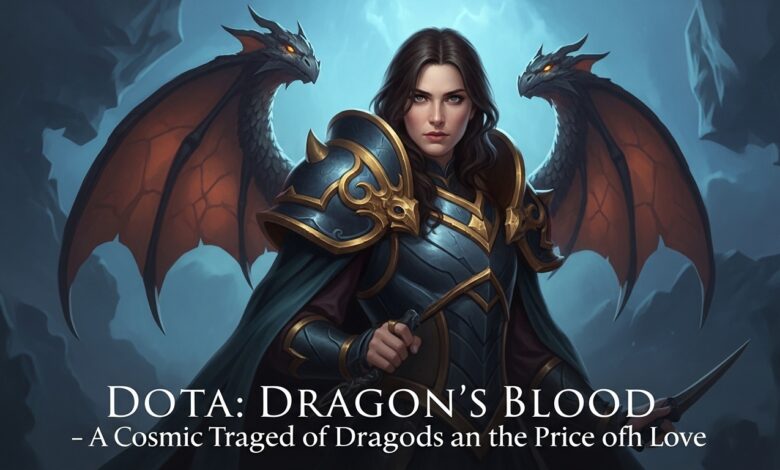
Dota: Dragon’s Blood is a landmark achievement in animated fantasy storytelling, serving as both a thrilling standalone narrative and a surprisingly deep expansion of the existing Dota 2 universe. Developed by Studio Mir in collaboration with Netflix and Valve Corporation, the series first premiered in March 2021 and concluded with its third and final book, “Book 3: The Dire Ancients’ War,” in August 2022. While the average video game adaptation often struggles to balance fan service with accessible storytelling, Dragon’s Blood manages to weave a complex, emotionally resonant epic about identity, sacrifice, and the cyclical nature of violence. The series centers on the conflicted Dragon Knight, Davion, whose life becomes irrevocably intertwined with a powerful Eldwurm and a rebellious princess on the run. Through its eight episodes per book, the show expands from a seemingly straightforward monster-hunting quest into a multiverse-spanning conflict that redefines the very cosmology of the Dota universe. For newcomers, the series offers high-stakes drama and beautiful animation, while longtime fans are rewarded with lore-accurate deep cuts, character origins for heroes like Invoker and Luna, and a fresh interpretation of the ancient war between the Radiant and the Dire.
The protagonist, Davion, is a classic fantasy archetype turned on its head. He is a Dragon Knight of the Dragon’s Blood Order, a man whose entire identity is built on the noble pursuit of slaying dragons, whom he sees as mindless, destructive beasts. His worldview is shattered during a battle with the fearsome Eldwurm Slyrak. In a desperate move to survive, Davion is forced to share his body with the very creature he swore to destroy, becoming a hybrid being capable of transforming into a dragon at will. This physical fusion is a brilliant metaphor for internal conflict; Davion must now grapple with Slyrak’s memories, instincts, and ancient grief. He is no longer just a knight but a walking contradiction, a vessel for the race he has dedicated his life to eradicating. The relationship between Davion and Slyrak evolves from hostile coexistence to a grudging partnership and finally to a poignant understanding that neither can exist without the other. This dynamic is the emotional core of the series, teaching Davion that the world is not divided into simple categories of good and evil, monsters and men. His journey forces him to question the teachings of his order and confront the uncomfortable truth that the dragons, once symbols of pure chaos, were actually guardians of a natural balance that humanity has long since forgotten.
Opposite Davion is Princess Mirana of the Moon, a character who begins as a damsel in distress fleeing a coup but quickly reveals herself to be one of the most complex and proactive figures in the narrative. Mirana is the heir to the throne of the Helio Empire, but her destiny is far grander than any earthly crown. She is chosen by the goddess Selemene, the Goddess of the Moon, a fickle and narcissistic deity who grants magic only to those who worship her unconditionally. Mirana’s arc is one of disillusionment and spiritual awakening. Initially a devout follower, she gradually realizes that Selemene is not a benevolent mother but a tyrant who treats her worshippers as disposable tools. The death of Mirana’s loyal friend and guardian, Marci, serves as a brutal turning point, shattering Mirana’s faith and pushing her to seek a higher, more ancient power. This search leads her to the remnants of the Helio Imperium and the truth about the original sun and moon gods. Mirana’s transformation from a sheltered princess to a hardened, battle-tested warrior-queen is a masterclass in character development. She learns that true leadership does not come from divine appointment but from the willingness to bear the burden of impossible choices. By the final book, Mirana has become the new Empress, not because a god chose her, but because she earned the loyalty of her people through blood, sacrifice, and an unyielding will to end the cycle of divine abuse.
No discussion of Dota: Dragon’s Blood is complete without acknowledging its secret protagonist and de facto antagonist: the Invoker. In the game, the Invoker is known as a powerful but arrogant mage. In the series, he is transformed into a tragic figure of Shakespearean proportions. The Invoker’s true name is revealed to be Filomena’s father, a man who has lived for millennia, mastering every spell in existence to achieve one impossible goal: resurrect his daughter, who died of a mundane illness centuries ago. His magic is not born of devotion to a god like Selemene’s but of pure, unadulterated will and understanding of the universe’s source code. The Invoker has shattered reality, created multiple parallel universes, and orchestrated the rise and fall of empires, all to find a single timeline where Filomena lives. He is the ultimate expression of the show’s central theme: that love, when taken to an extreme, can become a monstrous force of destruction. The Invoker is not evil; he is a broken father who refuses to accept loss. His conflict with the Dragon Knight and Princess Mirana is not a battle of good versus evil but a collision of two valid but incompatible perspectives. Davion fights for a present and future where beings can coexist. The Invoker fights to preserve a past that no longer exists, willing to let the entire universe burn if it means his daughter gets to see another sunrise. His final choice in the series is heartbreakingly logical; he sacrifices his own memories and divinity to restore reality, finally accepting that the Filomena he loved is gone, and that true love means letting go.
The world-building in Dota: Dragon’s Blood is exceptional, seamlessly integrating the game’s mechanics into the narrative’s logic. The Radiant and the Dire, the two ancient stones that corrupt and empower heroes in the game, are reimagined as fundamental cosmic forces locked in an eternal conflict. The series introduces the concept of the “Fundamental Elements” and the “Primordial Mind,” a higher plane of existence where beings like the Invoker and the ancient wizard Kael reside. The dragons, known as Eldwurms, are not mere beasts but aspects of a shattered primordial dragon who created the universe. Each Eldwurm represents a different element: Slyrak is fire, Lirrak is ice, Vahdrak is chaos, and so on. The act of a Dragon Knight merging with an Eldwurm is revealed to be a small-scale replication of a cosmic accident that birthed the universe itself. This deep lore is delivered not through tedious exposition but through visual storytelling and character conflict. The show also gives significant depth to supporting characters from the game. Luna, the Moon Rider, is portrayed not as a simple zealot but as a deeply traumatized soldier whose fanatic loyalty to Selemene is a coping mechanism for past horrors. Terrorblade, the demon marauder, is upgraded from a generic villain to a terrifyingly competent schemer who nearly succeeds in unmaking reality to achieve his own twisted form of liberation. Even smaller roles like Fymryn, an elf from the oppressed race known as the Mene, and Bram, a young knight who idolizes Davion, are given meaningful arcs that reinforce the show’s themes of duty, faith, and belonging.
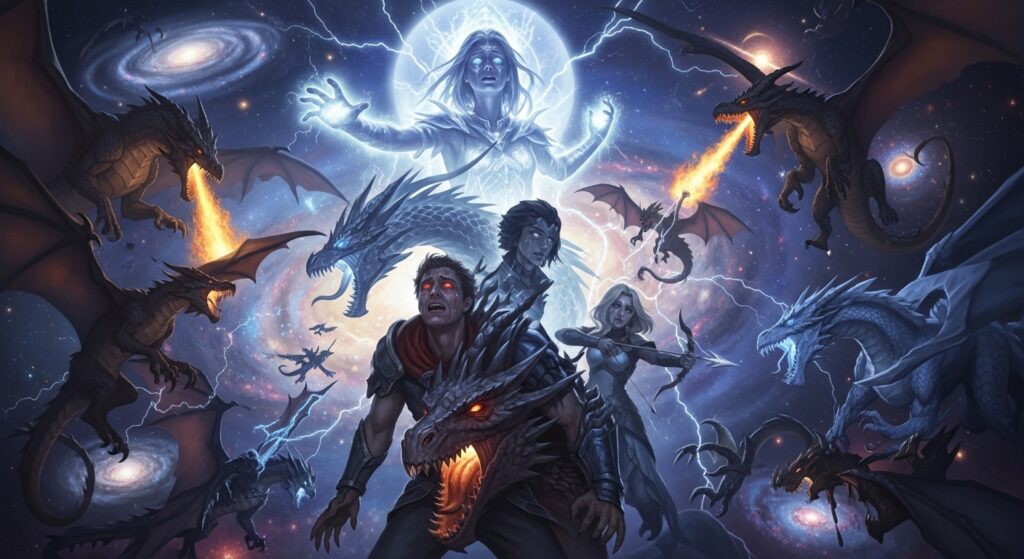
Visually, Studio Mir delivers some of the most fluid and impactful action sequences in modern animation. The studio, known for The Legend of Korra and The Witcher: Nightmare of the Wolf, brings its signature blend of crisp character animation and dynamic camera work to the world of Dota. The dragon designs are suitably monstrous and majestic, each Eldwurm having a unique silhouette and movement style that reflects its elemental nature. Slyrak’s red and black form moves with a heavy, primal fury, while the icy Lirrak glides with an otherworldly, serpentine grace. The magic systems are visualized with distinct visual languages: Selemene’s lunar magic appears as shimmering silver threads, the Invoker’s spells are intricate geometric patterns of light, and the Demon’s corruption manifests as oily, organic black tendrils. The battles are not just spectacle; they are extensions of character. A fight between Davion and the Invoker is not about who punches harder but about clashing philosophies made physical. The final confrontation in the “Dire Ancients’ War” is a visual feast of scale and emotion, where entire landscapes are rewritten and the fate of multiple realities hangs in the balance. Yet, amidst the cosmic explosions, Studio Mir never loses sight of the small, human moments—a tear rolling down Marci’s face, the tremble in the Invoker’s hand as he touches his daughter’s memory, or the quiet understanding between Davion and Slyrak in a moment of shared solitude. These small details elevate the animation from merely competent to genuinely artistic.
The series’ greatest strength, however, is its refusal to provide easy answers. Dota: Dragon’s Blood is a tragedy at its heart. Almost every character’s noble goal leads to unforeseen suffering. Davion’s desire to protect his friends forces him to lose his own humanity. Mirana’s rise to power is paved with the bodies of those she loved. The Invoker’s love for his daughter leads him to commit atrocities across multiple timelines. The show asks difficult questions: Is a world without conflict possible, or is struggle the very engine of existence? Is it better to live a short, free life or an eternal, predetermined one? The final resolution is bittersweet. The Ancients are reunited, breaking the cycle of war, but this peace comes at the cost of rewriting history itself. The world that emerges is one without magic, where dragons are myths, and the heroes are separated, their memories of each other faded like a dream. Davion, stripped of Slyrak, returns to being a simple knight. Mirana rules a peaceful but mundane empire. And the Invoker, his divinity gone, lives a quiet, mortal life as a simple father to a daughter who will never know the universes he destroyed for her. This ending is not happy in the conventional sense, but it is deeply satisfying because it feels earned. The characters pay the ultimate price for peace, and the show has the courage to let them live with the consequences. For fans of epic fantasy, complex character studies, or simply breathtaking animation, Dota: Dragon’s Blood is an essential viewing. It proves that video game adaptations can be more than just marketing material; they can be profound works of art that stand alongside the best of the fantasy genre. It is a story about the dragons we fight without and, more importantly, the dragons we carry within.