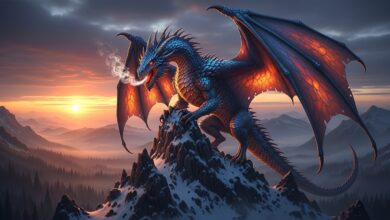
The Pure Blood Dragon: A Study in Primordial Essence and Untamed Majesty
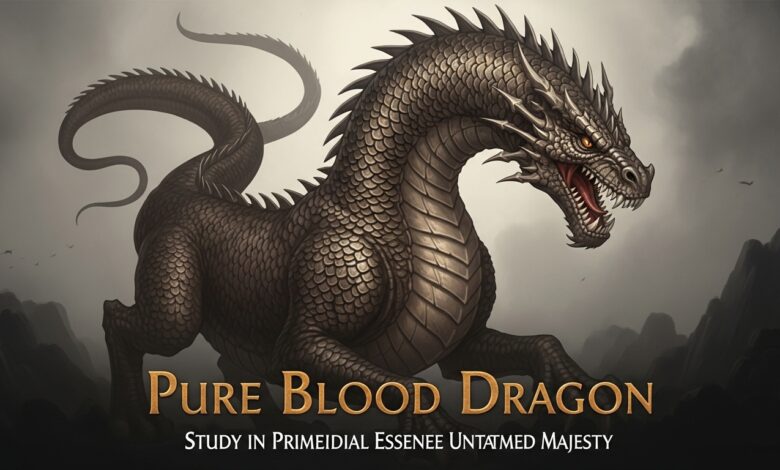
In the vast and varied tapestry of dragon lore that stretches across human mythology, fantasy literature, and modern cinematic universes, few concepts are as potent, as misunderstood, or as fiercely compelling as that of the Pure Blood Dragon. This is not merely a creature of scale and flame, a variant of a common species, or a title won through conquest. The Pure Blood Dragon is an ontological statement, a living testament to the unbroken chain of creation itself. To speak of a Pure Blood Dragon is to speak of the beginning of things, of a lineage untainted by the passage of ages, and of a power that owes nothing to evolution, adaptation, or the meddling hands of lesser gods. It is the dragon in its most essential, unalloyed, and terrifying form.
The very term “pure blood” carries a weight of implication that transcends mere genetics. In the world of dragons, blood is not a simple biological fluid; it is the carrier of memory, the vessel of ancestral magic, and the living map of a creature’s connection to the primordial forces that birthed the world. A Pure Blood Dragon is one whose lineage traces back, without deviation or dilution, to the First Flight. These were the proto-dragons, the great wyrms who were not born but who coalesced from the raw chaos of a newly solidified planet. They were the children of the world’s molten heart and the cold void of space, given form by the first thunderclap and the first volcanic eruption. Their blood was not red but a liquid star-stuff, a glowing ichor that held the blueprint of draconic perfection.
Over countless eons, lesser dragons emerged. Their blood thinned as they adapted to specific environments, mated with magical beasts, or were altered by the whims of capricious deities. The forest drake, with its feathered wings and venomous bite, carries a distant echo of the pure blood, but its essence is muddled by the green magic of the woods. The sea serpent, vast and terrible, has traded the fire of the core for the cold pressure of the abyss, its blood now salty and thick like brine. The wyvern, often mistaken for a true dragon, is a tragic creature of diluted heritage, a distant cousin whose blood carries only the faintest whisper of its glorious ancestors. These are the common dragons of legend, powerful in their own right, but they are to the Pure Blood Dragon what a candle is to a captive sun.
To encounter a Pure Blood Dragon is to witness a violation of natural law as understood by mortal minds. It does not simply exist within the world; the world exists in relation to it. Its arrival is preceded by a shift in the fundamental frequencies of reality. The air becomes heavy, not with the weight of a storm, but with the weight of a forgotten era. Time seems to stutter, as if the present moment is reluctantly making way for the return of something far older and more real. The dragon’s hide is not scaled in the way a lizard is scaled. Instead, it is a hide of crystallized magic, each scale a facet of a gem that reflects not light, but the history of the place it looks upon. A Pure Blood Dragon’s eye, slit-pupiled and burning with the light of a quasar, sees not just the physical form of a knight or a king, but the entire chain of their ancestry, the deeds of their bloodline, and the faint, dying spark of the primordial fire that all living things inherit.
The power of such a being defies the standard categorizations of magical ability. It does not cast spells, for spells are formulae, and formulae are for those who have forgotten what magic truly is. A Pure Blood Dragon is magic. Its breath is not an attack but an expression of its own nature. One might breathe the Voidfrost, a cold that does not freeze water but freezes possibility, turning potential futures into dead, crystalline shards. Another might exhale the Solar Furnace, a stream of plasma that does not burn matter but unmakes the bonds between its atoms, returning it to a state of base, radiant energy. The most ancient among them are said to breathe the Silence, a colorless, soundless exhalation that erases sound, memory, and eventually the target itself from the causal chain of history. After being breathed upon by such a creature, not only are you dead, but you have never been born.
Their intelligence is another quality that sets them apart. The cunning of a common dragon is a predatory intelligence, sharpened by hunger and the need to defend a hoard. The wisdom of a Pure Blood Dragon is cosmic in scale. It has no need for a hoard of gold and jewels. Those are the trinkets of lesser beings trying to emulate the luster of pure blood. The true hoard of a Pure Blood Dragon is knowledge. It collects the final songs of dying stars, the first words spoken by the first thinking creature, the taste of a forgotten civilization’s last sunset. It sleeps not in a cave but in the temporal fold between the second and third chime of a cosmic clock. It dreams not of sheep or frightened villagers, but of the tectonic dance that will reshape continents ten thousand years hence. To speak with a Pure Blood Dragon is to converse with a living library of all things that have been, and a speculative archive of all things that could be.
The relationship between Pure Blood Dragons and the deities of most fantasy pantheons is complex and often hostile. While gods are usually depicted as the creators of the world and its inhabitants, the Pure Blood Dragon predates the concept of divine authority. Most creation myths begin with a void and then a god speaking the world into being. The Pure Blood Dragon knows the truth: it was there in the void, and it was the silent, patient audience to that first divine word. Some gods, in their arrogance, have sought to enslave or destroy these dragons, seeing them as a threat to their supremacy. Such endeavors have historically ended in the god’s humiliation or death. A Pure Blood Dragon cannot be unmade by the being that arrived after it. The dragon’s power is not granted; it is intrinsic. In the quiet politics of the celestial spheres, the Pure Blood Dragon holds a seat of honor not because it was invited, but because it refused to leave when the table was set.
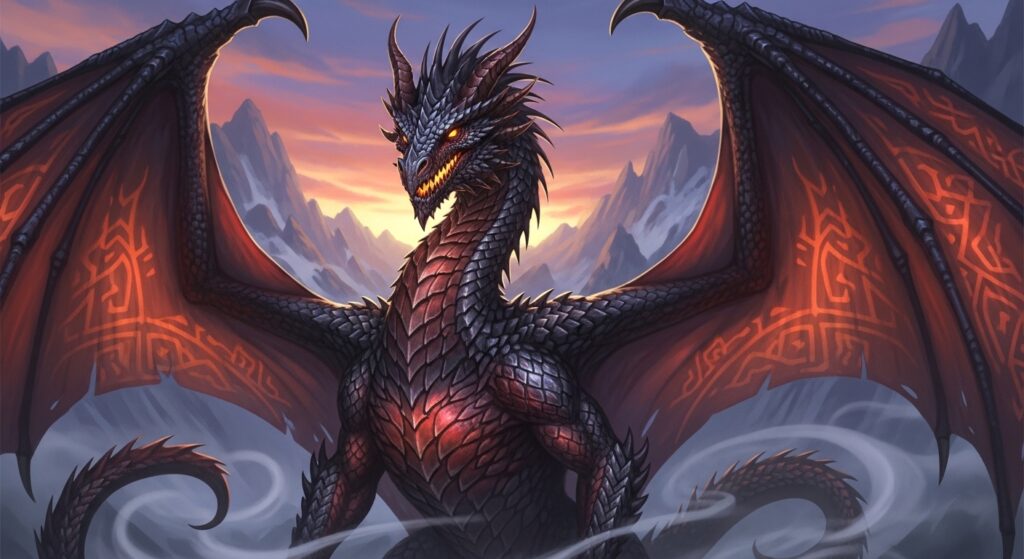
This primordial status creates a unique set of behavioral imperatives. A Pure Blood Dragon is almost never malevolent in the petty way of a villain. It does not destroy a city out of anger or greed. If it destroys a city, it is because that city was built on a geomantic nexus that was causing the dragon a low-grade metaphysical irritation, much as a human might brush a fly from their arm. The dragon’s morality is not good or evil; it is ecological. It maintains the balance of magical energies on a planetary scale, culling civilizations that grow too powerful in forbidden arts, diverting the paths of comets that would crack the world’s crust, and occasionally correcting the orbit of the moon. Human concepts of justice, mercy, and cruelty are as relevant to a Pure Blood Dragon as the ethics of bacteria are to a forest ranger. This is not cruelty; it is perspective.
The existence of such a creature presents a profound challenge to the heroic archetype. How does one slay a being that is older than the concept of death? How does one bargain with an entity that owns the first coin ever minted and finds it a quaint relic? The traditional dragon-slaying narrative falls apart. A knight in shining armor, armed with a blessed lance and a heart full of courage, would not even register as a threat. The dragon might not even see him. To the dragon, the knight is a brief, noisy mote of dust. The only beings capable of truly interacting with a Pure Blood Dragon are other Pure Blood Dragons, the few remaining Firstborn gods, or those rare mortal sorcerers who have, through centuries of study and self-sacrifice, managed to splice a single drop of pure blood into their own lineage. These dragon-blooded individuals are not heroes in the making; they are tragedies waiting to happen, caught between the fragile morality of humanity and the vast, amoral intellect of their ancestral patron.
The greatest mystery surrounding Pure Blood Dragons is their scarcity. Where are they now? Most lore agrees that they have withdrawn from the active stage of the world. Some believe they sleep in the planetary core, their slumbering thoughts causing the magnetic field that protects the world from solar winds. Others whisper that they have become translucent, existing in a parallel phase of reality, watching the bustling dramas of mortals and lesser dragons with the detached interest of a scholar observing an anthill. A few dark prophecies warn that they are not gone, but waiting. They are waiting for the world to grow old enough, for the blood of all other creatures to become so mixed and so tired that the original pattern is nearly forgotten. At that moment of greatest dilution, when magic is a faint whisper and the last king has no memory of the first fire, the Pure Blood Dragons will return. They will not return to rule or to conquer. They will return to remember. And in their terrible, beautiful, absolute remembrance, the current world will be revealed as the pale, half-forgotten dream it has always been, ready to be reshaped in the image of the true, the first, and the pure.