Netflix’s DOTA: Dragon’s Blood (2021-2022) emerges as a significant entry in the expanding landscape of video game adaptations, translating the complex mythology of Valve’s Defense of the Ancients 2 into an animated fantasy series that spans multiple seasons and explores themes of divinity, sacrifice, and cosmic conflict. While the series operates within familiar genre conventions of Western animation and high fantasy, its narrative structures and character dynamics offer rich material for postcolonial analysis. The show’s engagement with dragon mythology, its depiction of imperial power through the Dragon Knight Davion, and its exploration of ancient versus modern cosmologies reveal deep entanglements with colonial discourse. This article examines how DOTA: Dragon’s Blood deploys the figure of the dragon and the concept of dragon’s blood to interrogate questions of sovereignty, cultural hybridity, and the violence of imperial expansion, while also considering how the series both reproduces and potentially subverts the colonial logics embedded in its source material and genre traditions.
The series establishes its postcolonial coordinates through its central protagonist, Davion, a Dragon Knight who undergoes a transformative fusion with the ancient dragon Slyrak after a ritualistic consumption of dragon’s blood. This premise immediately invokes the colonial dynamics of bodily appropriation and indigenous incorporation that characterize imperial encounter. Davion’s transformation is not merely physical but existential—he becomes a hybrid being, simultaneously human and dragon, capable of accessing draconic power while maintaining human consciousness. This hybridity mirrors the experience of the colonial subject who must navigate multiple cultural systems, absorbing the colonizer’s knowledge and power while retaining connection to colonized identities. Yet Davion’s position is complicated by his status as Dragon Knight, a member of an order dedicated to hunting and killing dragons rather than honoring them. His transformation thus represents a kind of colonial guilt made flesh, the hunter becoming the hunted, the exterminator incorporating the exterminated. The dragon’s blood that flows through his veins serves as permanent reminder of the violence through which his power was obtained, a corporeal archive of imperial sin.
The world-building of DOTA: Dragon’s Blood presents a cosmology structured by ancient conflicts between primordial powers and contemporary political arrangements, encoding postcolonial temporalities through its narrative layering. The series depicts a world where ancient dragons, elder gods, and fundamental forces of creation and destruction preceded and arguably supersede the current political order dominated by human kingdoms and the mysterious Ancients. This temporal structure—where the deep past contains powers and knowledges that exceed present comprehension—mirrors the postcolonial experience of living within institutions and epistemologies that have suppressed or marginalized indigenous ways of knowing. The Invoker, one of the series’ most compelling characters, embodies this temporal complexity as a being of immense age and knowledge who operates according to motivations that exceed human moral categories. His manipulation of events across centuries suggests the persistence of subaltern agency within colonial temporalities, the ways that colonized peoples maintain connections to pre-colonial pasts and alternative futures despite the dominance of imperial historical narratives.
The treatment of dragon’s blood as both source of power and vector of corruption establishes a central postcolonial problematic regarding the ethics of utilizing colonized resources for imperial advancement. Throughout the series, characters consume or seek to consume dragon’s blood to gain enhanced abilities, extended lifespans, or transformative powers. This consumption is never presented as unambiguously beneficial; it carries costs of madness, physical deformation, and spiritual corruption that reflect the toxic legacy of colonial extraction. The Dragon Knights as an order represent the institutionalization of this consumption, their entire martial tradition built upon the killing of dragons and the harvesting of their essence. The series gradually reveals the genocidal dimensions of this practice, as the near-extinction of dragons emerges not as natural evolution but as the result of systematic hunting by human powers. This revelation forces reconsideration of Davion’s heroism, positioning him within a structure of violence that his individual virtue cannot redeem. The postcolonial resonance is clear: the benefits enjoyed by imperial subjects derive from historical violence that continues to structure present inequalities, and individual moral excellence cannot absolve systemic complicity.
The character of Mirana, the Princess of the Moon, introduces gendered and racialized dimensions to the series’ postcolonial analysis through her navigation of royal duty and personal desire. As a member of the Dark Moon Order and heir to a divine lineage, Mirana embodies the contradictions of colonial femininity—simultaneously privileged by her association with imperial power and constrained by the gendered expectations that structure that power. Her relationship with Davion crosses boundaries of species and political affiliation, suggesting the possibility of alliance across colonial divides. Yet the series ultimately subordinates her narrative agency to Davion’s heroic journey, reproducing the pattern whereby women in postcolonial contexts serve as symbols of cultural authenticity or vehicles for male redemption rather than autonomous subjects. Her divine connection to Selemene, the moon goddess, further complicates her position, as she must navigate between human political concerns and cosmic forces that exceed colonial temporality. The postcolonial potential of Mirana’s character lies in this navigation of multiple belonging, but the series often reduces this complexity to romantic subplot and martial capability.
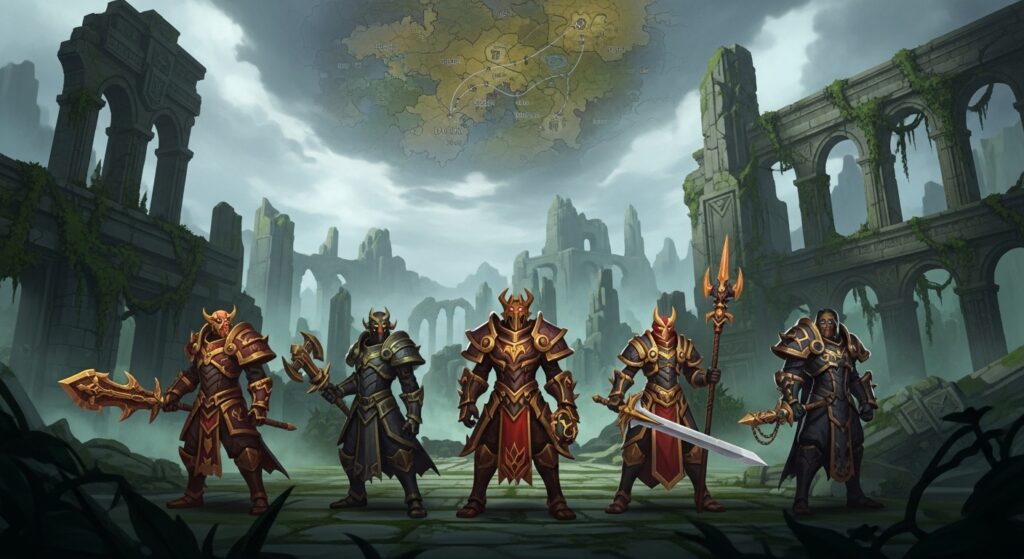
The depiction of the Eldwurm, ancient dragons who embody fundamental aspects of reality, presents perhaps the most explicit site for postcolonial theological analysis in the series. These beings—Slyrak of fire, Aethrak of air, Lirrak of water, and others—represent a cosmology that precedes and encompasses the human-centered theology of the series’ present. Their gradual awakening and intervention in mortal affairs suggests the return of repressed indigenous sovereignty, the resurgence of powers that colonial orders believed extinct or contained. The Terrorblade, the series’ primary antagonist, seeks to exploit this resurgence for his own apocalyptic ends, demonstrating how colonial and anti-colonial forces alike may appropriate indigenous power for destructive purposes. The Eldwurm’s blood, more potent and dangerous than that of their lesser descendants, becomes the ultimate object of desire and fear, representing the concentrated essence of alternative cosmologies that threaten imperial stability. The series’ treatment of these beings remains ambivalent, simultaneously presenting them as victims of human aggression and as threats to human survival that justify continued imperial mobilization.
The spatial politics of DOTA: Dragon’s Blood reveal the geographical dimensions of its colonial imaginary through the contrast between established kingdoms and wild territories. The series presents a world divided between civilized spaces—cities, temples, and fortifications—and wilderness areas inhabited by dragons, barbarians, and other threats to order. This spatial binary maps onto the colonial distinction between metropolitan centers and peripheral territories, where the periphery is simultaneously the source of valuable resources and the site of dangerous otherness requiring containment. Davion’s movement between these spaces, his comfort in both courtly intrigue and frontier violence, represents the flexibility of imperial subjects who can operate across colonial boundaries while maintaining core allegiance to imperial values. The dragon’s blood in his veins allows him to survive in the wilderness, to communicate with its inhabitants, yet this hybridity serves ultimately to extend imperial reach rather than to challenge imperial structure. The series’ most radical potential lies in moments when Davion’s hybridity produces genuine crisis of loyalty, when his draconic aspects demand recognition and action that conflict with his human commitments.
The narrative arc involving the Invoker and his daughter Filomena introduces themes of parental sacrifice and generational trauma that resonate with postcolonial experiences of displacement and loss. The Invoker’s manipulation of cosmic forces to save his daughter, his willingness to destroy worlds and betray allies for familial love, presents a radical individualism that challenges the collective demands of both imperial and anti-imperial politics. This narrative thread suggests that the violence of colonial modernity produces damaged subjects who reproduce that damage in their intimate relations, unable to imagine solidarity beyond the nuclear family. The Invoker’s vast knowledge and power, accumulated over millennia, prove insufficient to protect his daughter from the consequences of his own actions, illustrating the limits of individual mastery within systems of domination. His final choices, which involve accepting loss and limitation, offer a modest ethics of decolonization that recognizes the irreversibility of historical violence and the necessity of living with rather than transcending trauma.
The series’ engagement with questions of divinity and mortal limitation carries postcolonial implications regarding the epistemological violence of secular modernity. The world of DOTA: Dragon’s Blood is thoroughly enchanted, where gods walk among mortals and cosmic forces respond to ritual and sacrifice. This enchantment is not presented as primitive superstition to be overcome but as ontological reality that exceeds human comprehension and control. The postcolonial significance lies in the series’ refusal of the disenchantment narrative that characterized colonial modernity, its presentation of alternative cosmologies as viable frameworks for understanding and acting in the world. Yet this refusal is compromised by the series’ ultimate subordination of divine power to narrative convenience, where gods prove vulnerable to mortal weapons and cosmic forces bend to dramatic necessity. The dragon’s blood, as material connection between mortal and divine, represents the persistence of enchantment within modernity, yet its commodification and weaponization suggest the continued subordination of sacred power to imperial utility.
The animation style and production context of DOTA: Dragon’s Blood introduce questions of cultural imperialism through the global circulation of American streaming content and Japanese animation influences. The series represents a collaboration between American game developer Valve, American streaming platform Netflix, and South Korean animation studio Studio Mir, creating a complex chain of cultural production that spans multiple imperial and postcolonial contexts. The visual aesthetic, which combines Western fantasy conventions with anime-influenced action sequences, reflects the hybrid cultural forms produced by globalized media industries. This hybridity is not neutral but structured by power relations that privilege American narrative content and Japanese animation expertise while marginalizing other cultural traditions. The dragon’s blood as narrative device circulates through this global production network, its meanings shaped by multiple cultural contexts yet ultimately subordinated to the commercial imperatives of transnational entertainment corporations.
The conclusion of DOTA: Dragon’s Blood, which sees Davion’s ultimate sacrifice and the temporary restoration of cosmic balance, offers a ambivalent resolution to the postcolonial tensions the series has explored. Davion’s death represents the impossibility of hybrid identity within colonial structures, the ultimate incompatibility of draconic and human allegiance that forces choice and loss. Yet his sacrifice is also presented as redemptive, enabling the survival of companions and the continuation of political projects that his hybridity had complicated. This narrative resolution reflects the postcolonial dilemma of the tragic mulatto, the hybrid figure who must die to enable the purity of others, whose existence threatens the boundaries that structure colonial order. The series’ refusal to fully resolve the cosmic conflicts it has established, its maintenance of narrative possibility for future continuation, suggests the ongoing nature of postcolonial struggle rather than its definitive conclusion. The dragon’s blood continues to flow, the Eldwurm continue to dream, and the work of decolonization remains incomplete.
DOTA: Dragon’s Blood ultimately demonstrates both the possibilities and limitations of postcolonial critique within contemporary fantasy animation. The series engages seriously with questions of imperial violence, indigenous sovereignty, and the ethics of power, using the figure of the dragon and the device of dragon’s blood to explore these themes through genre conventions accessible to global audiences. Yet its reproduction of heroic individualism, its subordination of female and non-human characters, and its ultimate restoration of narrative order limit its radical potential. The dragon’s blood that flows through Davion’s veins, that empowers and corrupts, that connects mortal to divine and present to ancient past, serves as potent symbol for the persistence of colonial violence in contemporary media and the ongoing necessity of imagining alternatives. The series invites viewers to consider what it means to live with the blood of the colonized, to wield power derived from historical violence, and to seek redemption within systems that resist transformation. These questions, posed through the spectacular vocabulary of animated fantasy, retain their urgency in a world where colonial structures continue to shape global inequality and cultural production.