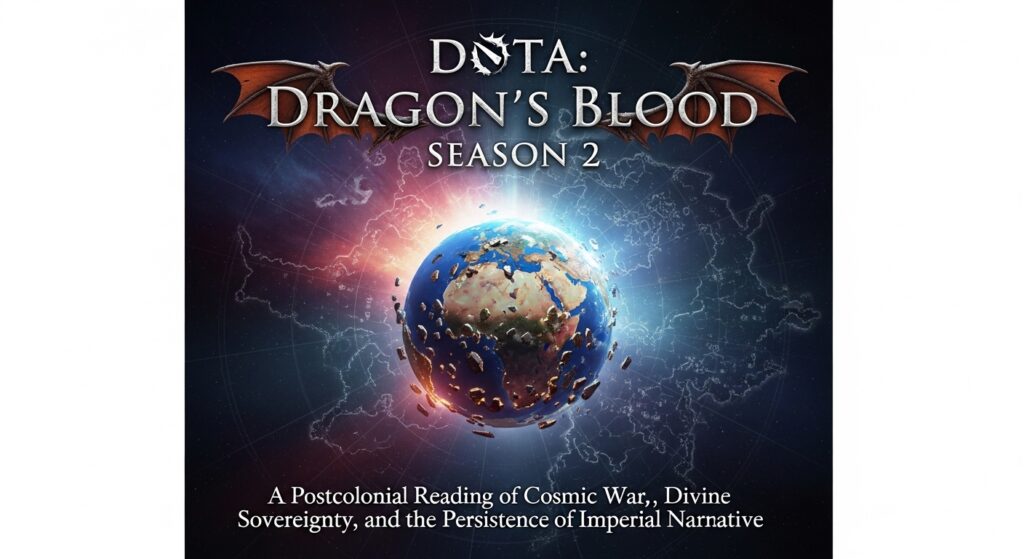
Netflix’s continuation of DOTA: Dragon’s Blood into its second season deepens the series’ engagement with themes of cosmic conflict, divine intervention, and the political struggles of mortal beings caught between forces that exceed their comprehension. Building upon the foundation established in the inaugural season, Season 2 expands its narrative scope to encompass multiple planes of existence, ancient deities, and the ongoing transformation of its central protagonist Davion, the Dragon Knight whose body serves as vessel for the ancient dragon Slyrak. This expansion invites sustained postcolonial analysis, as the series’ cosmological architecture, its treatment of divine and draconic power, and its representation of political resistance reveal complex negotiations with colonial discourse. The second season’s intensification of cosmic stakes, its introduction of new realms and powers, and its development of character arcs established in the first season demonstrate both the possibilities and limitations of postcolonial critique within contemporary animated fantasy production.
The narrative structure of Season 2 immediately establishes its postcolonial coordinates through the multiplication of cosmic threats and the corresponding expansion of imperial intervention required to address them. Where the first season focused primarily on the Terrorblade’s apocalyptic ambitions and the immediate political conflicts of the Dragon Knight’s world, the second season introduces the Elder Dragons as fundamental forces of reality and the Invoker’s millennia-spanning manipulations as responses to divine cruelty. This cosmological escalation mirrors the expansionist logic of colonial empire, where the identification of new threats and new territories requiring intervention justifies the extension of military and political control. The blood of dragons, which flowed through Davion’s veins as marker of hybrid identity in the first season, becomes in the second season the medium through which cosmic forces contend for dominance of reality itself. This transformation of bodily substance into cosmological resource reflects the colonial logic of extraction, where the physical being of colonized subjects becomes raw material for imperial projects that exceed their individual significance.
The character development of Davion throughout Season 2 presents a sustained examination of hybrid identity and its political implications that resonates with postcolonial theories of creolization and mestizaje. The Dragon Knight’s struggle to maintain human consciousness against the encroaching dominance of Slyrak’s ancient mind literalizes the experience of colonial subjects who must navigate multiple cultural systems, absorbing the colonizer’s power while retaining connection to subaltern identity. Season 2 intensifies this struggle through Davion’s physical transformations, which become increasingly draconic as the narrative progresses, and through his psychological fragmentation, which manifests as dialogue with internal voices and memories that may not be his own. The postcolonial significance lies in the series’ refusal to resolve this hybridity into comfortable synthesis, its insistence that Davion’s position between human and dragon remains permanently unstable and politically consequential. His relationships with human companions, particularly Mirana and Marci, become strained by his transformation, reproducing the social isolation that colonial hybridity frequently produces.
The introduction of the Elder Dragons as fundamental aspects of reality in Season 2 expands the series’ cosmological scope while potentially reinforcing colonial hierarchies of knowledge and power. These beings—embodiments of fire, water, air, earth, and other primordial forces—represent a theological order that precedes and encompasses the political arrangements of mortal civilization. Their awakening and intervention in mortal affairs suggest the return of repressed indigenous sovereignty, the resurgence of powers that colonial orders believed extinct or contained. Yet the series’ representation of these powers remains ambivalent, simultaneously presenting them as victims of ancient betrayal and as threats to mortal existence that justify continued imperial mobilization. The blood of the Elder Dragons, more potent and dangerous than that of their lesser descendants, becomes the ultimate object of desire and fear, representing the concentrated essence of alternative cosmologies that threaten imperial stability. The postcolonial critic must navigate between recognition of indigenous resurgence and critique of how such narratives may serve to justify continued domination in the name of protection against primordial threat.
The narrative arc of the Invoker, revealed more fully in Season 2, engages with questions of parental sacrifice and generational trauma that resonate with postcolonial experiences of displacement and loss. The millennia-spanning scope of the Invoker’s schemes, his willingness to destroy worlds and betray allies for the sake of his daughter Filomena, presents a radical individualism that challenges the collective demands of both imperial and anti-imperial politics. This narrative thread suggests that the violence of colonial modernity produces damaged subjects who reproduce that damage in their intimate relations, unable to imagine solidarity beyond the nuclear family. The Invoker’s vast knowledge and power, accumulated over ages of observation and manipulation, prove insufficient to protect his daughter from the consequences of his own actions, illustrating the limits of individual mastery within systems of domination. His final choices in Season 2, which involve accepting loss and limitation, offer a modest ethics of decolonization that recognizes the irreversibility of historical violence and the necessity of living with rather than transcending trauma.
The political narrative involving the Dark Moon Order and the contested succession of divine power introduces gendered dimensions to the series’ postcolonial analysis through its examination of institutional authority and religious legitimacy. Selemene’s rule, presented in the first season as established order, becomes in Season 2 the object of critical examination and political resistance, her divine authority revealed as maintained through violence and exclusion. This narrative development potentially enables feminist critique of colonial institutions, recognizing how imperial power frequently operates through feminized figures who serve as acceptable faces for domination. Yet the series’ resolution of this political conflict, which involves replacement of one divine ruler with another rather than transformation of the underlying theological order, suggests the limits of its political imagination. The blood that flows through these conflicts—divine blood, dragon blood, mortal blood—marks the physiological cost of political struggle, the literal bleeding that accompanies metaphorical transformation of power relations.
The representation of the various planes of existence introduced in Season 2, from the elemental realms to the mysterious void spaces, reproduces colonial spatial imaginaries through their organization of difference and hierarchy. These realms exist in complex relationship to the mortal world, simultaneously separate from and connected to it through portals and passages that enable narrative movement. This spatial architecture mirrors the colonial geography of metropole and periphery, where distant territories exist in relationship of dependency and exploitation with imperial centers. The dragons that inhabit these spaces, particularly the Elder Dragons in their elemental domains, represent indigenous powers that resist full incorporation into imperial cosmology yet remain vulnerable to extraction and appropriation. Davion’s movement between these spaces, enabled by his hybrid physiology, represents the mobility of imperial subjects who can traverse colonial boundaries while maintaining core allegiance to dominant power. The postcolonial potential of this spatial narrative lies in moments when boundary crossing produces genuine crisis of loyalty, when exposure to alternative ways of being challenges rather than confirms imperial subjectivity.
The visual and aesthetic development of Season 2, produced by Studio Mir with increased resources and expanded scope, demonstrates the global political economy of contemporary animation that structures even seemingly independent creative work. The South Korean studio’s labor, celebrated for its quality and intensity, generates value that accrues primarily to American platform holder and global distributor, reproducing the colonial extraction of cultural production from peripheral contexts. The aesthetic choices of Season 2, which combine Western fantasy conventions with anime-influenced action sequences, reflect the hybrid cultural forms produced by globalized media industries under conditions of American cultural dominance. The blood that animates these images, the dragon’s blood that provides narrative motivation and visual spectacle, connects to this material context of production, its vivid representation enabled by labor conditions and economic structures that extend colonial inequality into digital domain. The postcolonial analysis must attend to these material connections, recognizing that the aesthetic experience of Season 2 occurs within and depends upon global economic arrangements that the narrative may critique or reproduce.
The reception and fan engagement with Season 2 reveal how colonial imaginaries circulate through consumer communities, where the series’ cosmological complexity becomes resource for identity formation and subcultural distinction. Online discussion emphasizes the lore accuracy, the character development, and the visual spectacle of dragon combat, positioning these elements as virtues that distinguish DOTA: Dragon’s Blood from more conventional animated productions. This discourse of sophisticated appreciation references colonial traditions of exotic knowledge, where mastery of complex cultural systems provides metropolitan subjects with cultural capital and social distinction. The blood of dragons, as object of fan knowledge and speculation, becomes available for identification and appropriation, its meanings extended through fan creation and community discussion beyond the control of original producers. The postcolonial critic recognizes in this reception the persistence of colonial pleasure in exotic mastery, the satisfaction derived from comprehensive knowledge of other cultures that remains safely contained within consumption rather than demanding political engagement.
The theological and philosophical dimensions of Season 2’s narrative, particularly its engagement with questions of determinism, free will, and the ethics of intervention, carry postcolonial implications regarding the epistemological violence of universalizing discourse. The series presents multiple perspectives on these questions—the Invoker’s manipulative determinism, the Elder Dragons’ fatalistic acceptance, the mortal characters’ struggling agency—without definitive resolution, suggesting the genuine complexity of ethical choice within systems of domination. Yet this philosophical pluralism occurs within framework that privileges certain voices and perspectives, the ancient and powerful receiving more narrative attention than the contemporary and subaltern. The blood that flows through these philosophical conflicts, marking the cost of different approaches to cosmic order, suggests that abstract debate occurs through material suffering that the narrative only partially acknowledges. The postcolonial demand is for recognition of whose blood enables philosophical reflection, whose suffering provides occasion for narrative exploration of ethical possibility.
The conclusion of Season 2, which leaves multiple narrative threads unresolved and cosmic conflicts ongoing, reflects both the commercial imperatives of franchise production and the genuine difficulty of resolving postcolonial tensions within existing narrative frameworks. The series refuses the satisfaction of definitive resolution, maintaining the dragon’s blood as flowing, the divine powers as contested, the mortal characters as caught between forces they cannot fully comprehend or control. This narrative openness potentially enables continued critical engagement, the refusal of closure that postcolonial theory identifies as necessary for justice-oriented cultural production. Yet it also risks the endless deferral of political transformation, the maintenance of tension without progress that characterizes neoliberal cultural production. The postcolonial critic must navigate between appreciation of narrative complexity and demand for political commitment, recognizing that Season 2’s cosmological scope enables both critical reflection and uncritical consumption.
DOTA: Dragon’s Blood Season 2 ultimately demonstrates both the expanded possibilities and continued limitations of postcolonial critique within contemporary animated fantasy production. The series engages seriously with questions of hybrid identity, indigenous resurgence, and the ethics of power, using the figure of the dragon and the device of dragon’s blood to explore these themes through genre conventions accessible to global audiences. Yet its reproduction of heroic individualism, its subordination of collective political action to personal sacrifice, and its ultimate maintenance of cosmological hierarchy limit its radical potential. The dragon’s blood that flows through Davion’s veins, that empowers and corrupts, that connects mortal to divine and present to ancient past, serves as potent symbol for the persistence of colonial violence in contemporary media and the ongoing necessity of imagining alternatives. The series invites viewers to consider what it means to live with the blood of the colonized, to wield power derived from historical violence, and to seek redemption within systems that resist transformation. These questions, posed through the spectacular vocabulary of animated fantasy, retain their urgency in a world where colonial structures continue to shape global inequality and cultural production. The blood continues to flow, the dragons continue to dream, and the work of decolonization proceeds through the very media that colonial modernity produced.