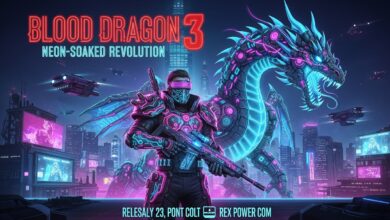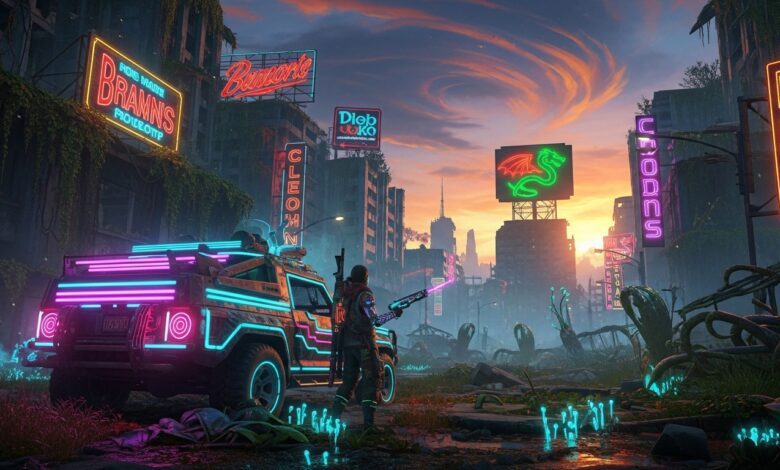
The release of Far Cry New Dawn in 2019 presented players with a vibrant post-apocalyptic vision that unexpectedly carried forward elements from one of the franchise’s most beloved experimental entries. Set seventeen years after the nuclear catastrophe that concluded Far Cry 5 this spinoff title embraced a pink and purple color palette that immediately evoked memories of the 2013 cult classic Blood Dragon. While New Dawn functioned as direct narrative sequel to its predecessor the visual and tonal echoes of Blood Dragon created fascinating interplay between different branches of the Far Cry universe demonstrating how experimental content can influence mainstream franchise development in unexpected ways.
Far Cry New Dawn unfolds in a transformed Hope County Montana where survivors have begun rebuilding society amidst the radioactive ruins of civilization. The game’s art direction deliberately rejected the grim gray-brown aesthetic typical of post-apocalyptic media in favor of saturated colors that suggested nature’s resilience and humanity’s persistent capacity for beauty even in devastation. This choice of visual palette hot pinks deep purples and neon accents immediately distinguished New Dawn from other entries in the genre while creating subconscious connection to Blood Dragon’s distinctive look. The developers acknowledged this influence openly noting that Blood Dragon’s success had demonstrated audience appetite for vibrant unconventional visual approaches that rejected realism in favor of stylized expression.
The Blood Dragon references in New Dawn extend beyond mere color palette into specific environmental details and narrative elements that reward attentive players. Expedition missions transport characters to locations outside Hope County including areas that feature Blood Dragon aesthetic elements and environmental storytelling. These sequences suggest that the retro-futuristic world of Blood Dragon exists within the broader Far Cry multiverse potentially as fictional entertainment consumed by characters in the main timeline or as alternate reality accessible through the dimensional instability caused by nuclear catastrophe. The ambiguity of these references allows multiple interpretations whether as simple Easter eggs for fans or as hints toward larger cosmic connections between seemingly separate entries.
The Highwaymen faction that serves as primary antagonists in New Dawn embody aesthetic sensibilities that bridge post-apocalyptic survivalism and Blood Dragon’s exaggerated action movie tropes. Their leader Twins Mickey and Lou employ visual language of 1980s action cinema with aggressive poses dramatic lighting and theatrical presentation that would feel at home in the earlier game’s satirical universe. This characterization demonstrates how Blood Dragon’s influence extended beyond visual design into narrative approach with New Dawn embracing heightened reality and performative villainy that distinguished it from more grounded Far Cry entries. The Twins represent evolution of Blood Dragon’s sensibility applied to more conventionally structured narrative.
The weapon customization system in New Dawn particularly the ability to create increasingly outlandish and colorful armaments directly channels Blood Dragon’s approach to gear progression. Where previous Far Cry entries emphasized realistic military equipment New Dawn encourages players to construct weapons that look like they emerged from 1980s science fiction prop departments. Saw blade launchers makeshift flamethrowers and chromed firearms with neon accents all suggest aesthetic continuity with Blood Dragon’s exaggerated arsenal. This approach to equipment design recognizes that post-apocalyptic settings liberate designers from realism constraints allowing creative weapon concepts that would feel out of place in contemporary military settings.
The soundtrack of New Dawn similarly reflects Blood Dragon influence with composer Tyler Bates incorporating synthwave elements and electronic textures alongside more conventional orchestral scoring. The music shifts dynamically between atmospheric exploration themes and intense combat sequences with the latter often featuring pulsing bass lines and arpeggiated synthesizers that recall Power Glove’s iconic work on the earlier game. This musical continuity creates emotional connection for players familiar with Blood Dragon even when the gameplay context differs significantly. The soundtrack demonstrates how audio identity can bridge different entries in a franchise creating cohesive aesthetic experience across separate narratives.
The Expeditions game mode in New Dawn represents most explicit structural borrowing from Blood Dragon’s approach to discrete focused content. These missions transport players to self-contained maps with specific objectives and rewards offering concentrated experiences distinct from the open world exploration of main Hope County. This design philosophy mirrors Blood Dragon’s standalone nature as content that could be experienced independently without requiring engagement with larger systemic complexity. The Expeditions allow developers to create varied environmental and gameplay scenarios that might not fit within the narrative logic of main setting extending player engagement through modular content delivery.
The character of Guy Marvel who appears in both Far Cry 5 and New Dawn serves as diegetic connection between the franchise’s realistic and experimental branches. This filmmaker character creates low-budget action movies within the game world his productions clearly referencing Blood Dragon’s aesthetic and narrative tropes. Through Guy Marvel the game explicitly acknowledges Blood Dragon as fictional entertainment consumed by characters in the main Far Cry universe explaining the aesthetic similarities as influence from popular media rather than supernatural coincidence. This metafictional framing allows New Dawn to incorporate Blood Dragon elements without requiring narrative justification that might strain the post-apocalyptic setting’s internal logic.
The visual effects in New Dawn particularly those associated with radiation supernatural phenomena and high-tier equipment employ color grading and particle effects that directly recall Blood Dragon’s distinctive look. Glowing pink flora aurora-like atmospheric phenomena and chromatic aberration in certain sequences all suggest that the nuclear apocalypse has somehow made the world more visually interesting rather than less. This aesthetic choice rejects the documentary realism that characterized earlier Far Cry entries embracing instead the heightened stylization that Blood Dragon had proved commercially viable. The result creates unique visual identity for New Dawn that distinguishes it from both its direct predecessor and the broader post-apocalyptic genre.
The vehicle customization and combat in New Dawn similarly embrace Blood Dragon’s philosophy of exaggerated fun over realistic simulation. Post-apocalyptic vehicles can be upgraded with mounted weapons neon lighting and chromatic paint schemes that serve no tactical purpose but significant aesthetic function. Car combat emphasizes explosive spectacle and arcade handling rather than simulation physics encouraging players to engage with transportation as entertainment rather than mere traversal. These systems demonstrate how Blood Dragon’s influence extended beyond surface aesthetics into core gameplay philosophy prioritizing player enjoyment and visual excitement over gritty realism.
The narrative tone of New Dawn occupies middle ground between the serious political themes of Far Cry 5 and the ironic self-awareness of Blood Dragon. The post-apocalyptic setting allows for moments of genuine human drama and survival struggle while the colorful aesthetic and exaggerated antagonists prevent descent into pure grimdark misery. This tonal balance suggests that Blood Dragon’s greatest legacy may be demonstration that Far Cry franchise could support varied emotional registers without sacrificing commercial appeal. New Dawn proves that the underlying systems of open world exploration and emergent combat could support different aesthetic skins and narrative approaches.
The reception of New Dawn’s Blood Dragon influences among fans and critics revealed divided opinions about appropriate balance between serious and playful elements. Some players appreciated the visual distinctiveness and tonal variety that references to the earlier game provided. Others felt that the post-apocalyptic setting demanded more consistent grimness and that Blood Dragon’s aesthetic influence undermined narrative stakes. This division reflects broader debates about Far Cry franchise identity and whether experimental entries like Blood Dragon should influence mainstream development or remain isolated curiosities. The ongoing discussion demonstrates how significantly Blood Dragon had imprinted itself on fan expectations for the franchise.
The commercial performance of New Dawn relative to Blood Dragon’s cult success suggests different market dynamics for standalone experimental content versus franchise continuation. New Dawn sold respectably but failed to achieve the cultural impact or sustained engagement that Blood Dragon maintained despite its smaller initial release. This disparity indicates that Blood Dragon’s success derived partly from its unexpected nature and standalone accessibility rather than merely its aesthetic choices. New Dawn’s incorporation of similar elements within conventional franchise structure could not replicate the surprise and delight that had distinguished the original experiment.
The technical evolution from Blood Dragon to New Dawn demonstrates how game engine capabilities advanced across console generations enabling more sophisticated realization of similar aesthetic concepts. Blood Dragon’s neon effects and particle systems operated within limitations of 2013 technology while New Dawn employed more advanced rendering techniques to achieve similar visual impact with greater detail and stability. This technical progression allows appreciation of how aesthetic vision can persist across technological change with core concepts translating effectively to more capable hardware. The comparison highlights Blood Dragon’s achievement in establishing distinctive look with more limited resources.
The future of Blood Dragon influence within Far Cry franchise remains uncertain following New Dawn’s mixed reception and subsequent franchise direction. Far Cry 6 returned to contemporary political settings with more grounded aesthetic suggesting that New Dawn’s experimental approach represented temporary divergence rather than permanent evolution. However the continued cultural presence of Blood Dragon and fan demand for sequel or spiritual successor indicates that the neon-drenched aesthetic retains significant audience appeal. The relationship between New Dawn and Blood Dragon thus stands as fascinating case study in how franchises negotiate between experimental innovation and conservative continuity.
The thematic connections between New Dawn’s post-apocalyptic narrative and Blood Dragon’s retro-futuristic dystopia extend beyond surface aesthetics into shared concerns about human resilience and adaptation to catastrophic change. Both settings present worlds where civilization has collapsed or transformed beyond recognition yet individuals and communities persist in finding meaning and enjoyment. This thematic resonance suggests that Blood Dragon’s influence on New Dawn operated at deeper level than mere visual quotation touching on fundamental questions about how games can approach dark subject matter without succumbing to despair. The persistence of color humor and style in both settings represents affirmative response to apocalyptic anxiety.
The character progression systems in New Dawn particularly the RPG-inspired tier system for enemies and equipment reflect Blood Dragon’s influence in simplifying and gamifying progression mechanics. Where mainline Far Cry entries often emphasized realistic weapon characteristics and tactical considerations New Dawn embraces transparent numerical progression and visible power growth. This approach prioritizes satisfying feedback loops and clear player advancement over simulation authenticity creating experience more aligned with action game traditions than military shooter conventions. The influence of Blood Dragon’s streamlined systems is evident in this design choice which recognizes that stylized settings justify stylized mechanics.
The environmental storytelling in New Dawn’s post-apocalyptic landscape occasionally references Blood Dragon directly through discarded merchandise posters and audio logs that suggest the 1980s-action-movie aesthetic existed as popular culture before the nuclear war. These details create nested fiction where Blood Dragon is fiction within New Dawn’s fiction allowing players to appreciate the connection without requiring literal coexistence of separate game worlds. This metafictional approach demonstrates sophisticated understanding of how game universes can reference each other while maintaining separate integrity. The environmental details reward exploration and franchise knowledge creating layers of meaning accessible to different levels of player investment.
The multiplayer and cooperative elements of New Dawn though limited compared to main campaign similarly reflect Blood Dragon’s influence in prioritizing immediate fun over complex persistent systems. The cooperative Expeditions allow shared experiences of concentrated content without requiring extensive time investment or ongoing commitment. This design philosophy recognizes that many players seek social gaming experiences that respect their time and provide immediate satisfaction. Blood Dragon’s success as focused standalone experience informed this approach suggesting that multiplayer content need not aspire to endless engagement to provide genuine value.
The ultimate legacy of Blood Dragon’s influence on New Dawn may be demonstration that franchise experiments can permanently alter creative possibilities even when not directly continued. New Dawn’s willingness to embrace color exaggeration and stylization in post-apocalyptic setting expanded what Far Cry could be even if subsequent entries retreated from these possibilities. The connection between these games stands as evidence that Blood Dragon was not mere aberration but genuine evolution in franchise thinking that continues to influence development culture even when specific elements are not replicated. Players who experienced both games can trace line of influence that enriches appreciation of both the experimental original and its more conventional successor.